Camshaft for Alfa Romeo Giulia OE Equivalent: Sourcing Guide
For procurement teams sourcing a camshaft for Alfa Romeo Giulia OE equivalent applications, the question is not whether the part fits the catalog description. It is whether the replacement preserves the original engine’s timing, sensor logic, lubrication path, and wear behavior. Small deviations in lobe height, journal diameter, phase angle, or finish can show up later as idle instability, emissions drift, or accelerated wear.
Driventus supplies engine components from Taizhou, Zhejiang for aftermarket and B2B distribution channels. We manufacture under IATF 16949:2016 and ISO 9001:2015 systems, with controlled inspection on critical dimensions and traceable batch records. Driventus is an independent aftermarket manufacturer; brand names are referenced for fitment only. For planning purposes, many B2B buyers request samples first, then move to a 100–300 pcs trial order after dimensional sign-off, before scaling to 500–2,000 pcs per release depending on demand, packaging requirements, and claim history.
Decision rules for OE-equivalent fitment
For this part family, OE-equivalent means the camshaft matches the original engine’s operating geometry and installation interface closely enough to restore intended function after replacement.
Use this order of checks:
- Engine code first, model name second
- Original camshaft sample before catalogue data
- Journal diameter, width, and roundness
- Lobe lift, base circle, and nose radius
- Phasing, keyway, bolt pattern, and sensor target geometry
- Surface hardness and finish on lobes and journals
A correct replacement should not require changes to the cylinder head, timing drive, or ECU calibration. If the engine variant uses variable valve timing, confirm the phaser mounting details and oil feed passages before ordering. In practice, OE-equivalence is about repeatable fit, stable timing behavior, and durability that mirrors the original component under real operating conditions.
Procurement teams usually set acceptance around journal diameter within ±0.01 mm of the reference, runout no more than 0.02 mm TIR on centers, and lobe-to-lobe phase variation held within 0.5°–1.0° depending on the engine program. Hardness targets are commonly specified in the 50–60 HRC range for surface-treated steel lobes, or to the OE hardness band if a chilled-cast design is used. Always validate against the actual engine code because the same Giulia nameplate can hide different intake/exhaust profiles and phaser interfaces across markets and model years.
Failure modes that create comebacks
Camshaft sourcing problems usually start with parts that look close enough. They fail later at installation or after the first heat cycle.
The common failure modes are:
- Wrong engine variant: same Giulia nameplate, different cam profile
- Incorrect phase relationship: idle quality and emissions problems
- Mismatched sensor target: ECU signal errors and warning lights
- Poor hardness control: rapid lobe or journal wear
- Excess runout: noise, vibration, and timing instability
- Weak packaging: freight damage and warehouse corrosion
Use the engine code, VIN data, and a measured sample part to confirm fitment. Do not rely on model name alone, because the same Giulia platform can use different cam profiles across engine variants and production years.
For production purchasing, ask for inspection reports on first article samples and retained master samples. This is especially important when buying from multiple suppliers, consolidating SKUs, or replacing an existing source with a new manufacturing lot. If possible, compare the old and new parts side by side before release to production or warehouse stock.
A practical buyer checklist is to record: journal OD at each location, lobe base circle and max lift, overall length, thrust face position, keyway/bolt-circle dimensions, and sensor target tooth count if applicable. If you are buying against a drawing, ask the supplier to quote to the same GD&T callouts as the sample. Common controls include journal diameter within 0.005–0.015 mm, cam lobe lift within 0.02–0.05 mm, and endplay-compatible thrust location within 0.03 mm, but the exact tolerance should be tied to the target OE print or approved sample. Packaging should also be confirmed early: anti-rust oil, VCI bag, molded tray, and end-cap protection reduce shipping damage and warehouse corrosion risk.
Spec deep-dive: materials and process control
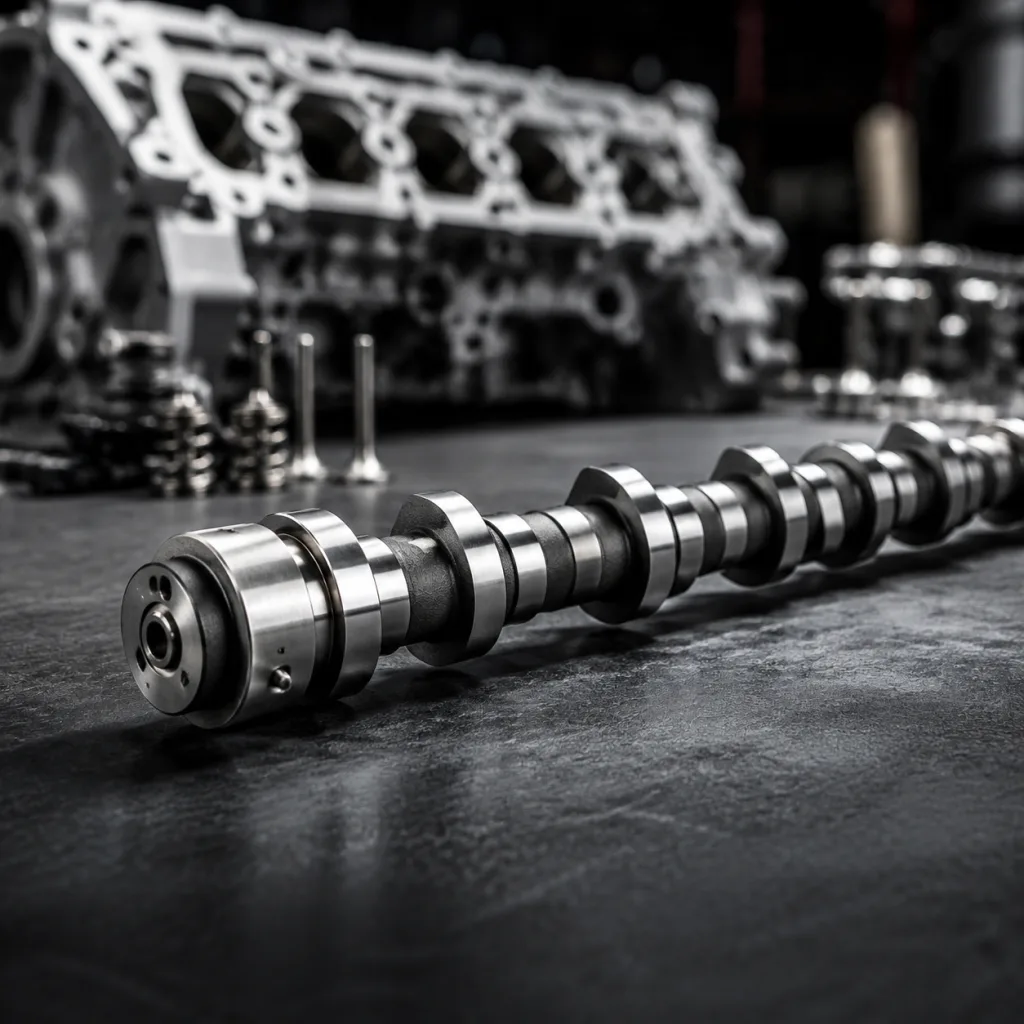
Camshafts are usually manufactured from chilled cast iron or forged steel, depending on the application and duty cycle. A reliable OE-equivalent part requires consistent metallurgical control, controlled machining, and post-machining inspection.
Driventus uses controlled processes for machining, heat treatment, and final measurement. For buyers, the relevant controls are:
- Hardness verification on lobe and journal surfaces
- Concentricity and runout checks
- Surface roughness control on bearing areas
- Induction or nitriding validation, where specified
- Cleanliness control to reduce early bearing wear
If your target market includes the EU or UK, ensure material declarations support REACH (EC) No 1907/2006 where applicable. For global aftermarket supply, stable process control matters more than a low unit price when warranty exposure, claim handling, and downstream installer confidence are considered. In many cases, the most expensive camshaft is the one that creates a repeat return or damages the rest of the valve train.
Buyers should ask whether the cam is produced from a one-piece forged blank, cast chilled iron, or chilled cast with induction-hardened lobes, because the process affects price and service life. As a rough sourcing guide, cast OE-equivalent camshafts can be lower cost and faster to tool, while forged or nitrided steel versions typically carry a premium for material and heat-treatment control. MOQ often starts at 50–100 pcs for stocked references, while new tooling or custom profiles may require 200–500 pcs MOQ with a one-time tooling or fixture charge. Lead time is commonly 15–30 days for stock lots and 45–75 days for new or customized programs, depending on heat treatment, inspection depth, and packaging requirements. Request a hardness certificate, runout report, and surface roughness record with every production lot, not only on the first shipment.
Step-by-step sourcing with Driventus
Procurement teams often need more than a single part number. They need a stable supply plan, packaging consistency, and documented quality controls that can be replicated across multiple orders.
Follow this sequence:
1. Share the engine code, OE reference, and sample photos. 2. Confirm critical dimensions against the original camshaft. 3. Lock the material, heat treatment, and finish target. 4. Review packaging, barcode, and carton requirements. 5. Approve samples before production release. 6. Set the reorder plan around forecast volume.
Driventus supports:
- OE number cross-reference review using fitment data supplied by the buyer
- Batch traceability for production lots
- Dimensional inspection against agreed drawings or samples
- Private label and carton specification support
- Consolidated engine-component supply through our catalog
If the required Giulia application is not covered by an existing drawing, our custom manufacturing service can be used to develop a sample-approved part based on customer specifications. For related engine items, see engine components. This approach helps buyers standardize supplier communication, reduce mismatch risk, and build a clearer approval record for future reorders.
For commercial planning, buyers usually want a quote structure that separates unit price, tooling or fixture cost, packing cost, and freight terms. A typical B2B quotation may include price breaks at 100, 300, 500, and 1,000 pcs, with lower per-unit pricing at higher volumes once setup is amortized. If the part is stocked, sample lead time can be 3–7 days; if it requires production scheduling, expect 2–4 weeks; if it needs custom machining or a new heat-treatment recipe, lead time usually extends to 6–10 weeks. When comparing suppliers, normalize the quote by asking for the same Incoterms, same carton quantity, same inspection scope, and the same warranty period so the real landed cost is visible.
Validation plan before release
Before approving a supplier, request evidence that the camshaft has passed fitment and durability checks relevant to the application. A catalog match alone is not enough for release into a professional distribution channel.
Recommended validation items:
1. Dimensional inspection against the agreed drawing or sample 2. Surface hardness and case depth records, where applicable 3. Dynamic balance and runout measurements 4. Trial installation on the target engine variant 5. Oil pressure and noise checks after warm-up 6. Extended bench or vehicle endurance where the buyer requires it
If the engine uses emissions-sensitive valve timing, ask whether timing stability has been checked under load. Standards such as IATF 16949:2016 and ISO 9001:2015 support process discipline, but they do not replace part-specific validation on the exact application. A supplier should be able to show controlled inspection data, not only a declaration of fit. For higher-risk programs, request sign-off samples from both the supplier and your own incoming quality team before full rollout.
A practical validation plan for distributors is to test 2–3 samples from different production dates, not only one piece from a single lot. Measure lobe lift, base-circle eccentricity, journal taper, and total indicated runout, then install one sample on an engine test unit or controlled vehicle to check cold start, idle stability, oil pressure, and phaser response if equipped. If your program is warranty-sensitive, consider a 24–72 hour bench endurance cycle or a 500–1,000 km road pilot before broad release. Record all results against the lot number so future claims can be traced back to a specific batch.
Q-and-A for distributors and repair chains
For distributors, the deciding factors are usually part coverage, claim rate, and repeatability. For repair chains, the priority is installation consistency and low comeback risk. In both channels, the camshaft must arrive with the same fitment confidence that technicians expect from the original part.
Use this shortlist during sourcing:
- Confirm exact engine variant and OE reference before release
- Ask for sample dimensions on first order
- Verify packaging and barcode requirements for your warehouse system
- Check lead time, MOQ, and re-order stability
- Keep one approved sample in-house for incoming inspection
Where brand references are used, they are for fitment only. Driventus is an independent aftermarket manufacturer; brand names are referenced for fitment only. If you need a wider sourcing program across pistons, gaskets, pumps, or turbocharger-adjacent components, review our catalog and align the camshaft purchase with the rest of the engine set to reduce mixed-batch claims and simplify inventory control.
Commercial buyers should also evaluate defect allowance and replacement terms. Ask whether the supplier can support AQL-based incoming inspection, for example AQL 1.0 for critical dimensions and AQL 2.5 for cosmetic packaging checks, plus a written policy for short shipments and functional failures. MOQ for branded carton programs may be lower if standard packaging is used, while private label, printed inserts, or multilingual labels can increase setup cost and minimum volume. If you sell through repair networks, confirm that carton quantity matches mechanic demand, because overpack or underpack mismatches slow shelf replenishment and increase handling loss. The best sourcing decision balances fitment certainty, claim containment, and landed cost rather than only piece price.
Frequently asked questions
Match the engine code, measure the original camshaft, and compare journal sizes, lobe profile, timing features, and trigger geometry. VIN data helps, but physical verification is still required before release. For buying control, confirm runout, overall length, thrust position, and hardness against the approved sample before booking the order.
If the replacement matches the original timing, lift, and sensor features, ECU changes are usually not needed. Variable valve timing systems still require exact phaser and oil-feed compatibility. Before release, verify that phase angle, target wheel geometry, and oil passage routing match the OE part to avoid driveability issues.
Ask for dimensional inspection results, material or heat-treatment records, batch traceability, and confirmation of IATF 16949:2016 and ISO 9001:2015 systems. If applicable, request REACH-related material declarations. For a commercial quote, also request MOQ, sample cost, lead time by lot size, packaging specification, and warranty/claim terms so landed cost can be compared fairly.
If you need a verified replacement plan, share the engine code, OE reference, and sample dimensions. We will review fitment and production options, then send the next steps via /contact.html
Request a Quote