Camshaft for BMW X3 Aftermarket Replacement: Fitment Guide
BMW X3 applications span several petrol and diesel engine families, so a camshaft for BMW X3 aftermarket replacement cannot be chosen by model name, displacement, or production year alone. The part must match the installed engine code, cylinder-head layout, intake or exhaust position, journal diameters, thrust control, oil-feed pattern, sensor target, and any VANOS or other variable valve timing hardware. For procurement teams, the real target is OE-equivalent fitment backed by traceable material control, stable CNC grinding capability, and repeatable batch quality on every reorder. Driventus is an independent aftermarket manufacturer; brand names are referenced for fitment only. We supply engine components for distributors, repair networks, OEM, and Tier-1 programmes, with documented inspection, batch coding, and export packaging for cross-border supply. When buyers compare a direct replacement with a regrind or low-cost generic part, the differences usually show up in lobe profile accuracy, surface roughness, hardness depth, VVT indexing, and journal dimensional consistency well before the engine reaches the workshop.
Why OE-equivalent fitment matters
BMW X3 is a platform, not a single camshaft application. Depending on model year and market, it may use different petrol or diesel engine families, including four-cylinder and six-cylinder layouts, several cylinder-head designs, and different camshaft timing systems. A replacement has to match the engine family, valve train layout, camshaft position, and VANOS or other variable valve timing hardware, not just the vehicle badge or production year. Before issuing a purchase order, buyers should confirm lobe lift, base-circle diameter, journal diameter, journal spacing, thrust-face position, oil-feed features, dowel or key location, phaser interface, and the trigger wheel or sensor target.
OE-equivalent fitment matters because the camshaft controls valve opening, closing, lift, duration, and phase relationship with the crankshaft. Small profile or indexing errors can quickly become larger operating problems: rough idle, reduced torque, increased emissions, camshaft-crankshaft correlation faults, oil-pressure loss at the journals, phaser noise, or premature wear on lifters, followers, rocker arms, and bearing surfaces. A shaft that looks close on a basic vehicle list can still fail if the VVT drive feature, sensor target angle, or thrust-control geometry does not match the installed engine.
For sourcing teams, the most reliable route is a supplier that can map the engine code to an OE cross-reference, then verify the replacement against approved drawings, CMM or profile measurement data, or a physical sample. This becomes especially important when stock is being consolidated for multiple branches or export markets, where emissions level, market specification, production supersession, and engine-code variation may differ. Start with our catalog and the engine components category when you need to narrow the part family before quoting.
What to verify before ordering
Before ordering a camshaft for BMW X3 aftermarket replacement, verify the specification against the engine code and, where possible, the original sample part. A procurement list built only on make, model, and engine displacement can miss important differences in phaser indexing, sensor targets, journal layout, oil drilling, or production supersessions. Use the OE number as the starting point for identification, then confirm the mechanical and timing interfaces that determine whether the part will install, build oil pressure correctly, and run without diagnostic faults.
Checkpoint
What must match
Why it matters
Engine code
Exact installed engine family and variant
Prevents mis-ordering by body style, year, or displacement alone
OE cross-reference
Supplier mapping to the installed engine and supersession chain
Confirms the commercial part number is tied to the correct application
Intake or exhaust position
Camshaft side, bank, and cylinder-head position
Prevents mixing similar-looking shafts with different timing roles
Lobe geometry
Lift, duration, base circle, lobe phase, ramp form, and nose radius
Controls airflow, valve timing, idle quality, emissions, and follower contact
Journal and thrust dimensions
Diameters, spacing, widths, thrust-face location, and end float control features
Affects oil film, axial control, bearing noise, and service life
VVT interface
Phaser drive, keying, dowel pin, bolt pattern, locking feature, and angular index
Incorrect indexing changes cam timing and may trigger fault codes
Sensor trigger wheel
Tooth count, target shape, air-gap surface, and angular position
Prevents signal errors, no-start conditions, and correlation faults
Oil-feed and lubrication features
Oil holes, grooves, plugs, chamfers, and gallery alignment
Ensures correct oil delivery to journals and timing-control hardware
Surface condition
Hardness, roughness, cleanliness, chamfering, and finish
Reduces wear on lifters, followers, journals, and bearing surfaces
Packaging and labelling
Part number, batch number, cam position, corrosion protection, and carton marking
Supports warehouse control, traceability, and safe export handling
</tr></thead><tbody> </tbody></table>If the OE number is available, treat it as a cross-reference rather than the only fitment check. Ask for a dimensional report covering critical-to-function points such as journal diameters, runout, lobe lift, base circle, thrust width, phaser location, and sensor target position. For mixed orders, require each camshaft position to be clearly labelled so warehouse staff and workshops can distinguish intake from exhaust, left bank from right bank where applicable, and superseded versions from current production.
Material and machining controls
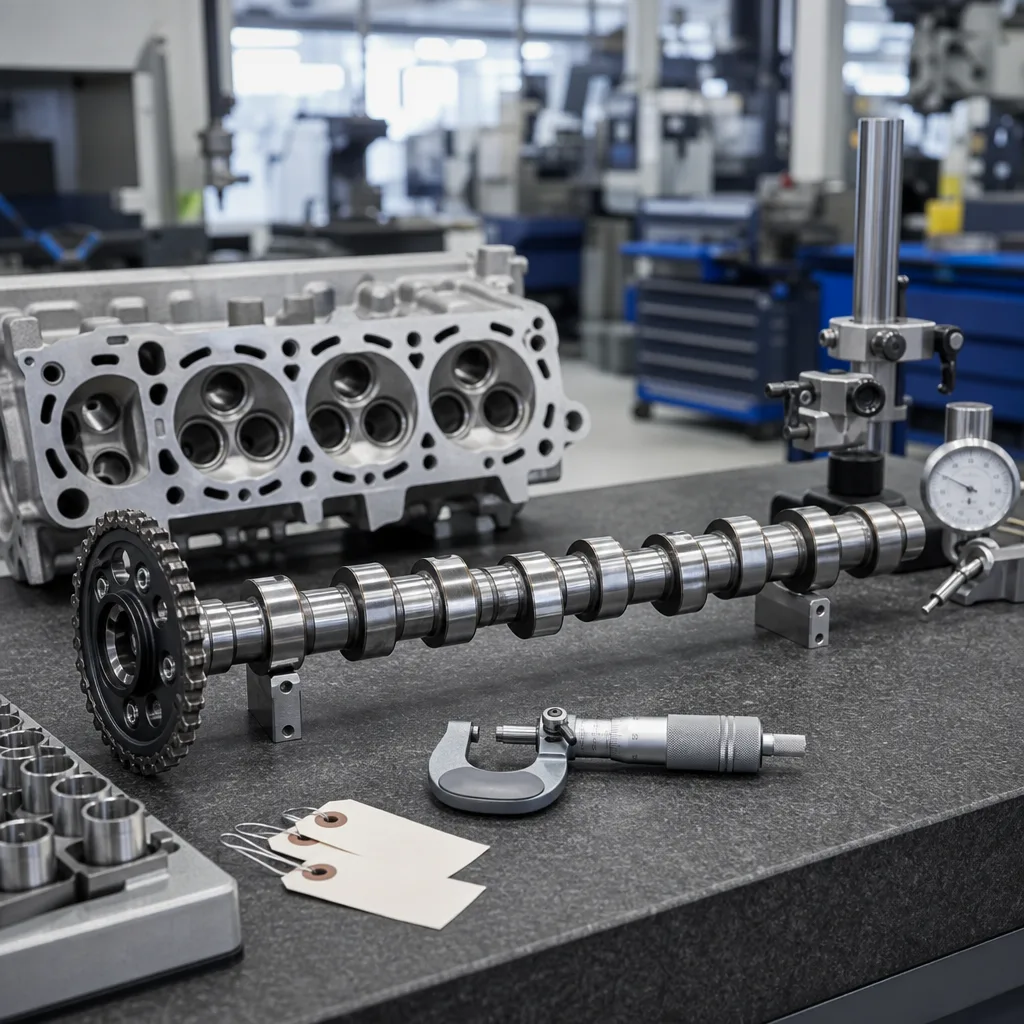
Camshafts for BMW X3 engines are judged by process control, not appearance. Depending on the engine family and production design, the correct part may be chilled cast iron, ductile iron, forged steel, assembled steel, or an OE-matched alloy. For replacement supply, the priorities are repeatable lobe profile control, correct case or chilled-layer hardness, stable journal geometry, controlled straightness, and consistent surface finish across batches. A clean-looking shaft is not enough; the working surfaces must withstand repeated contact loading while maintaining accurate valve timing and oil-film support.
Typical production and inspection controls include:
Material selection matched to the OE design or buyer-approved aftermarket drawing
Controlled casting, forging, tube, or blank preparation before machining
Heat treatment, induction hardening, carburising, nitriding, or chilled-surface control where required by the design
CNC grinding of lobe profiles and journals to the approved drawing
Verification of lift, base circle, phase angle, opening and closing ramps, and lobe-to-lobe relationship
Hardness verification on working surfaces and core material, with case depth or hardened-layer checks where applicable
Runout, straightness, concentricity, and journal cylindricity checks after finishing
Surface roughness inspection on lobe and journal contact areas using the agreed Ra or Rz requirement
Inspection of oil holes, grooves, thrust faces, keyways, dowel holes, threads, plugs, and phaser interfaces
Magnetic particle inspection, crack detection, or other non-destructive testing where the process or buyer specification requires it
Final washing, anti-rust oil or VCI protection, and protective packaging to prevent corrosion and transit damage
These controls matter even more on engines with variable valve timing because the camshaft sits inside a timed mechanical and electronic system. If a sensor target is shifted, a phaser interface is incorrectly indexed, an oil-control passage is restricted, or a lobe profile is outside tolerance, the engine management system may detect correlation errors even when the part physically installs. For B2B buyers, inspection records should therefore cover both basic dimensions and timing-critical geometry.
A low-cost regrind can be acceptable only when the base material, remaining hardened layer, and final geometry stay within the approved tolerance stack. If those points cannot be proven, the part should be treated as a risk item. Regrinding can reduce the base circle, change follower preload or hydraulic lash adjuster operating range, alter the follower contact pattern, remove hardened material, and shift valve-train geometry; without documented control, any short-term purchasing saving may be lost through claims, repeat labour, or engine damage.
Quality system and documentation
A credible supplier should document both the production system and the part itself. At minimum, ask for ISO 9001:2015 certification, IATF 16949:2016 where automotive-series production is required, an REACH (EC) No 1907/2006 statement for supplied materials where applicable, and batch traceability to the melt, heat, casting lot, forging lot, or machining batch as relevant. For many export programmes, EN 10204 3.1 material certificates, first-article inspection, hardness reports, lobe profile checks, dimensional inspection records, and final release records are the practical minimum.
This paperwork matters because the purchase decision is not only about fitment. It is also about warranty exposure, incoming inspection time, shipment consistency, and the ability to reconcile one delivery with the next. A distributor or repair-network buyer needs to know which batch entered which warehouse, which inspection report belongs to which shipment, and how quickly the supplier can isolate affected stock if a field issue appears. Batch coding, part labels, carton labels, pallet labels, and packing lists should therefore connect cleanly to the supplier's internal production and inspection records.
A typical quality file for a camshaft order may include the approved drawing or specification reference, control plan, material certificate, heat-treatment record, hardness report, profile measurement report, dimensional report, surface roughness data, runout data, sample approval record, certificate of conformity, and final inspection release. For private-label or long-term supply programmes, buyers may also request PPAP-style documentation, packaging specifications, barcode rules, photo records, golden-sample retention, and agreed acceptance criteria for incoming inspection.
Validation can include profile measurement, end-play checks, assembly checks with the phaser or timing hardware, sensor target verification, oil-feed verification, trial installation, and durability cycles against the buyer's internal specification. Review our quality system if you need to align supplier paperwork with your internal audit file.
When custom manufacturing is the better route
Custom manufacturing becomes the better route when the OE part is discontinued or superseded, when a fleet needs controlled private-label supply, when aftermarket catalogues show inconsistent references, or when a repair network wants one standard part number across multiple branches. In these cases, the objective is not just a one-off replacement. It is a stable supply plan with agreed tolerances, packaging, label formats, inspection gates, batch traceability, and repeatable lead times.
This route also helps when the buyer has a sample but no reliable drawing, when a regional vehicle population uses a less common engine variant, or when multiple camshafts in the same programme need to ship with related timing and sealing components. A controlled development process can start from OE reference data, customer samples, 3D scanning, profile measurement, or a buyer-approved drawing. The supplier should then confirm material grade, heat treatment or surface treatment, machining datum strategy, lobe profile measurement method, phaser interface geometry, sensor target angle, oil-feed layout, and packaging requirements before releasing bulk production.
For distributors and importers, custom manufacturing can reduce catalogue confusion. Instead of buying from several uncontrolled sources, the buyer can define the approved camshaft specification, carton label, batch code, inspection file, and reorder process. For workshops and fleet maintenance groups, that consistency reduces installation questions and makes warranty handling clearer. For OEM or Tier-1 programmes, the same discipline supports sample approval, staged validation, PPAP-style review, and repeat production under a documented quality system.
Driventus supports this through custom manufacturing and by supplying related engine components when a broader bill of materials is needed. If you are consolidating procurement across distributors, workshops, or import warehouses, request a matched quotation for the camshaft, ancillary seals, timing-related hardware, fasteners, and any associated installation components together. This reduces receiving rework, improves stock control, and makes incoming inspection simpler.
Frequently asked questions
Match the engine code, OE cross-reference, intake or exhaust position, lobe profile, journal dimensions, thrust location, VVT interface, oil-feed features, and trigger wheel position. A supplier should provide a dimensional report for critical features, not just a vehicle list.
Yes, if the geometry, material, hardness, surface finish, timing interfaces, oil-feed layout, and inspection process are controlled to the OE drawing or a buyer-approved equivalent specification. Fitment should be validated before release to avoid installation faults and warranty claims.
Commercial invoice, packing list, certificate of conformity, material certificate, inspection report, batch traceability, and REACH statement if required. Add market-specific labels, barcode rules, corrosion protection, carton markings, pallet requirements, and private-label artwork before shipment.
If you need fitment confirmation, batch documentation, or a private-label supply plan, use [request a quote](/contact.html)