BMW Brake Replacement: How Buyers Avoid Fitment and Comeback Risk
BMW brake replacement is rarely a simple matter of matching pad shape or disc diameter. For distributors, repair groups, importers and procurement teams, the real issue is whether a part installs cleanly, matches the intended brake system and stays consistent across repeat orders. That means checking dimensions, friction stability, rotor machining, coating durability, hardware completeness and traceability.
BMW applications make this harder than many buyers expect. Two references can look nearly identical yet differ in axle load, caliper layout, rotor height, ventilation design or electronic wear-sensor arrangement. If one critical detail is wrong, the result is predictable: extra workshop time, noise or vibration complaints, avoidable returns and weak confidence in the programme.
This article breaks down bmw brake replacement from a sourcing angle rather than a consumer one. The focus is practical: what to verify, where programmes usually fail, what documentation to request and how to approve pads, discs and hardware without turning the range into an expensive trial-and-error exercise. Driventus is an independent aftermarket manufacturer; brand names are referenced for fitment only.
Start with the decision: what makes a BMW brake replacement part worth approving?
In any bmw brake replacement programme, the target is not just part availability. The target is a part that fits first time, works as intended and does not create avoidable warranty cost.
A useful decision framework starts with seven checkpoints:
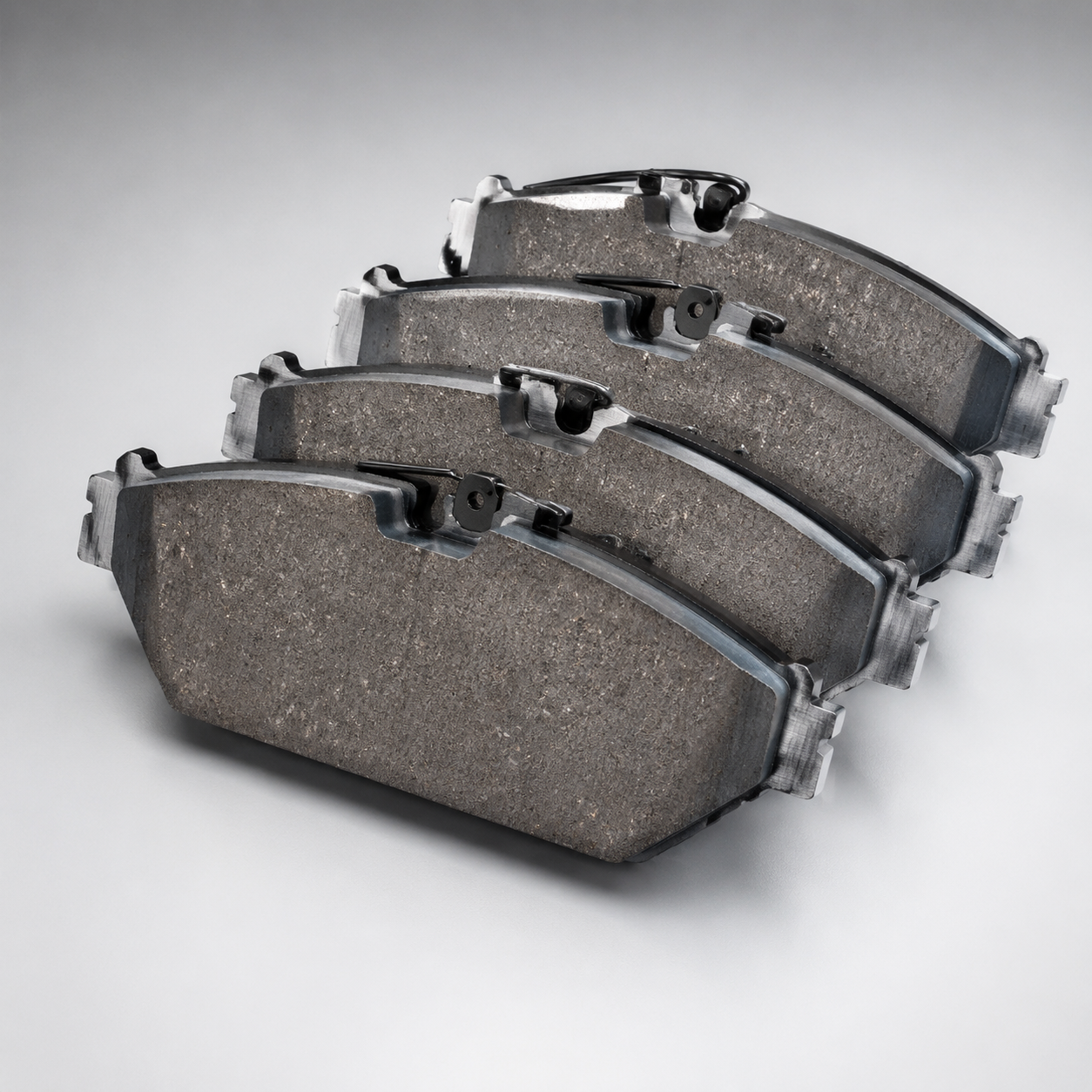
- Pad backing-plate dimensions: profile, total thickness, backing-plate thickness, abutment contact points and chamfer geometry
- Friction material stability: consistent coefficient behaviour across low, medium and high temperatures, often within a controlled μ band such as 0.35-0.45 for normal service depending on formulation and market need
- Disc dimensions: outside diameter, nominal thickness, minimum thickness marking, overall height and centre bore
- Runout and balance: controls that support smooth operation and low vibration; incoming checks often target disc lateral runout at or below 0.05-0.08 mm before mounting and disc thickness variation within 0.01-0.015 mm across the braking face
- Surface protection: coating performance in storage and service, sometimes reviewed through salt-spray testing such as 72-240 hours depending on coating system and non-friction-area requirement
- Hardware compatibility: shims, clips, springs and electronic wear-sensor routing where applicable
- Traceability: batch marking tied to production date, material lot, line or cavity, and inspection records
This is also where buyers should separate standard service demand from severe-duty demand. A city-driven passenger car, a heavier BMW SUV and a higher-output variant may share family resemblance while needing different thermal capacity, rotor hardness control or friction behaviour. On paper, the shape may match. In service, the wrong construction shows up quickly.
BMW platforms often share design language, but brake details still move by chassis code, engine output, production period and brake-system supplier variant. That is why approval should combine catalog work with actual dimensional review and sample inspection. Silhouette is not enough. Shop-floor checks should include bracket sliding fit, piston-side clearance, sensor clip retention and rotor seating on the hub without rocking.
Commercially, this matters because the cheapest line item is often the most expensive programme. Saving USD 0.60-1.20 per pad set means very little if return or rework rates rise by 2-3%. For mixed BMW coverage, buyers often set MOQ by movement class: trial orders around 100-300 sets, stronger sellers at 500-1,000 sets, and lower negotiated MOQ for niche references grouped into a wider programme buy. Where broader European coverage is needed, fitment mapping can also be compared alongside our catalog to reduce unnecessary SKU overlap.
Where BMW brake replacement programmes usually go wrong
Most problems in bmw brake replacement are not exotic engineering failures. They come from a handful of repeatable sourcing mistakes.
1. A dimension is close, but not close enough
A pad that is slightly oversized at the abutment can bind in the bracket. A disc with poor hat-height control can shift caliper position and change contact pattern. Even 0.20-0.30 mm excess on a critical edge can be enough to create fitting resistance or drag complaints.
2. Friction batches do not behave the same way
Variation in formulation, cure or density changes noise, dust, pedal response and wear balance. One lot feels acceptable; the next produces complaints. Workshops notice this fast.
3. Rotor machining is inconsistent
Lateral runout and thickness variation are common triggers for judder complaints shortly after installation. Buyers should be cautious if incoming discs regularly exceed roughly 0.05-0.08 mm free-state runout or show visible face variation after mounting checks.
4. Corrosion protection is treated as cosmetic
It is not. Weak coating on hats, vanes or backing plates creates storage risk, poor shelf appearance and faster visible degradation in corrosive environments. This matters even more when stock moves by sea freight and sits in warehouse inventory for 3-9 months.
5. The kit is incomplete
Missing clips, springs, bolts or wear-sensor provisions convert a normal installation into a return. For distributors, one missing fitting item can erase margin through reverse logistics alone.
6. Fitment mapping is wrong
Sometimes the part is manufactured correctly and still fails in the field because it was assigned to the wrong production range or brake-system variant. In BMW ranges, buyers should separately verify chassis code, axle, disc size, supplier variant and sensor side where relevant.
These are technical failures, but they quickly become commercial ones. Installer trust drops. Stock planning gets distorted. Slow-moving references become expensive. A more stable model is to buy by movement class: high-volume items on shorter replenishment cycles, niche items grouped into quarterly buys, and safety-stock logic for strategically important but irregular-demand references.
OE-match is not visual similarity: the comparison buyers should make
In bmw brake replacement, OE-match should mean functional equivalence, not just a familiar outline. A part only counts as OE-equivalent if it fits the installation envelope and reproduces the important operating features of the intended application.
| Check point | Brake pads | Brake discs |
|---|---|---|
| Critical dimensions | Length, width, total thickness, backing-plate thickness | Diameter, thickness, hat height, centre bore |
| Material control | Friction formulation, compressibility, shear strength | Grey iron grade, hardness, microstructure |
| Functional features | Slot, chamfer, shim, sensor provision | Vent type, drilling/slotting pattern if specified |
| Installation fit | Caliper bracket clearance, abutment fit | Hub fit, wheel mounting face accuracy |
| Surface finish | Coating on backing plate, adhesive integrity | Anti-corrosion coating, braking surface condition |