Best Site for Car Parts: How B2B Buyers Assess Suppliers
For a procurement team, the best site for car parts is not the flashiest catalogue or the lowest advertised price. It is the supplier platform that helps you rule vendors in or out fast, before your team wastes time on weak RFQs, vague claims, or mismatched capability.
In B2B aftermarket sourcing, a website is an early filter. It should tell you whether the supplier can support your part family, your quality expectations, your documentation needs, and your commercial model. Buyers in the EU, UK, US, Canada, Australia, and Brazil also need practical export support: compliant paperwork, stable packaging, traceability, and lead times that hold across repeat orders.
That is why the best site for car parts is really the one that reduces uncertainty. It should surface fitment references, manufacturing scope, test methods, MOQ logic, sampling route, and quality-system signals early. This article breaks down how procurement teams actually judge supplier websites before RFQ, sample approval, and factory qualification.
Start with a decision filter, not a product search
A supplier website should help your team make a quick sourcing decision: continue, clarify, or discard. If it only gives you photos and broad marketing claims, it is not doing its job.
For aftermarket replacement parts, the first screen should answer a simple question: does this supplier look operationally ready for your programme?
Useful website content usually includes:
Product scope by system and vehicle application
Fitment references and, where relevant, OE cross-reference format
Manufacturing capability by process, such as casting, forging, CNC machining, heat treatment, dynamic balancing, pressure or leak testing, and final assembly
Quality documents, including IATF 16949:2016 and ISO 9001:2015 where held
Core specifications such as material grade, hardness range, surface treatment, key dimensions, and critical tolerances
Export packaging, labelling, and traceability approach
MOQ, sample policy, indicative unit-price logic, and lead-time windows
Contact paths for RFQ, drawing review, or private-label discussion
That mix matters because procurement teams do not need retail-style persuasion. They need enough evidence to judge dimensional control, material consistency, and batch discipline.
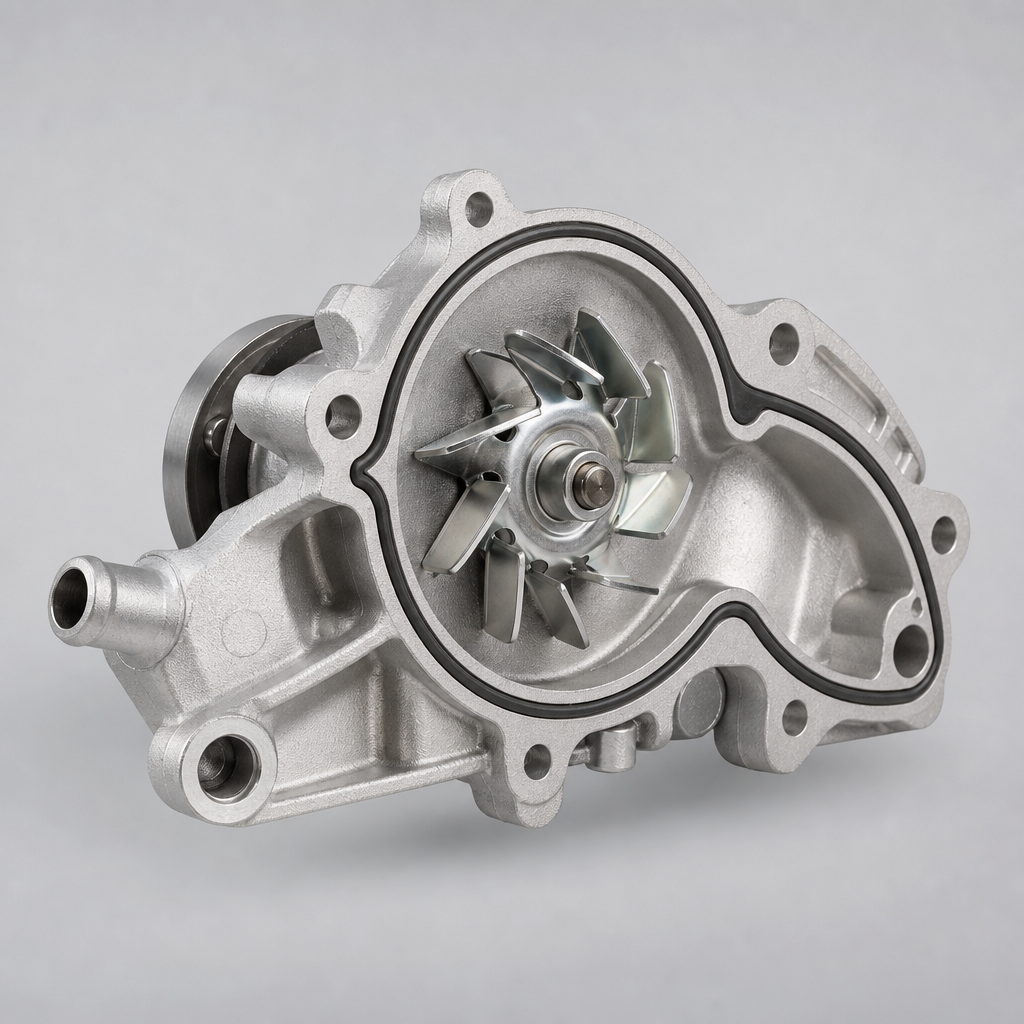
Take a typical oil pump, water pump housing, timing component, or machined engine part. A serious supplier page should show more than an image. It should point to the casting alloy or steel grade, bore or shaft tolerance, leak-test pressure, balancing threshold where relevant, and whether critical checks are 100% inspected or managed under an AQL plan. Even indicative data such as bore tolerance ±0.02 mm, flatness ≤0.05 mm, leak test at 0.3-0.5 MPa for 30-60 seconds, or runout control ≤0.03 mm tells you the supplier understands automotive production.
At Driventus, buyers can review our catalog by component family and use that as a starting point for RFQ alignment across engine and powertrain parts.
Compare websites by failure modes, not by homepage polish
Search results can make many suppliers look interchangeable. The faster way to spot the best site for car parts is to compare where weaker sites usually fail.
Evaluation point
What strong suppliers show
Warning sign
Product coverage
Clear categories, application range, and part-family depth
Mixed unrelated products with little structure
Technical content
Materials, dimensions, tolerances, process notes, and testing scope
Only generic sales text
Certification
Named standards such as IATF 16949:2016 and ISO 9001:2015
Vague statements like "certified quality"
Traceability
Batch control, inspection points, packaging IDs, and production-date coding
No mention of lot control
RFQ readiness
MOQ, sample route, unit-price drivers, and lead-time guidance
No commercial information
Compliance awareness
References to REACH (EC) No 1907/2006 where relevant
No compliance language for export markets
Factory visibility
Process photos, capability summary, equipment list, and audit openness
No indication of manufacturing base
Contact response path
Dedicated enquiry route for B2B buyers
Only consumer-style checkout or a generic form
</tr></thead><tbody> </tbody></table>Then check whether the site matches your operating model.
Distributors and wholesalers need SKU continuity, branded or neutral packaging options, and replenishment planning. Useful sites mention carton pack counts such as 4, 8, 12, or 20 pieces per master carton, mixed-order flexibility, and reorder lead times.
OEM and Tier-1 sourcing teams need drawing control, PPAP-related discussion where applicable, and disciplined process records. If tolerances tighter than ±0.01-0.02 mm or capability targets such as CpK/PpK ≥1.33 matter, the supplier should be ready for that conversation.
Repair chains need stable fitment, low return rates, and standardised packaging across branches. Good signals include barcode support, branch-ready labels, and consistent inner-box dimensions.
One more filter: response speed. If two suppliers offer similar parts, the stronger candidate is often the one that can return a usable RFQ package within 24-72 hours with part photos, OE references, MOQ, sample cost, lead time, and tooling constraints.
If a website hides these basics, it may rank well, but it is unlikely to be the best site for car parts for a procurement team.
Pressure-test the commercial model before you shortlist
A technically credible site can still fail on commercial execution. This is where many sourcing conversations stall.
Commercial checkpoints to verify
MOQ by SKU and by mixed order: confirm whether minimums apply per item, per box quantity, or per shipment value.
Sampling route: ask whether samples come from production tooling, a pilot run, or a manual pre-series build.
Lead time: separate sample lead time from mass-production lead time, and ask about peak-season variation.
Packaging: verify inner box, master carton, palletisation, barcode format, and shipping mark control.
Private label: confirm the artwork approval process and carton revision control.
Audit access: ask whether the factory can support remote document review or an on-site audit.
The table below is a practical screen.
Commercial item
Typical buyer question
Why it matters
MOQ
What is the minimum order by part number?
Affects SKU launch economics
Lead time
What is the standard production window after deposit or PO release?
Impacts inventory planning
Capacity
Can the supplier sustain repeat monthly volume?
Reduces stock-out risk
Packaging
Are carton specs standardised across orders?
Prevents receiving errors
Labelling
Can labels include buyer SKU, barcode, and batch code?
Supports warehouse traceability
Audit
Can the factory share process flow and control plans?
Helps supplier approval
Claims handling
What is the non-conformance response process?
Measures post-shipment discipline
</tr></thead><tbody> </tbody></table>Push for usable numbers. Wide ranges are often a sign that the supplier has not thought through execution.
In many aftermarket programmes, realistic starting points look like this:
MOQ logic: standard items may start at 50-200 pieces per SKU, while slower-moving or heavier parts may require one full carton or one pallet layer. Mixed orders may be accepted if the shipment reaches a threshold such as USD 3,000-10,000 or fills a minimum CBM.
Price logic: unit price usually moves with material grade, machining time, balancing requirement, surface treatment, packaging complexity, and order volume. Buyers should ask for breakpoints such as 100 / 500 / 1,000 pieces rather than one flat quote.
Sample logic: catalogue samples may ship in 3-10 days if stock exists; production-tool samples often take 2-4 weeks; new tooling or customised packaging can extend this to 4-8 weeks.
Mass-production lead time: repeat orders may run 25-40 days, while new items, peak-season bookings, or outsourced finishing steps can push production to 45-60 days.
Packaging logic: confirm inner box dimensions, master carton gross weight, and pallet standard. Many buyers cap carton weight at 12-15 kg for manual handling, require corner protection, and specify pallet height limits such as 1.0-1.2 m.
Audit readiness should be just as concrete. A prepared supplier should be able to share a process flow chart, control plan, incoming inspection standard, in-process check frequency, final inspection format, calibration list, and a non-conformance workflow such as containment within 24 hours, root-cause response within 3-5 working days, and corrective action closure with evidence.
Buyers evaluating a long-term source should also review the supplier’s quality system before moving to trial orders.
Read the technical detail like a risk report
The best site for car parts does more than list SKUs. It shows how failure risk is controlled.
For engine and powertrain components, that usually comes down to discipline in areas such as:
Material verification
Machining tolerance control
Surface finish consistency
Dynamic balancing where applicable
Leak testing for fluid-handling parts
Torque and sealing validation for assembled items
Final inspection records and batch traceability
Published standards should be named correctly where relevant. Examples buyers may expect to see include IATF 16949:2016, ISO 9001:2015, and substance-control obligations linked to REACH (EC) No 1907/2006 for applicable markets and materials. Claims should stay specific to the part, process, and test method.
The most useful websites make those claims easy to interrogate. A buyer should be able to ask:
What raw material grade is used, and is each heat or melt traceable by lot number?
Which dimensions are critical to function, and what are the actual drawing tolerances, for example bearing bore ±0.01 mm, mounting-hole position ±0.05 mm, or mating-face flatness ≤0.03 mm?
What surface roughness is controlled on sealing or sliding areas, such as Ra 0.8-1.6 μm?
Is hardness verified after heat treatment, for example HRC 58-62 for a wear component or a specified HB range for cast material?
Is balancing controlled to a stated residual unbalance limit for rotating parts?
Are pressure or leak tests performed at a defined value such as 0.3 MPa, 0.5 MPa, or another part-specific test condition?
Good sites also avoid a common red flag: overstating compatibility. Fitment references should be factual, controlled, and easy to verify. Where OE cross-references are used, they should appear in a neutral format such as OE 06A107065 only when relevant to the enquiry.
Compliance detail should be equally practical. Buyers may need confirmation on restricted substances, coating declarations, material reports, country-of-origin statements, and document retention periods. In some programmes, packaging compliance matters too, including barcode symbology, carton markings, fumigation status where wood is used, and export documents such as packing list, commercial invoice, and certificate of origin.
If your programme requires design adaptation, branding changes, or application-specific adjustments, it is useful to check whether the supplier offers custom manufacturing rather than only standard catalogue supply.
When a trading-style site is enough, and when factory access matters
Not every purchase needs a factory-backed supplier. But repeat-volume programmes usually do.
Some sites aggregate thousands of listings and give buyers broad choice with limited production visibility. That can work for spot buys. It is weaker when you need consistent repeat orders, tighter control, or faster corrective action.
A factory-backed supplier can often provide:
Better control of process changes
Faster technical feedback on drawings and samples
More stable packaging and batch traceability
A shorter communication chain for corrective action
More reliable planning for repeat orders
This does not make every manufacturer a fit. Buyers still need to verify process capability, export experience, and communication quality. But direct manufacturing control usually removes ambiguity when something goes wrong.
In practice, factory-backed sourcing often improves four decisions:
Cost transparency: the supplier can explain how forging weight, machining cycle time, balancing, coating, and packaging affect piece price instead of quoting one opaque number.
Lead-time control: buyers can separate in-house steps from outsourced ones. For example, machining may be completed in 10-15 days, while outsourced heat treatment, plating, or printing adds another 5-10 days.
Tolerance accountability: if a critical bore, shaft, or flange dimension is out of spec, the team with the actual gauges, fixtures, and machine settings can respond immediately.
Corrective action speed: containment stock, re-inspection, sorting, or rework can start faster when the decision maker is at the production site.
A trading company may still be workable if it adds real programme-management value and can document factory control. The key is proof. Buyers should ask who owns tooling, who approves process changes, who keeps calibration records, and who signs final inspection reports.
Driventus manufactures engine and powertrain components for export programmes and supports B2B buyers with catalogue supply and project-based sourcing. Driventus is an independent aftermarket manufacturer; brand names are referenced for fitment only.
A six-step shortlist process buyers can actually use
If you are trying to identify the best site for car parts for a live sourcing programme, use a repeatable shortlist process.
1. Review product-family relevance and fitment depth. 2. Check for named certifications and process transparency. 3. Verify whether the site speaks to wholesale, OEM-service, or chain-repair requirements. 4. Request MOQ, sample policy, and standard lead time. 5. Review packaging, labelling, and traceability controls. 6. Move only qualified suppliers to sample or audit stage.
This keeps search visibility separate from sourcing quality.
To make the shortlist comparable, ask every supplier for the same first-round RFQ package:
Target part numbers and OE cross-references
Annual volume estimate and opening order quantity
Required MOQ by SKU and mixed-order acceptance
Price breaks at defined quantities such as 100 / 500 / 1,000 pieces
Sample timing, sample charges, and whether samples are from production tooling
Standard production lead time and peak-season lead time
Packaging specification including box count, carton size, gross weight, pallet pattern, and barcode format
Quality documents including certification copies, inspection reports, and traceability method
Any critical tolerances, test conditions, or validation requirements for the part family
A simple weighted score helps. Many teams compare suppliers across technical fit, commercial fit, quality system, response speed, and export readiness. Even a basic matrix, such as 30% technical, 25% commercial, 20% quality, 15% logistics, and 10% communication, makes it easier to identify the best site for car parts in a sourcing context rather than a search-ranking context.
If you are sourcing aftermarket replacement parts across engine, cooling, or powertrain categories, start with a structured review of our catalog and then request a quote with target volume, market, packaging needs, and any audit requirements.
Frequently asked questions
It should help buyers pre-qualify the source quickly by showing product scope, fitment references, certification, MOQ, lead time, packaging detail, and a clear RFQ route. Strong sites also provide concrete technical information such as material grade, test method, key tolerances, and commercial logic like carton MOQ, mixed-order minimum value, and standard sample timing. If the site relies only on generic sales language, it adds sourcing time instead of reducing risk.
Not in every case, but factory-backed suppliers usually offer stronger control over process changes, traceability, sampling, and corrective action. For repeat-volume aftermarket programmes, that visibility often lowers quality and delivery risk. Buyers can usually get clearer answers on tolerance control, tooling status, production capacity, and realistic lead times when the source directly manages manufacturing.
Common baseline references include IATF 16949:2016 and ISO 9001:2015. Depending on the part and market, buyers may also review material and substance compliance aligned with REACH (EC) No 1907/2006 and request supporting records during qualification. For higher-risk parts, buyers should also ask how these systems translate into process controls such as calibration, lot traceability, inspection frequency, leak testing, hardness checks, and retention of production records.
If you are comparing suppliers for aftermarket replacement parts, we can review your target applications, MOQ, packaging specification, tolerance requirements, and lead-time targets in a practical RFQ discussion. Contact Driventus to [request a quote](/contact.html).