aftermarket replacement parts · 2026-06-13

Auto Parts Online Shopping for B2B Buyers

Auto parts online shopping has moved well beyond retail replacement orders. For aftermarket distributors, importers, repair-chain procurement teams and OEM-adjacent buyers, digital sourcing can shorten RFQ cycles, reveal new suppliers and support repeat replenishment programs. It also raises the standard for verification. A product page is not a production approval, and an online match does not confirm that the part will fit every regional application.

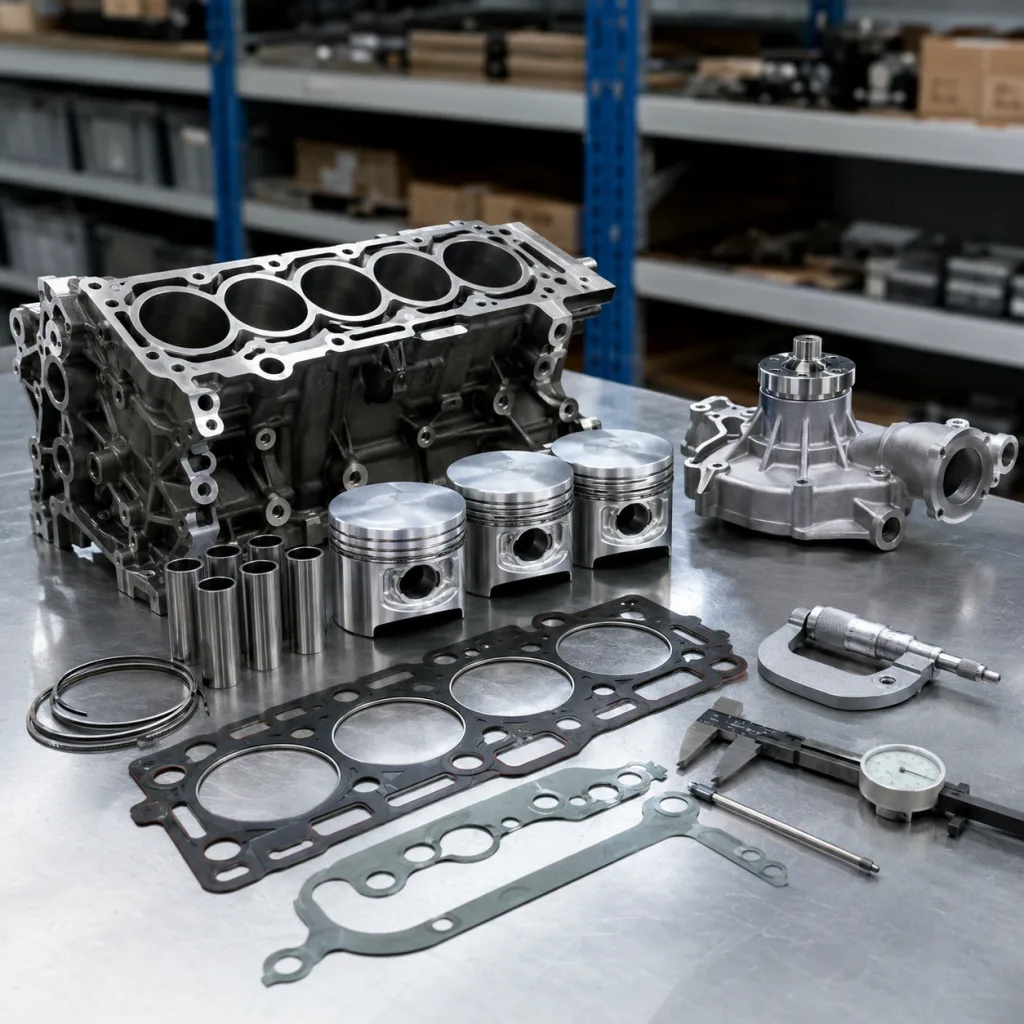
Professional buyers still need structured evidence: part-number cross-references, application notes, drawings where available, material declarations, batch traceability, packaging data, warranty terms and proof of process control. This guide explains how to evaluate aftermarket replacement parts online before committing to container-volume purchases, scheduled orders or private-label programs. It focuses on engine and powertrain components such as pistons, crankshafts, gaskets, water pumps and turbochargers, where dimensional accuracy, material consistency and repeatable assembly directly affect fitment, service life and claim rates. Driventus is an independent aftermarket manufacturer; brand names are referenced for fitment only.

Start With Fitment, Not Price

Fitment control should come before price comparison. A low unit price has limited value if the part creates returns, workshop delays, warranty disputes or customs classification problems. Procurement teams should treat online listings as technical leads, not as final approval evidence.

Before issuing a purchase order for aftermarket replacement parts, confirm the following details:

  • OE-style cross-reference format, such as OE 06A… or OE 11251…, where applicable
  • Engine code, displacement, fuel type and production year range
  • Vehicle platform and regional application differences
  • Critical dimensions, including bore, stroke-related geometry, bolt pattern, gasket thickness or impeller diameter
  • Material grade, coating and surface treatment
  • Included accessories, seals, bolts, clips or installation hardware
  • Packaging unit, carton quantity and pallet configuration
  • Country-of-origin marking and HS code support documents

One of the most common sourcing mistakes is assuming that a visible reference number covers all regional applications. A water pump or gasket may share a general family description but differ in housing angle, sensor port, sealing bead profile, coolant passage geometry or installation hardware. For distributors, each mismatch can become a return, a customer complaint and an inventory correction.

When reviewing our catalog, buyers can use product family pages to shortlist parts and then request cross-reference confirmation before bulk ordering. For complex or high-volume items, Driventus can review samples, drawings or existing reference parts to confirm dimensional compatibility before a purchase program moves forward.

Compare Online Supplier Models

Online suppliers do not play the same role in the supply chain. Understanding the model behind the quotation helps buyers judge price stability, technical support, quality response and long-term availability.

</tr></thead><tbody> </tbody></table>For B2B auto parts online shopping, the right supplier model depends on the purpose of the order. A repair chain filling an urgent stock gap may prioritise local availability. An importer building a 12-month gasket, piston, crankshaft or pump program should place more weight on manufacturing control, documentation, change management and corrective-action capability.

Driventus manufactures engine and powertrain components in Taizhou, Zhejiang, with internal control over machining, assembly, inspection and packaging processes for many product lines. This operating structure helps procurement teams standardise parts across repeat orders and reduces the risk of unexplained source changes. Where customers need private-label packaging, drawing-based development or application-specific adjustments, custom manufacturing is available after technical review.

Documentation Buyers Should Request Before Bulk Orders

Digital sourcing works best when documentation is treated as part of the product. Buyers should request key documents early, while there is still time to clarify technical gaps, adjust packaging or pause a risky order.

Supplier type Typical strength Main procurement risk Best use case
Trading companyBroad assortment and fast quotationLimited process control and slower root-cause responseSmall mixed orders or market testing
Marketplace sellerEasy search and low entry quantityInconsistent source, packaging and batch traceabilitySpot purchases, not strategic supply
Stocking distributorLocal inventory and faster deliveryHigher price and limited customisationUrgent replenishment
Vertically integrated manufacturerProcess control, tooling knowledge and repeatabilityLonger initial validation cycleProgram supply and private-label lines

</tr></thead><tbody> </tbody></table>For engine components, buyers may also request hardness readings, surface roughness data, pressure-test results, balancing records or torque-related assembly records depending on part type. For friction and brake-adjacent programs, SAE J2527 may be relevant to noise and performance assessment, but it should not be cited for unrelated engine products. For emissions-relevant components, regulations such as ECE R-83 may affect vehicle-level compliance, while replacement engine parts still need to be evaluated in their correct technical context.

Driventus operates under IATF 16949:2016 and ISO 9001:2015. Buyers can review our quality system for information on process control, inspection discipline and supplier qualification expectations. Certification does not replace part validation, but it provides a structured basis for audits, corrective actions and continuous improvement.

How to Validate Aftermarket Replacement Parts Online

A reliable online buying process separates commercial screening from technical approval. This prevents a supplier from being accepted simply because the quotation is fast, complete or attractive on price.

Recommended validation sequence:

1. Application screening: Match OE-style references, engine codes, vehicle coverage and regional fitment notes. 2. Supplier qualification: Review certification, export history, production scope, audit readiness and communication speed. 3. Technical confirmation: Check drawings, samples, critical dimensions, material data and inspection method. 4. Pilot order: Place a controlled first order with defined batch size, packaging and inspection criteria. 5. Incoming inspection: Measure critical features before distribution to branches or customers. 6. Field feedback review: Track installation issues, early failures, noise, leakage or fitment complaints. 7. Repeat-order control: Lock packaging, reference numbers, batch identification and change-notification rules.

For dimensional parts such as pistons and crankshafts, incoming inspection should focus on critical-to-function dimensions, not only visual appearance. For sealing parts, measure thickness, hole alignment, bead geometry and surface condition. For water pumps, inspect impeller type, shaft play, sealing surface and casting quality. For turbochargers, check actuator configuration, oil feed and drain interfaces, compressor housing orientation and balance documentation.

The goal is repeatability. A first sample that fits is useful, but stable performance over multiple batches is what protects margins and customer service levels. Online purchasing platforms may hide manufacturing-source changes, so buyers should confirm whether repeat orders will come from the same facility, process route and specification.

Commercial Terms That Affect Total Landed Cost

The visible unit price is only one part of the buying decision. For importers and wholesalers, total landed cost also reflects freight efficiency, packaging density, claim rate, documentation accuracy, inspection workload and stock availability.

Evaluate these items before comparing final quotations:

  • MOQ by part number and by shipment
  • Lead time for standard stock, production orders and packaging changes
  • Incoterms, such as EXW, FOB or CIF
  • Carton dimensions, gross weight, pallet quantity and container loading estimate
  • Private-label carton and label setup costs
  • Sample cost and refund policy for approved bulk orders
  • Payment terms and currency
  • Spare parts availability for repeat replenishment
  • Claim handling time and required evidence
  • Change-notification procedure for materials, tooling, sub-suppliers or packaging

A higher unit price may be more economical if it reduces claim frequency, improves container utilisation or shortens inspection time. Conversely, a low quotation can become expensive if the supplier cannot hold tolerances, maintain packaging consistency or provide export documents without repeated corrections.

Auto parts online shopping should therefore include a landed-cost worksheet. At minimum, compare unit price, freight per unit, duty, packaging cost, inspection cost, expected return allowance and working-capital impact from MOQ. For multi-location repair chains, also include branch replenishment cost, downtime caused by incorrect fitment and the administrative cost of resolving claims.

Red Flags in Digital Auto Parts Sourcing

Some online listings are useful but incomplete. Others show risk that should be addressed before sampling, payment or shipment. Buyers should pause when a supplier cannot answer technical questions, avoids documentation or appears to source unrelated product categories from many unknown factories.

Common warning signs include:

  • No clear manufacturing scope or process description
  • Refusal to provide certificate copies or audit information
  • Product photos that do not match the stated application
  • Vague fitment language without engine codes or OE-style references
  • No batch number or traceability format
  • Frequent changes in carton design, label format or country-of-origin marking
  • Claims that imply vehicle manufacturer approval without evidence
  • Pressure to skip samples or inspection before large orders
  • No written warranty procedure
  • Inconsistent answers about material, hardness, coating or test method

Procurement teams should also be cautious with copied catalogue data. A listing may reproduce broad application information but omit regional variations, supersessions or installation notes. The safer approach is to build an internal approval file for each high-volume SKU, including supplier quotation, fitment evidence, sample inspection, packaging approval, shipment documents and claim history.

Driventus is an independent aftermarket manufacturer; brand names are referenced for fitment only. We do not claim approval or endorsement by vehicle manufacturers. For buyers building a new sourcing program or replacing an unstable supplier, the next step is to share target part numbers, annual volume, packaging requirements and destination market. Our team can then review availability, tooling status and validation requirements before you request a quote.

Frequently asked questions

Use OE-style cross-references, engine codes, dimensions, photos, samples and application notes together. Do not rely on a product title or vehicle model alone. For high-volume SKUs, create an approval file with sample inspection results and confirmed packaging data.

IATF 16949:2016 and ISO 9001:2015 are important quality-management references for automotive suppliers. Buyers may also need REACH (EC) No 1907/2006 statements for EU chemical compliance screening, depending on product and market requirements.

Not usually. Compare total landed cost, including freight, duty, packaging, inspection time, claim rate, MOQ and replenishment stability. A slightly higher unit price can reduce returns and protect customer service levels.

If you are building a repeat supply program for aftermarket engine and powertrain parts, share your target references, annual volume and market requirements. Driventus can review fitment and production options through /contact.html

Request a Quote
Document or data point Why it matters When to request it
IATF 16949:2016 and ISO 9001:2015 certificatesConfirms audited quality-management frameworkSupplier qualification stage
Product inspection reportShows dimensions, functional checks and batch statusBefore shipment
Material declarationSupports restricted-substance and customer compliance reviewBefore order confirmation
REACH (EC) No 1907/2006 statement where applicableSupports EU chemical compliance screeningBefore EU shipment
Packaging specificationPrevents damage, mislabelling and warehouse handling issuesBefore artwork or carton approval
Warranty and claim procedureDefines evidence, timing and responsibilityBefore first order
Traceability formatLinks production batch to inspection recordsBefore repeat supply