Alternator OEM Product Development Capability for Europe
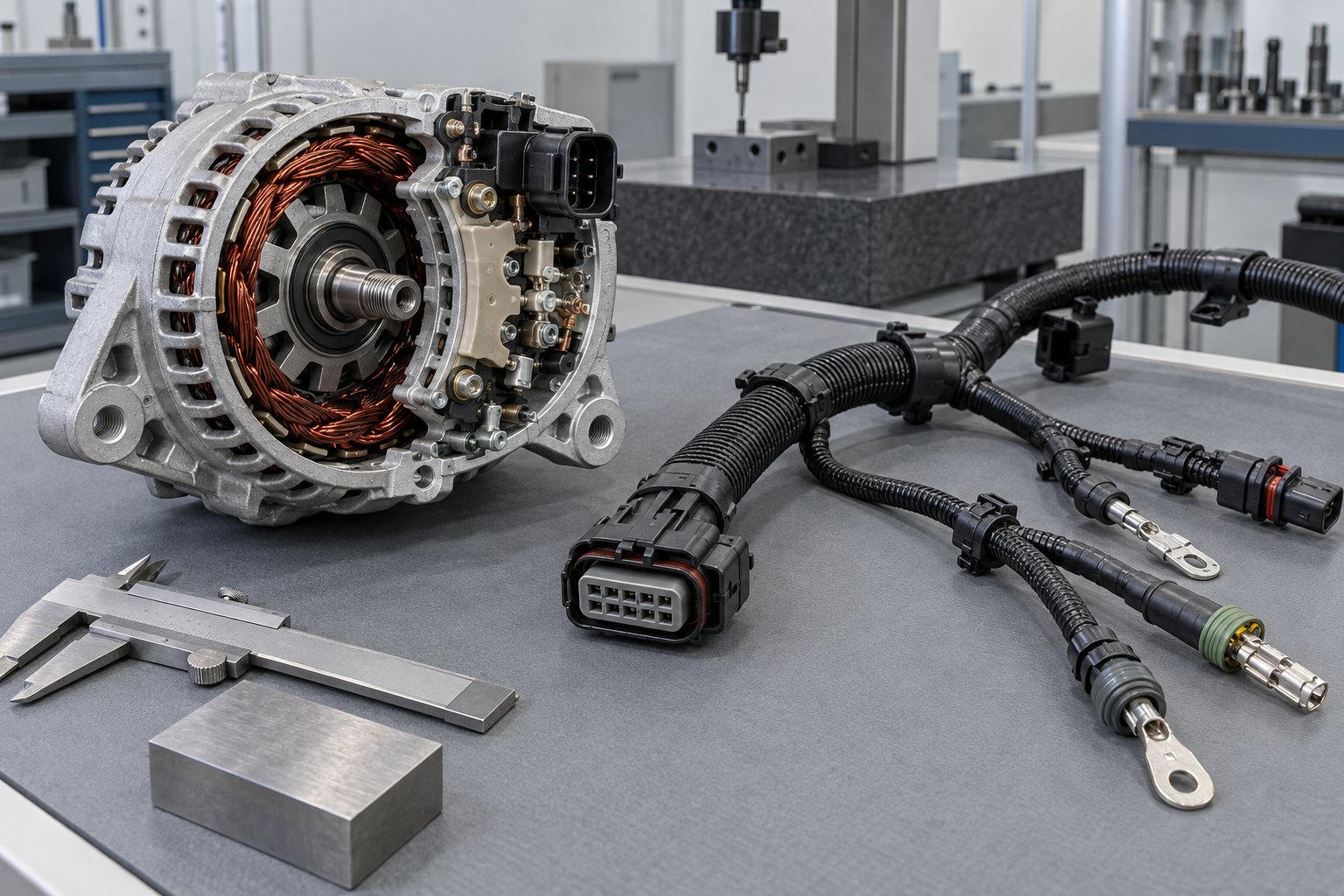
European buyers comparing alternator OEM product development capability should award a program only when the manufacturer can show a controlled path from a written load, mount, and duty-cycle specification to a frozen wiring harness interface, measured prototypes, and a repeatable manufacturing release. A catalogue ampere rating, a sample photograph, or a verbal offer of flexibility is not that path. This briefing is for B2B procurement teams placing programs in Europe. It does not invite buyers from other sales markets. A factory's country of origin is a sourcing fact, not a target market.
Vincent Xi, Editorial Author at Driventus Auto Parts, prepared this briefing. Profile: https://driventus.com/authors/vincent-xi/. No first-hand test, factory visit, or customer-program experience is approved for this byline, so none is claimed.
What alternator OEM product development capability means for a European award
For a European OEM or tier buyer, product development capability is the demonstrated ability to engineer an alternator to a stated electrical load, mechanical envelope, environment, and connector scheme, then manufacture that definition without silent change. Public descriptions from specialist makers show the categories this claim usually covers. They do not prove that any given European drawing has been tooled.
Linz Electric describes special alternators made with in-house production of windings, shafts, regulators, and related parts, a multidisciplinary design and engineering team, rapid prototyping, in-house tests under what it calls real conditions, and close customer collaboration for applications in transportation, construction, and industry (Linz Electric on special alternators). Those are process categories a buyer can demand to see as records. They are not, by themselves, evidence for a specific mount, regulator setting, or harness.
Mecc Alte, as profiled by Magnetics Magazine, is described as having designed and manufactured alternators for more than 70 years, working with OEM clients through an integrated process from design and materials to production. The same profile reports output of 450,000 units annually and cites a V-Type series with advanced winding treatments for harsh environments plus newer permanent-magnet generator systems (Magnetics Magazine profile of Mecc Alte). Read the numbers with their scope attached. The unit on the first figure is years of reported design and manufacture. The unit on the second is alternator units per year. The scope of both is that company's history and output as stated in the magazine profile, not European demand, not an industry total, and not a result for Driventus Auto Parts. The as-of context is the profile itself. The excerpt relied on here does not show a publication date, so confirm the article date and whether both figures are still current before anyone puts them in a scorecard. The V-Type and permanent-magnet examples are illustrations of how one manufacturer talks about development. They are not a shortlist.
Hebei Jinlitong describes engineered-to-order high-output alternators built to stated loads, duty cycles, and mounts, covering prototyping through end-of-line testing, and states that application-specific units can lower total cost of ownership versus standard units for generator sets and industrial equipment (Hebei Jinlitong on engineered-to-order alternators). The material used here does not publish the cost baseline, the current or hour-count behind "high output," or the end-of-line limits. Treat the cost sentence as the supplier's claim. Require the worksheet before it influences an award.
Use the three sources only as pattern recognition. A file that can support a European manufacturing award names the application constraints, which parts the supplier winds or machines, the prototype quantity, the test profile, and the release record that links the approved sample to series production.
Wiring harness manufacturing inputs the development file must freeze
An alternator does not finish product development as a bare machine. The program also freezes the wiring harness that carries supply, sense, indicator or communication, and ground. Wiring harness manufacturing is an input to alternator development, not a later accessory buy. If a second plant builds the harness, the alternator developer must still own the interface, or the electrical result has no single owner.
Freeze the interface before the first prototype loop, in language both plants can build to:
- System voltage and test voltage, stated separately. An example calculation, not a measured output and not a rating to copy: 180 amperes times 14 volts equals 2,520 watts, while 180 amperes times 28 volts equals 5,040 watts. Units are amperes, volts, and watts. Scope is an arithmetic illustration of why one current figure cannot describe both a 12-volt-class and a 24-volt-class system. As-of date is not applicable. Verify the real test voltage, current, speed, and duty in the supplier quote. Alternator test voltage is often specified at a point other than a nominal 14 or 28 volts, so do not put 180 amperes or these watt figures on a drawing.
- Conductor cross-section, insulation family, temperature class, and circuit identification. Confirm conductor metal in the quote rather than assuming a photograph shows the production winding or lead material.
- Terminal family, plating, seal, cavity lock, and the regulator pinout.
- Branch lengths and clip points from the alternator connector or eyelet to the first takeout. An example allowance, not a design rule: 25 millimetres of extra length is meaningful only against a stated engine-rock envelope on the installation drawing. Unit: millimetres. Scope: a single planning assumption. Verify or delete it in the quote.
- Conduit, abrasion sleeve, and strain relief at the alternator.
- Which plant crimps, which plant overmoulds if required, and which crimp cross-section and pull-off class is contractual.
IPC/WHMA-A-620 is an acceptance document buyers often cite for cable and wire harness assemblies. The ISO 6722 family is often cited for road-vehicle single-core cable. Putting either name in a statement of work creates a requirement the supplier must meet or formally deviate. It does not mean Driventus Auto Parts, Linz Electric, Mecc Alte, or Hebei Jinlitong holds a certificate. None of the sources used here states a current certificate. A standard's text is also not the same thing as a shop's actual crimp tooling or pull-test practice.
Harness evidence that belongs in the alternator dossier is a crimp-height record, a pull-test tied to the terminal part number, a continuity and short test, and a revision-controlled print. Without that pack, an alternator test report may describe a different lead set from the one that will ship.
Product development capability: prototype, test, and manufacturing release
Split product development capability into gates that can be audited: definition, prototype, validation, and manufacturing release. Trade-offs are measurable only when each gate has a quantity, a limit, and an owner.
Definition. Linz Electric's account stresses customer collaboration and in-house windings, shafts, and regulators. Collaboration is visible only when notes map to a changed drawing. Hebei Jinlitong's account ties custom builds to loads, duty cycles, and mounts. Those three items are the minimum electrical-mechanical set. Add the wiring harness revision and the European destination list or the file is still open. A single requirements sheet should list continuous and peak current, idle and rated speed, cut-in if it matters to the application, ambient temperature, vibration axis, mount geometry, pulley, rotation, and connector.
Prototype. Convert "rapid" prototyping, the phrase used by Linz Electric, into a date, a quantity, and a configuration list. Example planning assumption, not a recorded build: two loops of six alternator-and-harness sets equal twelve development sets. Unit: sets. Scope: a two-loop illustration before any production-part approval. Verify the quantity in the quote and use the quoted number if it differs. Soft tooling may be acceptable for a fit check and unacceptable for a thermal or durability sample. State which parts may still change after each loop.
Validation. In-house testing "under real conditions" is not a method. Ask which procedure, speeds, loads, temperatures, and durations were run, and on which serial numbers. Buyers of road-vehicle alternators often refer to ISO 8854 for test methods and general requirements for alternators with regulators. Environmental conditioning of vehicle electrical equipment is often discussed under the ISO 16750 series. Confirm the edition on the publisher's catalogue before a contract names either document. Citing a method does not mean the factory operates an accredited laboratory, and it does not certify any company named in this briefing. A usable report lists sample serials, the harness revision fitted to those samples, the pass limit, and the failures with disposition.
The 450,000 alternator units per year reported for Mecc Alte show that published series scale and development fit are different questions. A large annual output, unit alternator units per year and scope that one manufacturer's reported production, does not prove a test on the buyer's duty cycle. A high-volume plant may still need a new winding, regulator setting, housing clocking, or harness for a European engine bay. A smaller engineered-to-order shop may fit a low-volume special and must still show the same sample-to-report traceability. The profile's V-Type winding-treatment example and permanent-magnet example are prompts to ask what material or topology changes for a harsh environment and which test justifies the change. They are not performance data for a bid.
Release. End-of-line testing, which Hebei Jinlitong includes in its custom-build description, should be written as limits: regulated voltage at stated speed and current, a no-load window if required, lamp or communication behaviour if the vehicle uses it, rotation, and any insulation check the design requires. Link that recipe to the approved prototype. The control plan should cover the stator winding, rectifier, regulator, shaft, and harness crimps. Vertical integration of windings, shafts, and regulators, as Linz Electric describes for its specials, can shorten the chain. It can also obscure purchased steps. A process-flow diagram should mark in-house versus purchased for each.
Example schedule arithmetic, not an offered lead time: 10 working days for definition, plus 15 working days for a prototype build, plus 20 working days for a validation run, equals 45 working days before a release meeting. Unit: working days. Scope: three blocks only, excluding tooling, chamber queues, and customer approval. Verify every block in the quote.
The commercial trade-off follows the same discipline. A standard unit can be faster to order and cheaper on piece price while missing mount, duty, or harness constraints. A special can match the duty and raise tooling, test, and harness cost. Hebei Jinlitong's lower-total-cost statement is not usable until the supplier shows piece price, tooling, test, harness, and warranty reserve against a named baseline. No such baseline is in the source excerpt.
Europe: separating EU, EEA, UK, and country rules
European delivery changes the compliance questions that sit beside product development capability. One rule does not cover Europe. This section is a procurement screen, not legal advice, and it does not claim that Driventus Auto Parts or any cited manufacturer holds a type approval.
European Union. Alternators for many road vehicles are handled inside whole-vehicle or system type approval rather than as a standalone consumer CE mark on the alternator. Vehicle electromagnetic compatibility is addressed under UN Regulation No. 10, which EU type-approval rules can bring into the vehicle file. Whether that regulation applies to a loose component, to a machine, or only to the finished vehicle depends on the approval route. State the route in the request. Do not accept a generic "CE certified" line as a substitute when the application is an on-road vehicle.
EEA, outside the EU. Norway, Iceland, and Liechtenstein are in the European Economic Area and are not EU member states. Alignment with EU technical rules is not the same as holding an approval issued by an EU authority. Switzerland is in neither the EU nor the EEA. If the program has more than one European destination, list each country and ask which approval, importer duty, and document language applies. Do not copy an EU conclusion onto an EEA or Swiss shipment without a check.
United Kingdom. Great Britain and Northern Ireland are not one compliance territory for this purpose. Great Britain operates its own type-approval arrangements, and an EU approval is not automatically valid there. Northern Ireland's position under the Windsor Framework can follow EU goods rules differently from Great Britain. A line that says only "UK approved" is too coarse. Require the territory, the regulation identifier, and the approval holder, or a written statement that approval sits with the vehicle manufacturer.
Inside the EU, commercial rules still differ by country. Documentation language, invoice content, and packaging producer-responsibility duties can be national. They do not change the electrical specification. They do change whether a file satisfies a particular customer's quality team and whether a shipment is complete. Name the Incoterms place in Europe and the language of the release pack.
IATF 16949 is a quality-management standard used in the automotive chain. It is not an alternator performance standard and it is not proof of development work on this drawing. If the European customer requires registration, ask for a current certificate that names the legal entity and the site that will wind, assemble, and test, and the site that will manufacture the wiring harness if it is different. No source in this article documents such a certificate.
Buyer decision table for manufacturing release
Compare offers on this program only. A cell should cite a document number, a limit, or a dated certificate, not a brochure adjective. Do not score any bidder with Mecc Alte's reported 450,000-unit annual output; that figure has a different scope.
| Decision point | Specify in the RFQ | Compare across offers | Verify before approval or order |
|---|---|---|---|
| Electrical duty | Test voltage, idle and rated speed, continuous and peak current, duty cycle, ambient | Whether each offer uses the buyer's points or a milder catalogue point | A report on the buyer's points, with sample identifiers |
| Mechanical envelope | Mount, pulley, rotation, regulator clocking, harness keep-out | Fit to the European installation model, including service access | Dimensioned sample or model overlay on the current revision |
| Wiring harness manufacturing | Wire specification, terminal, length, conduit, crimp class, and harness plant | In-house harness versus directed-buy harness, and who owns the interface | Crimp records, continuity test, and the harness revision used on alternator samples |
| Prototype gate | Quantity, configuration, and what may change after the loop | Lead time and which parts are soft-tooled | Measurements tied to serial numbers; reject untraceable samples |
| Validation scope | Method, such as a named edition of ISO 8854 or ISO 16750, plus limits | Lab location and whether any accreditation claim is documented | Procedure number, data location, and failure disposition |
| Series manufacturing | In-house versus purchased for winding, shaft, rectifier, regulator, and harness | Control-plan coverage and end-of-line limits | Process flow and a pilot at the quoted rate |
| European destination | Separate lines for each EU country, EEA country, Switzerland if used, Great Britain, and Northern Ireland | Who holds any required approval, and in which territory | The approval, or a written statement that the vehicle OEM holds it, plus document language |
| Special versus standard cost | Piece price, tooling, test, harness, packaging, and warranty reserve | Any lower-total-cost claim against a stated baseline | The supplier worksheet; reject an unquantified cost sentence |
| Change control | How a winding, regulator, or terminal change is flagged | Speed of a change versus traceability | A sample change record with customer-approval evidence, redacted if needed |
| Order and delivery | Incoterms place in Europe, pack, label data, traceability code | Minimum order and whether prototype tools can support the first lot | A signed deviation list with no open harness-length or set-point issues |
RFQ Checklist
Send the request with a controlled drawing pack and a destination list. Each line below is a buyer action before award.
- Ask the supplier to return a compliance matrix that accepts, rejects, or deviates every electrical, mount, and wiring harness requirement.
- Require the manufacturer to mark windings, shafts, regulators, rectifiers, and wiring harness steps as in-house or purchased.
- Specify each European destination on its own line, covering the relevant EU member state, EEA country, Switzerland if applicable, Great Britain, and Northern Ireland, and require a compliance note for each line.
- Ask the supplier to quote prototype quantity, configuration, and the harness revision fitted to those prototypes.
- Require the manufacturer to name the validation procedure, limits, sample size, and laboratory, and to state whether each ISO or UN regulation reference is contractual or background only.
- Specify conductor, terminal, plating, seal, branch length, conduit, and crimp acceptance class so wiring harness manufacturing cannot substitute parts after the alternator test.
- Ask the supplier to attach end-of-line limits for series manufacturing and to link those limits to the approved prototype serials.
- Require the manufacturer to submit quality-certificate copies only for the legal entities and sites on the order, and to omit the certificate if none exists.
- Specify a cost breakdown that separates piece price, tooling, harness, test, packaging, and warranty reserve so any total-cost claim can be checked.
- Ask the supplier to state lead time in calendar days from drawing freeze and from approval, to the European ship-to site named in the Incoterms.
- Require the manufacturer to describe change notification for a regulator set-point or terminal change, including notice to the harness plant.
- Specify the records required with the first series shipment: dimensional report, electrical end-of-line summary, harness continuity report, and closed deviations.
How this evidence was derived, and what it does not prove
Methodology. Manufacturer-practice statements in this article come only from three public pages. Linz Electric's page supplies the description of in-house windings, shafts, and regulators, prototyping, in-house tests, and customer collaboration for transportation, construction, and industrial applications. The Magnetics Magazine profile supplies the Mecc Alte history of more than 70 years, the reported 450,000 alternator units per year, the integrated design-to-production description, and the V-Type and permanent-magnet examples. Hebei Jinlitong's page supplies the description of builds to load, duty cycle, and mount, prototyping through end-of-line testing, and the unquantified total-cost claim. The watt, millimetre, set-count, and working-day figures are labeled example calculations or assumptions for quote checks. No search-volume, price-per-click, difficulty, ranking, or traffic figure is used. No Driventus Auto Parts plant capability, certificate, customer, or test result is stated, because the allowed sources do not establish one.
Limitations. The three pages are company or trade-press descriptions, not independent laboratory reports. They do not contain the approval numbers, harness drawings, or failure rates needed to award a program. Confirm the magazine profile's date and the continued accuracy of the 70-year statement and the 450,000-unit annual figure on the live page before reuse. "Real conditions," "rapid" prototypes, and "lower total cost of ownership" are undefined in the excerpts used here. ISO 8854, the ISO 16750 series, the ISO 6722 family, IPC/WHMA-A-620, UN Regulation No. 10, and IATF 16949 are external references a buyer may choose to invoke. Naming them does not certify any company, and a standard's requirement is not that company's practice. EU, EEA, Swiss, Great Britain, and Northern Ireland duties depend on the approval route and on the law in force on the order date; the customer's homologation team or counsel should confirm them. Before order, verify the quote, the manufacturing-site list, any certificate expiry, the harness revision on the test samples, and the destination-specific approval path.
Discuss Your Requirements
Review our manufacturing capabilities, then share your specifications for a supplier-fit review.