Alternator OEM Communication Workflow Review for New Zealand Wiring Harness Orders
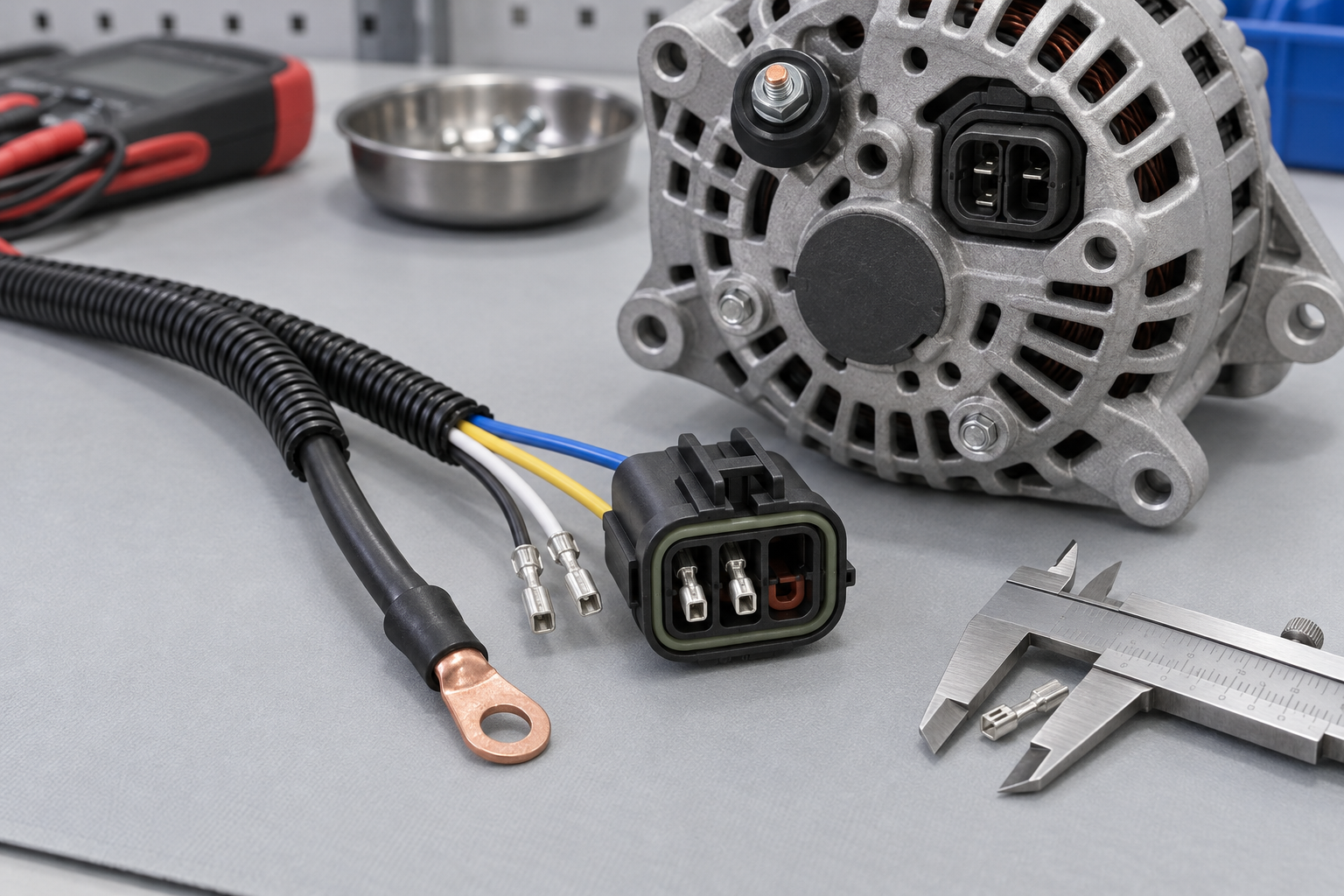
New Zealand buyers who place a manufacturing order for an alternator wiring harness should settle communication compatibility before release, not after a vehicle rejects the unit. The procurement answer is direct: lock the manufacturer ID, the communication method the platform actually uses, the connector cavities and wire functions, and the split of software responsibility, then build the harness only to that file. A generator that produces charging voltage can still be the wrong part if the regulator cannot complete the OEM exchange the engine computer expects.
This alternator OEM communication workflow review is an editorial buying note for wiring harness manufacturing. It converts published trade explanations into specify, compare, verify, approve, and order checks. It is not a Driventus laboratory report and it is not a certification. No first-hand factory visit, personal trial, named customer, or author experience claim is used. The named author is Vincent Xi, Editorial Author, Driventus Auto Parts: https://driventus.com/authors/vincent-xi/.
The source boundary is deliberate. PMM Online reports that newer alternators communicate with the vehicle ECU to determine charge rate and warning-light control, and that outdated vehicle software can cause communication issues which are then misdiagnosed as charging faults (How to avoid alternator misdiagnosis). SEG Automotive states that manufacturer ID is a common cause of generator replacement trouble, that the regulator must use the ID to communicate with engine management, that modern controllers can be controlled with BSS or LIN, and that a replacement must use the appropriate ID to signal it is comparable to the original (Manufacturer ID as a key factor in generator replacement). YMF Car Parts describes LIN and BSS as advanced two-way protocols in which the alternator can answer the CPU and the exchange sets more than voltage regulation (How Do Modern Car Alternators Communicate?). The harness is the manufactured path for that exchange, so those points belong on the drawing and the purchase order.
Communication Workflow Review Before Harness Manufacturing Release
A communication workflow review, for this order, is a pre-production file check. It does not replace a vehicle test the buyer has not commissioned, and this page does not report one. The review asks whether the alternator, regulator, engine computer, and wiring harness are specified as one set.
Record the control path first. The SEG page names 2 protocol families, BSS and LIN (unit: protocol families; scope: engine-management control of modern generators as described in that pro-tip; as-of context: the published page text, which gives no numeric publication date in the excerpt accessed; source: SEG Automotive). A note that says only smart plug does not choose between them. YMF’s description adds a functional consequence: because the flow is two-way, the harness must let the alternator answer, not merely receive a voltage command (YMF Car Parts).
Record the manufacturer ID next. Under the SEG explanation the ID is part of the communication, not a cosmetic carton mark. The harness cannot create a correct ID, but a missing, swapped, or poorly terminated communication wire can stop a correct regulator from being heard. The manufacturing file should therefore cite the ID the alternator offer will present and the cavities the harness offer will build, and those two citations must match.
Record the software context third. PMM Online, describing Autoelectro, links outdated ECU software to communication faults and misdiagnosis. Autoelectro is described as having nearly 4 decades of remanufacturing experience (unit: decades; scope: that remanufacturer’s published experience claim, not a Driventus repair metric and not a New Zealand warranty rate; as-of context: the undated article text accessed from PMM Online; source: PMM Online). The figure explains why the article separates newer communicating alternators from older machines. It is not a quality score and it does not transfer to any harness factory.
Release manufacturing only after those three records sit on the same revision of the drawing. If any one is unknown, the honest status is not quoted, not an assumption that a look-alike plug is close enough.
New Zealand Documentation and Receipt Controls for the Harness Order
New Zealand is the buyer market for this guidance. Importers ordering harnesses for alternator communication service should keep three evidence layers separate: the technical interface, the build record, and the shipment file. This page does not state a New Zealand duty, tax, biosecurity, or customs rule. Those requirements were outside the technical sources and should be confirmed with the importer’s broker or freight forwarder against the rules in force on the shipping date.
An example assumption to verify in the supplier quote, not a legal count and not a Driventus operating statistic, uses a gate of 3 records for each harness line (unit: records; scope: one alternator-communication wiring harness line on one purchase order received in New Zealand; as-of: goods receipt for that order). The records in the assumption are the commercial invoice, the packing list, and a written manufacturer-ID and protocol statement tied to the part number. If the quotation promises only two of the three, the missing record stays open. A connector photograph does not close it.
Build evidence should name the connector, terminal, insulation family, wire function, and the crimp or solder specification the factory will use on the communication circuit. None of those part numbers appears in the cited articles, so they must come from the buyer’s interface definition or the supplier’s controlled drawing. Colour alone is not a function. Multiple red wires in one shell can represent charge and ignition-sense leads, or they can be an assembly error.
Receipt in New Zealand should compare carton identity, part number, and quantity with the purchase-order line before stock is released to a workshop. A mixed carton of voltage-only looms and communicating looms is an acceptance failure even if the total piece count matches. Freight fields on the quotation, including the stated delivery term, piece count, and gross weight, should be the same fields later printed on the packing list. This article supplies no measured weight and no freight rate.
Manufacturer ID and Two-Way Protocol Demands on the Wiring Harness
SEG’s practical point for replacement generators is identity. The regulator has to communicate an ID the engine management system will accept as comparable to the original (SEG Automotive). Buyers who compare only amperage, pulley, and mounting pattern can approve a unit the computer will not accept. The wiring harness order has to follow the same identity decision. Otherwise the loom is manufactured for one interface and the alternator is purchased for another.
YMF’s description of LIN and BSS matters to cavity design. These methods are not a single voltage set-point. The alternator answers the CPU. A manufacturing specification that lists only a B+ cable and a ground, then adds an unnamed extra pin, does not define that answer path. The RFQ should require a cavity map: which cavity is power, which is ground, which is lamp or sense if still used, and which is the LIN or BSS conductor. Where the platform does not use LIN or BSS, the factory should not add a data pair for supposed compatibility. An extra conductor in the wrong cavity is a different product.
PMM Online’s misdiagnosis warning sits on the same interface (How to avoid alternator misdiagnosis). If software is outdated, changing the harness can leave the communication fault in place while the paperwork says the loom was renewed. For a New Zealand distributor supplying trade customers, the order acknowledgement should say whether software level is excluded from the harness supplier’s responsibility. Silence moves that argument to the warranty desk after the wire has been cut.
No standard is claimed as a company practice on this page. LIN and BSS are protocol names taken from the cited trade explanations. They are not certificates. If a buyer holds an OEM interface specification, the drawing may cite that document’s revision as the build target. That citation is a contract reference. It is not evidence that the harness maker has been approved by the vehicle manufacturer, unless a current approval document names the same part number. None is provided here.
Trade-offs That Change the Manufacturing Specification
Trade-offs should be scored with a unit and a check, not with a slogan.
Method named versus method implied. The sourced set from SEG is 2 named protocol families (unit: protocol families; scope: modern alternator control families in the cited SEG pro-tip; as-of context: published article text; source: SEG Automotive). Leaving both unnamed lets a supplier ship a shell that mates. The check is a quotation line that names one method and points to cavities on a revision-controlled drawing.
ID match versus visual match. SEG treats the wrong ID as a communication failure, not a cosmetic one. Scoring quotes on price and appearance alone can select a regulator the ECU rejects. Hold the harness award to the same ID so the two purchase lines cannot diverge.
Software correction versus parts replacement. PMM Online indicates that outdated software can produce the symptom. A new harness does not rewrite ECU software. The buyer action is to record the calibration identifier, when a competent workshop can read it, before authorising a remanufacture of the loom. This page lists no calibration for any vehicle.
Circuit count, as an example calculation to verify in the supplier quote and not as a measured result: assume two quotations for one platform, one drawing with 1 regulator communication circuit and the other with 2 (unit: circuits; scope: a hypothetical comparison of two offers for a single platform; as-of: the date printed on those quotations). One circuit is not automatically the better buy if the platform needs a two-way lead plus a separate lamp wire. Two circuits are not automatically correct if the second wire has no named function. Require a function map before award.
Sample fit versus production release. A sample that clicks into a bench shell proves shell fit for that piece. It does not prove ID, ECU acceptance, or that later crimps use the approved terminal. Release serial build only when the drawing, the ID statement, and the sample record share one part number and one revision.
Commercial numbers are supplier-specific. The sources used here state no price, lead time, scrap rate, or warranty percentage. Any such figure on a quote should be judged only against that quote and the buyer’s own receiving history, not against this article.
Buyer Decision Table
Each row is a procurement action for the alternator communication harness. A blank evidence cell means the order is not ready.
| Buyer action | What to lock | How to compare offers | Evidence required before approval | Acceptance risk if omitted |
|---|---|---|---|---|
| Specify the communication method | LIN, BSS, or the platform method actually required | Drop offers that name an unconfirmed method or none | Drawing note and quotation line on the same part number | Shell may mate while the ECU dialogue is absent |
| Specify the manufacturer ID | ID the regulator must present | Match the alternator line to the harness line | Written ID on both lines | Engine computer may reject a unit that still charges |
| Specify cavity and wire function | Power, ground, lamp, sense, and data cavities | Compare cavity maps, not catalogue photographs | Connector drawing and terminal part numbers | Swapped wires imitate a failed alternator |
| Verify software responsibility | Boundary of ECU software calibration reading | Keep software labour off the harness price | Written scope exclusion or buyer calibration record | Outdated software can be misread as a defective loom |
| Approve the sample | Sample identity, inspection date, and deviations | Reject samples that omit drawn communication cavities | Stored first-article record tied to the purchase order | Serial crimps can drift from reviewed initial build |
| Order the New Zealand document set | Commercial invoice, packing list, and ID-protocol statement | Compare the consignment against the example 3-record gate | Packing-list line quantity equals accepted quantity | Undocumented looms are hard to isolate and quarantine |
| Verify certification wording | OEM interface revision cited as a manufacturing target | Treat OEM as an interface fit target, not an approval | Current authorization document if certification is claimed | An unverified approval claim risks customs or warranty rejection |
RFQ Checklist
- Ask the supplier to print the manufacturer ID for the quoted regulator on the same quotation line as the alternator part number.
- Require the manufacturer to state whether the wiring harness is built for LIN, BSS, or another method named by the buyer, and to map every communication cavity to a wire function.
- Specify the vehicle platform and the warning-lamp or charge-control behaviour the harness must support, and exclude platforms that were not quoted.
- Ask the supplier to state in writing whether ECU software level is outside the harness scope, so an outdated-software fault is not automatically booked as a loom defect.
- Require the manufacturer to issue connector, terminal, wire-function, and crimp or solder specifications for the communication circuit before production release.
- Specify that a first-article harness is checked against the approved cavity map before any serial shipment to New Zealand is authorised.
- Ask the supplier to list the commercial invoice, packing list, and manufacturer-ID statement that will accompany the New Zealand consignment, and to name any record it will not supply.
- Require the manufacturer to omit certification or homologation claims unless a current document names the same part number.
- Specify that the purchase order, drawing revision, and sample record must all cite one communication method before production approval is granted.
- Require a receipt quarantine in New Zealand whenever the delivered part number, quantity, or ID statement does not match the purchase order.
Methodology, Limits, and Verification
Methodology. Technical statements were taken from the three public pages cited above and were not extended past their wording. The checks cover ECU communication for charge rate and warning-lamp control, misdiagnosis where software is outdated, manufacturer ID as a replacement key, BSS and LIN as named control methods, and two-way alternator-to-CPU communication. Numbers are either source-attributed with unit, scope, and as-of limits, or marked as example calculations or assumptions to verify in the supplier quote. The author is Vincent Xi, Editorial Author, https://driventus.com/authors/vincent-xi/. The role is editorial synthesis of those sources for a New Zealand B2B buying decision on wiring harness manufacturing.
Limitations. The excerpts contain no pinout, baud rate, ID code table, wire gauge, terminal plating, New Zealand legal citation, price, or certificate number. They do not show that any Driventus part carries a particular ID or protocol. Buyers should verify the interface on the OEM wiring information for the exact vehicle, confirm the regulator ID with the alternator supplier, and confirm software status before condemning a harness or a generator. A protocol name is not a certification. Cite an OEM specification on the drawing only when the buyer has that revision and the manufacturer agrees to build to it. Distinguish that document’s requirement from any unverified factory habit.
What to verify on the live file is practical. Match ID, method, cavity map, sample record, and the New Zealand shipment documents to one part number. If those checklist items cannot be matched, do not release manufacturing and do not book the goods into saleable stock. The decision stays on alternator OEM communication and the wiring harness that carries it. Unrelated charging accessories stay off the order unless they change the circuit list.
Discuss Your Requirements
Review our manufacturing capabilities, then share your specifications for a supplier-fit review.