CV Axle Sourcing Sustainability Sourcing Criteria for Malaysia
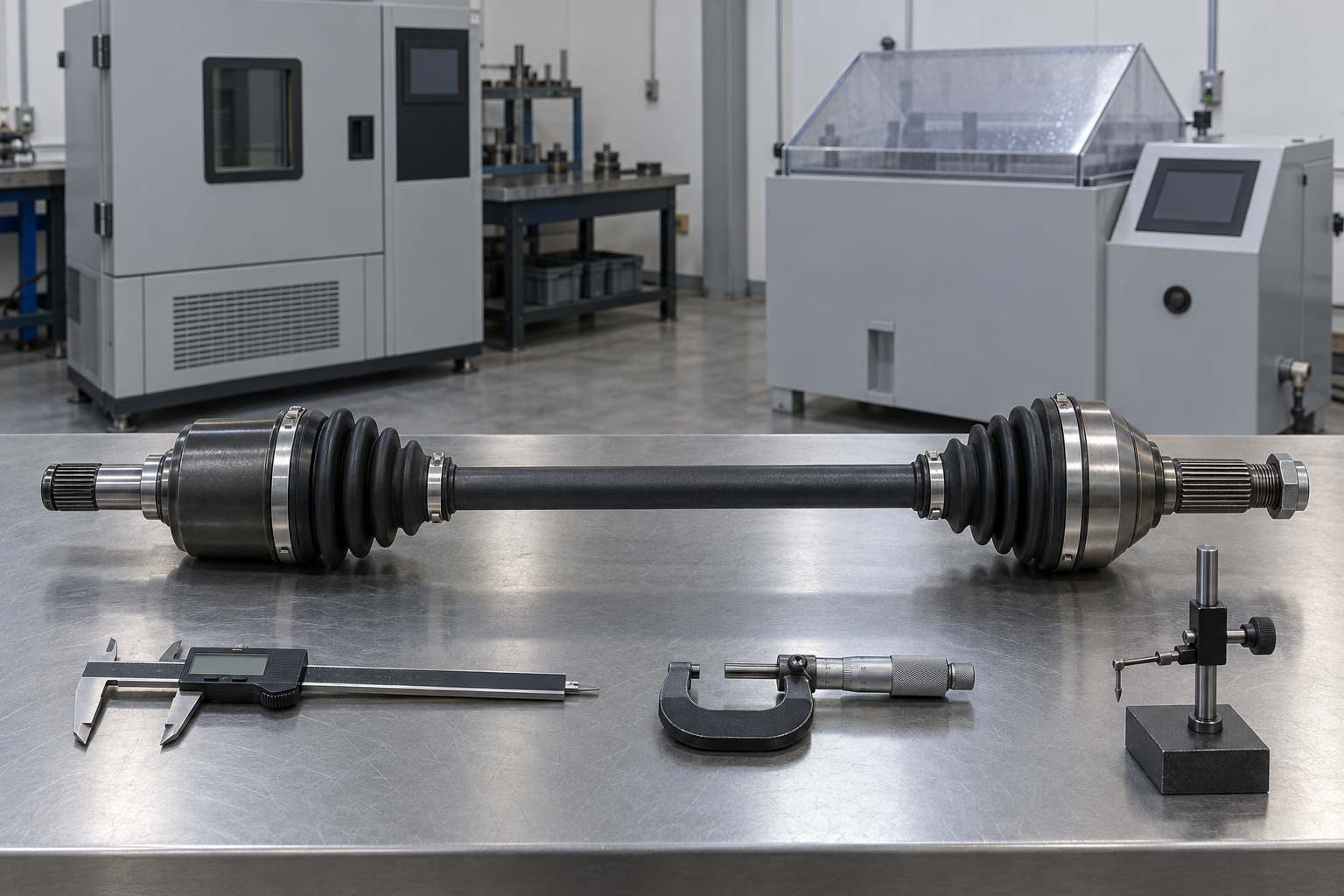
Malaysian procurement teams buying constant-velocity (CV) axles should treat sustainability sourcing criteria as scored evidence on the same request for quotation as fit, material, and tests. For a wheel hub axle buy, CV axle sourcing sustainability sourcing criteria means each bidder provides a supplier code of conduct, carbon-target or product-carbon status, a sustainability assessment, a steel-route statement, and raw-material due diligence before price or shipment is approved. This page addresses business buyers in Malaysia. It does not estimate search demand and it does not report a road test or plant trial.
Vincent Xi, Editorial Author, prepared this briefing. The byline profile is Vincent Xi. That profile is the approved attribution. It does not record a personal installation, a factory audit, or a customer outcome, and this article does not add one.
Published buyer programs are external benchmarks, not certifications of Driventus Auto Parts. GKN Automotive describes responsible sourcing that includes a circular-economy policy on carbon, recycled materials, waste, and local sourcing, and says suppliers provide sustainability roadmaps. Its stated targets by 2030 are 50 percent of spend with suppliers that have Science Based Targets initiative (SBTi) carbon targets, 95 percent of suppliers at an SAQ rating of C or better, and 90 percent of steel from electric arc furnaces (EAFs). The same page covers conflict minerals and a Supplier Code of Conduct (GKN Automotive responsible sourcing). Stellantis describes supplier ESG guidelines on human rights, business ethics, environment, and decarbonization; annual EcoVadis assessments of Tier 1 suppliers; CO2 requirements in award criteria for high-emission commodities; risk-based monitoring; on-site audits for high-risk suppliers; and OECD due diligence for raw materials (Stellantis supplier ESG). A CV axle selection note adds product items: certifications beyond ISO 9001 and IATF 16949, alloy-steel specifications, manufacturing tolerances, environmental testing for corrosion and temperature, OEM versus aftermarket scope, customization, and supply-chain transparency (CV axle supplier selection factors).
Sustainability sourcing criteria for CV axle awards in Malaysia
Put five gates on the RFQ. Each file should name the part number, the manufacturing site, and the document date. A group policy that does not name the shipping site is not enough to release an order.
Require a code of conduct covering labor and business ethics. GKN publishes a Supplier Code of Conduct in its responsible-sourcing program, and Stellantis includes human rights and business ethics in supplier ESG guidelines. Ask for the version that binds the factory on the purchase order. A code states an expectation. It does not, by itself, prove that a lot met it.
Require carbon evidence at the level you will score. GKN’s 2030 figure is a share of spend with suppliers that have SBTi targets, not grams of CO2 for one axle. Stellantis integrates specific CO2 requirements into award criteria for commodities it treats as high-emission. The sources used here do not classify CV axles in that commodity group. Ask whether the bidder has an SBTi or other carbon target, whether a product carbon footprint exists for the quoted axle, and which boundary and year that footprint uses. If none exists, record “not provided.” Do not turn a company pledge into a part-level number.
Require an assessment and its scale. GKN’s target is an SAQ rating of C or better. Stellantis describes annual EcoVadis assessments of its Tier 1 suppliers. Neither excerpt sets a universal minimum for every CV axle seller. Name the scheme, the year, and the legal entity. A parent score does not automatically cover a forge, machine shop, or joint plant that will ship.
Require a steel-route statement beside the mechanical spec. GKN’s target is 90 percent of steel from EAFs, within a policy that also refers to recycled materials and waste. That is GKN program scope, not a recycled-content percentage for every axle on the market. Ask whether the shaft and joints are EAF steel, basic-oxygen steel, or mixed, and whether any recycled share is a percent of mass with a year and a mill document. Keep alloy grade and tolerances on the same line. The CV axle selection source treats alloy steel and tolerances as quality requirements, separate from the sourcing narrative.
Require raw-material due diligence. GKN’s page covers conflict minerals. Stellantis refers to OECD due diligence for raw materials. Ask for a conflict-minerals declaration and a short note on how raw materials in the axle were checked, including the reporting year. Naming the OECD framework describes Stellantis’s stated approach. It does not mean the bidder, or Driventus Auto Parts, has been audited to that framework.
ISO 9001 and IATF 16949 are quality-management standards. The selection source lists them as a floor and tells buyers to look beyond them. A current certificate means a named site met that standard’s audit rules for the stated period. It is not an SAQ rating, an EcoVadis result, an EAF share, or a product carbon footprint. Do not treat a standard as held unless the bidder attaches a current document naming the site.
How to read the published percentages before comparing bids
Three GKN Automotive figures can be stored as benchmarks only if the scope stays attached.
The first is 50 percent of spend. The unit is percent of procurement spend. The scope is suppliers with SBTi carbon targets in GKN Automotive’s responsible-sourcing targets. The time context is the target year 2030 stated on that page. The excerpt gives no baseline year and no page-update date. Do not call 50 percent a current result, and do not assign it to a Malaysian buyer’s own contracts.
The second is 95 percent of suppliers. The unit is percent of suppliers. The scope is an SAQ rating of C or better. The time context is the same 2030 target year. Confirm which questionnaire edition and which rating letter the bidder is quoting. A self-assessment is not the same record as a third-party scorecard or a site audit.
The third is 90 percent of steel. The unit is percent of steel. The scope is steel from EAFs under GKN’s 2030 target, next to language on recycled materials, waste, and local sourcing. It does not prove that one quoted shaft is 90 percent EAF steel. Ask for the route that applies to the heat or lot you will receive.
Stellantis supplies a cycle rather than a percent in the excerpt used here: EcoVadis assessments of its Tier 1 suppliers are annual. The unit is one assessment cycle per year. The scope is Stellantis Tier 1 suppliers as described on its supplier ESG page. No minimum EcoVadis score appears in that excerpt. “Annual” is Stellantis’s stated cadence, not a finding that every plant in a Malaysian tender already has a current scorecard. A buyer may still require one.
Use this weighting only as an example calculation to verify against your own award sheet, not as a market measurement. Assign 40 points for documented carbon-target or product-carbon evidence, 30 points for an in-date SAQ or EcoVadis result on the shipping legal entity, and 30 points for a steel-route statement plus a conflict-minerals or raw-material file. Under that assumption only, a bid with carbon evidence and an assessment but no minerals file scores 70 out of 100 points. Replace the points with your approved scorecard. Do not use 70 as an industry average, a price factor, or an emissions factor.
GKN also says suppliers provide sustainability roadmaps. Score a roadmap only when it names the quoted site, an owner, a metric, and dates. A slide without those fields is weak approval evidence.
Trade-offs when sustainability evidence meets the axle specification
Sustainability gates change what you approve. They should not quietly change the mechanical specification.
Steel route versus strength and tolerance. An EAF route can support a lower-carbon sourcing story, which is why an EAF share appears in GKN’s targets. The axle still has to meet the alloy specification and tolerances on the drawing or reference sample. If a bidder offers an EAF or recycled route but cannot show grade, heat treatment, and tolerance records for the same part number, do not award on the route claim. If the route is stated only at company level, mark it unverified for the lot.
Company assessment versus part carbon. EcoVadis, as Stellantis describes it, is a company ESG assessment on an annual cycle for its Tier 1 suppliers. An SAQ rating, as used in GKN’s 95 percent target, is a questionnaire result. Neither file is automatically a product carbon footprint of one CV axle. Ask for the file you intend to score. If product-level carbon data is missing, the status is “not provided,” which you can score as zero on that line.
Circular claims versus a real offer. GKN’s policy language covers carbon, recycled materials, waste, and local sourcing. The sources do not say that CV axle producers as a class sell remanufactured axles or a fixed recycled-steel percentage. Ask whether a remanufactured unit is offered and which warranty, core, and test rules apply. If the answer is no, close the line. Do not print a circular-economy claim on the purchase order without a document.
Local supply versus ethics and carbon files. A nearer plant can matter for lead time and for the local-sourcing theme GKN names. It does not replace human-rights, conflict-minerals, or carbon evidence. Stellantis describes risk-based monitoring and on-site audits for higher-risk suppliers. Ask when the quoted site was last audited, by whom, and whether the scope was labor and environment or only product quality. If the date is missing, leave it blank.
Transparency versus a fast but thin quote. The CV axle selection source lists supply-chain transparency beside customization and OEM versus aftermarket focus. A quote that omits the code, the assessment year, or the steel route is incomplete. Compare price only across complete files, or score a missing pack as incomplete so it cannot win on price alone.
Quality-system evidence versus sustainability evidence. ISO 9001 and IATF 16949 help show that a plant runs a formal quality system. Corrosion and temperature testing belong in the quality file. SBTi status, SAQ or EcoVadis, EAF share, and minerals declarations belong in the sustainability file. Cross-reference both to one part number so a corrosion report is not mistaken for a carbon result.
Buyer decision table
Use the rows to specify, compare, verify, and approve. Benchmarks describe the cited programs. They are not Driventus Auto Parts results.
| Buyer task | What to put on the RFQ | How to compare bidders | Evidence that can support approval | Scope, unit, and source limit |
|---|---|---|---|---|
| Carbon status | SBTi or other target status, plus any product carbon footprint, boundary, and year | Keep company targets separate from part footprints | File naming the legal entity and year, or mark “not provided” | GKN: 50 percent of spend with SBTi suppliers by 2030; not grams CO2 per axle (GKN) |
| Assessment | SAQ, EcoVadis, or both; minimum result; legal entity | Prefer the shipping entity over a parent score; check the year | Scorecard or SAQ summary with rating, year, and entity | GKN: 95 percent of suppliers at SAQ C or better by 2030; Stellantis: annual EcoVadis for its Tier 1 suppliers, no cutoff in the excerpt (Stellantis) |
| Steel route | Alloy grade plus EAF, basic-oxygen, or mixed route, and any recycled mass share | Reject a route claim with no material document on that part | Certificate with process route and, if a percent is claimed, the percent and year | GKN: 90 percent of steel from EAFs by 2030, program scope, not a universal axle recipe (GKN) |
| Rights and minerals | Code of conduct plus conflict-minerals or raw-material due diligence for the bill of materials | Compare reporting year and whether subcontractors are in scope | Declaration and method note; unresolved high-risk gaps block award | GKN covers conflict minerals and a Supplier Code of Conduct; Stellantis cites OECD due diligence for raw materials |
| Durability tests | Corrosion and temperature tests you will accept; do not invent a limit | Compare method, date, sample basis, and the plant’s own pass limit | Report on the same part number you will order | Selection source lists corrosion and temperature testing, alloy steel, and tolerances (Accio) |
| Award math | Publish the point split before bids close | Apply one split to every complete file | Signed score sheet stored with the order | Example only: 40/30/30 points as assumed above; replace with approved weights |
Documents to align before a Malaysia order
Malaysia is the sales market for this decision. Hot, humid, and coastal service makes corrosion performance a practical acceptance topic. The sources do not publish a Malaysian climate standard, a national CV axle test limit, or an import-code list. Do not add those limits from this page. State the method, date, and result you will accept from the manufacturer’s own report.
On the order, tie every sustainability file to part number, revision, quantity, and manufacturing site. An EcoVadis report for another year, or an EAF statement for another commodity, does not cover this lot. If your policy classes the plant as higher risk, ask for the latest audit scope and date before shipment, consistent with the risk-based audits Stellantis describes for its own high-risk suppliers. If you do not class it that way, record the reason.
At acceptance, check three matches: the material document matches the RFQ grade; the test report matches the corrosion and temperature requirement you specified; and the code, assessment, and minerals files match the legal entity on the invoice. A mismatch is a reason to hold the lot.
State OEM versus aftermarket scope on the order. Evidence from one plant does not transfer to another plant unless the documents name the second site. A custom joint, boot, or spline needs the sustainability and test files updated to that part number.
RFQ Checklist
- Ask the supplier to attach a supplier code of conduct, with version date and the manufacturing site named on the quote, before prices are compared.
- Require the manufacturer to state SBTi or other carbon-target status and to declare whether a product carbon footprint exists for the quoted CV axle, including boundary and year.
- Specify the SAQ or EcoVadis rating scale and minimum result you will accept, the assessment year, and the legal entity that must appear on the scorecard.
- Ask the supplier to declare the steel route for the shaft and joints as EAF, basic-oxygen, or mixed, and to attach the mill certificate behind any claimed recycled-content percentage.
- Require the manufacturer to provide a conflict-minerals declaration or raw-material due-diligence note for the axle bill of materials, including the reporting year.
- Specify the alloy-steel grade, manufacturing tolerance limits, and corrosion and temperature test methods required before award.
- Require the supplier to provide current ISO 9001 or IATF 16949 certificates that name the specific shipping site, scoring them strictly as quality-management evidence.
- Ask the supplier to confirm whether a remanufactured CV axle option is offered in writing with warranty, core, and test rules.
- Require the supplier to map each sustainability and test document directly to the purchase-order part number, drawing revision, and manufacturing site before order release.
Method, sources, and limits
The factual claims above were taken from three public pages: GKN Automotive on responsible sourcing, Stellantis on supplier ESG performance, and a CV axle selection article listing certifications, alloy steel, tolerances, corrosion and temperature testing, and transparency. GKN’s 50 percent of spend, 95 percent of suppliers, and 90 percent of steel are 2030 targets in that company’s program. Stellantis’s EcoVadis practice is described as annual for its Tier 1 suppliers. No site visit or measured fleet result sits in the approved author basis, so none is claimed. The 40/30/30 split is an example calculation for a buyer scorecard, not a measured outcome.
The GKN excerpt does not give a publication date, a baseline year, or progress against the 2030 targets, so those percentages are not current performance. The Stellantis excerpt does not give an EcoVadis cutoff or class CV axles as a high-emission commodity. The selection article does not publish numeric tolerances, corrosion hours, or temperature set points, so this page does not either. SAQ is used as GKN’s term; confirm the questionnaire name and edition on the bid. Nothing here certifies Driventus Auto Parts or any bidder to ISO, IATF, SBTi, EcoVadis, SAQ, or OECD. A standard or buyer program states a requirement. A company’s practice is only what its current document shows for the named site and part.
Before award, verify document date, legal entity, part number, and whether steel, minerals, and carbon statements cover the lot to be received in Malaysia. Replace the example points with your approved weights. If a file is missing, leave the cell blank rather than estimating a score, a carbon factor, or a recycled percentage.
Discuss Your Requirements
Review our manufacturing capabilities, then share your specifications for a supplier-fit review.