CV Axle OEM Communication Workflow Review for European Buyers
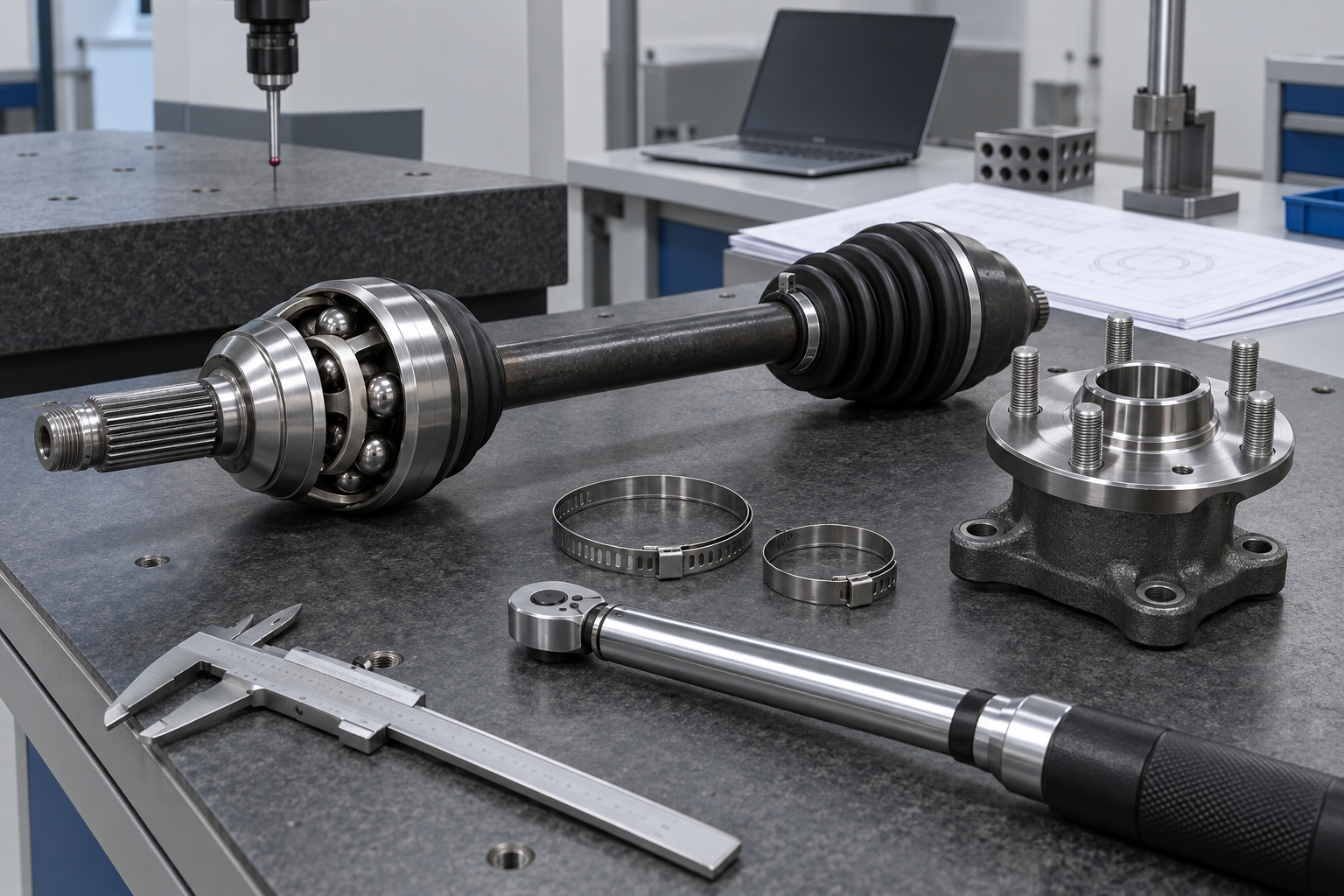
European buyers conducting a cv axle oem communication workflow review should treat technical exchange as a manufacturing release control for a wheel hub axle, not as a catalogue ordering routine. Approve an axle supplier only when the bilateral record confirms which engineering specification governs, which original-equipment design attributes are matched, which delivery schedules are firm, and which invoice can be cleared for payment. This review examines that procurement workflow using three published B2B technical sources. It does not introduce internal shop-floor measurements, unverified compliance certificates, proprietary customer case histories, or keyword traffic figures.
Vincent Xi, Editorial Author, prepared this editorial synthesis for Driventus Auto Parts. The author role and profile are public at https://driventus.com/authors/vincent-xi/. This byline represents an editorial research attribution; it is not a claim of personal factory audits, hands-on shop-floor testing, or proprietary engineering trials.
A manufacturing plant in the European Union, a facility in the European Economic Area outside the EU, and an assembly plant in the United Kingdom do not share an identical communication format. No statement below constitutes an EU directive, an EEA regulation, or a UK statutory requirement. National commercial laws, plant-level quality guidelines, and country-specific customer manuals remain the buyer's responsibility to verify.
Communication Workflow Review for European Manufacturing Releases
The primary procurement task is to establish an auditable path from request for quotation (RFQ) through to accepted receipt. Three source contexts define the checkpoints in this workflow.
SYZ Machine describes end-to-end engineering support for custom CV axles as a 3-step OEM workflow on its published ATV and UTV axle page. Step one comprises transmitting technical specifications, OEM part numbers, or physical sample axles. Step two consists of receiving an engineering solution accompanied by a factory quote within 24 hours. Step three spans support from prototype testing through mass manufacturing, dispatch, and after-sales service. The quantity 3 represents the count of formal workflow steps published by that supplier. The quantity 24 hours is the quotation turnaround time published on that same custom CV axle page; it is scoped strictly to SYZ Machine's published workflow and does not represent an industry-wide European manufacturing norm. The source excerpt carries no explicit document revision date, meaning the turnaround figure reflects the live site as accessed. Source: SYZ Machine ATV UTV axle page.
Aftermarket News reports that replacement CV axles must match original OE design attributes for durability and mechanical performance while mitigating noise, vibration, and harshness (NVH). The article highlights AAR socket designs for expanded joint articulation, 8-ball versus 6-ball internal socket configurations for mechanical strength, flat splines to eliminate backlash, hollow tubular shafts to dampen torque steer, and OE-quality thermoplastic elastomer (TPE) boots fastened with stainless steel band clamps. The figures 8-ball and 6-ball represent exact counts of bearing balls per internal socket configuration discussed in that analysis. They do not constitute load ratings in newton-metres, UNECE type-approval metrics, or Driventus test results. The excerpt does not state an original publication date. Source: OE CV Axle Trends.
Cogential IT's American Axle EDI automation guide documents electronic exchange across five standard transaction types: 830 planning schedules, 862 shipping schedules, 850 purchase orders, 856 advance ship notices, and 810 commercial invoices. These five transaction codes represent structural EDI document-type identifiers spanning forecast planning through commercial settlement, including just-in-time sequencing and compliance validation as described in that software guide. They do not indicate message transmission volumes, nor do they establish a mandatory EDI layout across EU, EEA, or UK automotive operations. Citing American Axle identifies the guide's subject; it does not invite commercial inquiries outside this review's European buyer focus. Source: American Axle EDI Automation Guide.
To plan communication workload, buyers can run an explicit example calculation to verify against supplier quotation assumptions: assume 1 shipping-schedule release per week across 52 weeks for a single European receiving facility. The resulting exchange volume is exactly 52 release transmissions per calendar year. Neither 1 release per week nor 52 weeks represents an observed empirical volume from the cited references.
Wheel Hub Axle Manufacturing Inputs the Buyer Must Send
Technical alignment begins with the initial data package outlined in step one of the SYZ workflow: technical drawings, OEM part numbers, or physical sample components. In a wheel hub axle project, these three inputs can easily diverge if not managed under formal engineering change control:
- A released engineering drawing governs critical dimensional tolerances, heat treatment, runout limits, and material chemistry.
- An OEM part number verifies commercial identity only when cross-referenced to an active internal revision level, rather than a generic aftermarket interchange table.
- A physical sample conveys only the specific geometry and wear state of the measured part, without communicating underlying design limits or process tolerances.
While the cited workflow accepts any of these three inputs to initiate a quotation, physical samples must never substitute for a controlled 2D/3D engineering drawing during production release.
Step two of the workflow—returning an engineering proposal and factory quotation within 24 hours—provides a published turnaround metric for custom off-highway driveline components. A European procurement team may adopt this 24-hour turnaround, extend it for multi-stage drawing translations, or establish a longer window when Production Part Approval Process (PPAP) documentation is required. Agreeing to a 24-hour timeline in commercial negotiations does not establish an EU, EEA, or UK legal standard, nor does it represent an offer from Driventus.
Step three encompasses technical support spanning prototype validation, serial production, logistics, and post-delivery claims. The underlying source does not publish explicit prototype build quantities, endurance testing durations in operating hours, defect targets in parts per million (PPM), or logistics lead times in calendar days. When these parameters impact assembly operations, buyers must write them into the RFQ. Source silence must be addressed through explicit contract terms.
Organize all technical release requests into four distinct communication dossiers:
- Component identification: drawing part number, active engineering revision, and an explicit hierarchy clause stating whether the 2D print or physical sample controls inspection.
- Design attribute conformity: the measurable OE design features verified during incoming quality control.
- Milestone schedule: quotation turnaround, prototype review gates, and production lead times, each tied to a defined time unit and calendar baseline.
- Commercial documentation: rolling demand forecasts, firm shipping schedules, purchase orders, dispatch notifications, and invoicing rules.
OE Attributes That Belong in the Communication Record
A purchase order stating generic "OE quality" provides zero technical protection against driveline vibration, premature boot degradation, or joint failure. The technical attributes highlighted by Aftermarket News should be translated directly into inspectable purchase order line items:
- Joint articulation: The source cites AAR socket architecture to support higher angular articulation. Specify the required socket geometry and mandate that the maximum working angle be recorded in degrees on the approved supplier manufacturing drawing. This review provides no degree value because none is stated in the reference text.
- Internal ball count: The source contrasts 8-ball socket architectures with traditional 6-ball configurations to enhance joint strength. Specify the exact ball count as an integer (balls per socket) on the component print. Specifying an 8-ball design does not replace load-to-failure testing; no test load in newton-metres is published in the cited excerpt.
- Spline engagement: Flat splines are cited as a design approach to eliminate joint backlash. Specify the exact spline profile and mandate a ring-gauge or micrometre measurement protocol. "Eliminate" reflects the source's qualitative claim rather than a measured tolerance verified for this article.
- Shaft structure: Hollow tubular center shafts reduce overall driveline mass and mitigate torque steer. State explicitly whether a solid forged bar or hollow welded tube is required; this selection fundamentally changes torsional stiffness and assembly mass. No specific mass differential in grams is provided in the source.
- Boot material and clamping: Thermoplastic elastomer (TPE) boots and stainless steel band clamps are cited for environmental resistance. State the exact polymer formulation (such as TPE-ether or polyester) and clamp metallurgy on the approved bill of materials. The phrase "OE quality" lacks regulatory standing and cannot replace a verified material specification.
Selecting these attributes impacts production tooling and metrology routines. As a result, two supplier bids claiming "OE match" can describe incompatible joint architectures. Furthermore, no international standard (such as ISO or UNECE), national standard, or OEM specification cited in the source text is held as a certification by Driventus or the referenced third parties. EDI transaction numbers represent document formats, not product homologations. Plant quality manuals apply only when issued by specific vehicle manufacturers to designated facilities.
Buyer Decision Table
Use the following matrix to specify, compare, verify, and approve driveline procurement artifacts. The source context identifies the reference page mentioning each item; it does not indicate that the artifact is legally required across all EU member states, EEA countries, or the UK.
| Communication artifact | Buyer action | Verify before approval | Source context | Consequence if missing |
|---|---|---|---|---|
| Engineering drawing, OEM part number, or physical sample | Specify primary design authority | Precedence clause between sample and drawing; active revision date | SYZ 3-step custom CV axle workflow | Supplier builds to an unverified sample dimension that contradicts print tolerances |
| Technical proposal with quotation | Compare internal joint architectures | Socket style, ball count, hollow vs. solid shaft, boot material, clamp alloy | SYZ step two, evaluated alongside Aftermarket News attributes | Commercial pricing approved without baseline design documentation |
| Quotation response clock | Approve response window in hours | Acceptance or adjustment of 24-hour turnaround; applicable time zone | SYZ states a factory quote within 24 hours on custom CV axle requests | Inability to distinguish delayed quotes from incomplete submissions |
| Prototype-to-production gate | Order staged validation | Signed deliverable sign-offs and calendar-day duration before series production | SYZ step three covers prototype testing through serial manufacturing | Series manufacturing begins on verbal prototype acceptance |
| OE attribute match for NVH control | Verify inspectable line items | Working joint angle, socket ball count, spline profile, center shaft style, boot and clamp specs | Aftermarket News on matching OE drivetrain design attributes | NVH mitigation cannot be validated during incoming parts inspection |
| Socket ball count designation | Compare joint load configuration | Explicit count of balls per socket indicated on production drawing | Aftermarket News contrast of 8-ball versus 6-ball sockets | Joints of differing internal architecture treated as interchangeable |
| 830 planning schedule | Separate capacity planning from firm build | Confirmation that European ship-to accepts EDI 830 or uses alternative EDIFACT formats | Cogential IT American Axle EDI guide | Upstream production planned on unsaved email estimates |
| 862 shipping schedule | Approve firm delivery windows | Net quantity, delivery horizon, and explicit superseding rule for new releases | Cogential IT American Axle EDI guide | Manufacturing plant produces against outdated delivery releases |
| 850 purchase order | Approve commercial terms | Contractual unit price, incoterms, and governing engineering revision | Cogential IT American Axle EDI guide | Parts ship against delivery schedules lacking commercial authorization |
| 856 advance ship notice (ASN) | Verify logistics dispatch | Carton-level quantities, carrier tracking, dispatch date, and line-item match | Cogential IT American Axle EDI guide | Receiving docks cannot match inbound freight to open schedules |
| 810 commercial invoice | Approve payment matching | Three-way match among purchase order, ASN, and receiving report | Cogential IT American Axle EDI guide | Invoices cleared for payment prior to physical receiving and inspection |
| Post-delivery warranty channel | Assign technical claim routing | Required inspection data and return procedure for failed field units | SYZ step three covers shipping and after-sales support | Field quality issues bypass engineering root-cause analysis |
Remove a table row only after documenting why that specific data exchange is unnecessary for the receiving plant.
EDI Documents in the Manufacturing Communication Path
The Cogential IT guide outlines standard EDI transactions utilized by American Axle suppliers from forecasting to settlement. European buyers should evaluate these transaction codes as functional process controls rather than statutory mandates.
An 830 planning schedule communicates medium-term demand forecasts. It enables raw material planning but does not authorize assembly or dispatch unless an explicit trading-partner agreement defines a firm forecast horizon. An 862 shipping schedule communicates near-term, firm delivery authorizations. It must detail the receiving dock, ship-to facility code, and rules for superseding previous releases. An 850 purchase order establishes commercial commitment, identifying unit price, payment terms, and controlling blueprint revisions. An 856 advance ship notice communicates dispatch details from the dock, enabling dock scheduling and advanced inventory tracking. An 810 invoice requests payment; conducting a three-way match between the 810 invoice, 856 ship notice, and 850 purchase order prevents premature cash release.
The count of five EDI transaction sets reflects one published automation guide. This count does not imply that European manufacturing plants must maintain all five electronic maps. European procurement teams should ask whether their receiving plant in the EU, EEA, or UK operates on ANSI ASC X12 standards (e.g., 830, 862) or European EDIFACT message standards (e.g., DELFOR, DELJIT, DESADV, INVOIC). The guide does not contrast these communication standards, and assuming X12 standards apply universally across Europe exceeds the published evidence. The term "compliance validation" in the source indicates message structure verification against customer-specific transaction maps; it does not indicate vehicular safety compliance.
When projecting annual EDI interface activity, buyers can use a simple example calculation to verify against supplier quotation assumptions: exchanging 5 document types once weekly over 52 weeks yields 260 transaction events per ship-to per year, excluding revision updates. The variables 5 document types and 52 calendar weeks represent illustrative modeling inputs rather than empirical traffic statistics or search metrics.
Communication trade-offs must remain transparent. A 24-hour quotation turnaround expedites simple projects but increases procurement risk if engineering drawings require translation or PPAP level approvals. Relying on physical samples can shorten initial RFQ discussions but risks duplicating worn features or unapproved design revisions; an explicit 2D engineering drawing must remain the final release authority. OEM part numbers establish basic identity, whereas ball count, spline profile, center shaft structure, boot polymer, and clamp metallurgy define actual NVH and endurance performance. Rolling forecasts and firm shipping releases control warehouse stock differently; because the source citations publish no safety stock equations, buyers must calculate buffer stock based on their own logistics lead times. Finally, manual portal entries carry lower startup costs than automated EDI connections but introduce human data-entry errors. Setup fees in euros or deployment durations in weeks must be quoted directly by EDI providers, as no pricing data appears in the cited sources.
RFQ Checklist
- Ask the supplier to name the governing input—technical specification and revision, OEM part number, or sample axle—and to list conflicts before pricing.
- Require the manufacturer to return an engineering solution stating socket construction, balls per socket where a ball joint is used, spline form, hollow or solid shaft, boot compound family, and clamp material.
- Specify whether this drawing controls an 8-ball socket, a 6-ball socket, or neither, using balls per socket as the unit.
- Specify the quote-response allowance in hours, the time zone, and whether the published 24-hour example is accepted or replaced for this European request.
- Ask the supplier to define prototype support as named deliverables, a signing role, and the calendar-day gate before mass manufacturing.
- Require the manufacturer to state which planning, shipping, purchase-order, ship-notice, and invoice documents it will exchange, and whether codes 830, 862, 850, 856, and 810 apply or are only a reference list.
- Verify that a planning schedule cannot authorize shipment unless the agreement says so, and that a later shipping schedule states if it replaces the previous release.
- Compare unit of measure, ship-to identity, and engineering revision across the purchase order, the ship notice, and the invoice before approving the map.
- Approve a three-way match so payment follows the accepted ship notice and the commercial order.
- Ask the supplier to confirm country of manufacture and the governing language of the specification as data fields, without treating that reply as a certificate or as one rule for the EU, the EEA, and the UK.
- Require the manufacturer to state how an incoming or field complaint re-enters the record, including the revision and the attribute to be rechecked.
- Specify the delivery acceptance evidence, such as a dimensional layout to the governing revision, and do not accept a verbal OE-match claim in place of the attribute list.
Methodology, Limits, and Verification
Methodology. Factual claims were extracted from the three publicly available B2B reference pages linked above and structured into a chronological manufacturing procurement workflow: buyer specification input, supplier engineering response, attribute verification, electronic transaction control, and quality acceptance. The 3-step sequence count and the 24-hour quotation turnaround time are reported strictly as stated by SYZ Machine for its published custom CV axle process. The 8-ball and 6-ball metrics represent socket ball counts reported by Aftermarket News. Transaction codes 830, 862, 850, 856, and 810 represent standardized EDI message identifiers described in the Cogential IT guide. Transaction totals of 52 releases and 260 EDI message events represent explicitly labeled illustrative calculations. No keyword search volumes, cost-per-click values, difficulty scores, organic ranks, or traffic estimates are cited or calculated, as none exist in the underlying technical references. No commercial claims, client rosters, factory accreditations, or proprietary testing capabilities were added for Driventus Auto Parts.
Source contexts. The first reference is SYZ Machine's ATV/UTV CV axle webpage, which illustrates the engineering transition from specification review to quotation, prototype validation, serial production, and customer support. The second reference is Aftermarket News' technical review of OE CV axle design trends, documenting the specific mechanical attributes necessary to match original NVH, articulation, and durability characteristics. The third reference is Cogential IT's EDI guide for American Axle, illustrating transaction architectures linking demand forecasting with invoicing. The first and third sources delineate commercial quoting from release execution, while the second provides the technical parameters needed to prevent unsubstantiated "OE match" claims.
Limitations. None of the cited web pages display verified revision dates; procurement teams must verify current terms directly against active supplier contracts and trading-partner specifications. The 3-step workflow is published in the context of custom ATV and UTV axles and serves as a process reference rather than proof of heavy commercial or passenger-car OEM homologation. The driveline attributes describe replacement aftermarket components and do not replace formal vehicle type-approval documentation under UNECE or EU frameworks. The EDI transaction numbers document a single North American Tier 1 automotive integration guide; they do not represent statutory standards for EU, EEA, or UK plants, nor do they confer product certifications. Where cited references remain silent on specific metrics, the RFQ checklist instructs the buyer to define those parameters directly in the purchase agreement.
Prior to contract release, verify four operational documents: the controlling engineering blueprint revision, the measurable attribute list used for incoming metrology, the specific EDI or electronic messaging format used by the European receiving facility, and the automated three-way reconciliation matching purchase orders, advance ship notices, and invoices.
Discuss Your Requirements
Review our manufacturing capabilities, then share your specifications for a supplier-fit review.