Coil Spring Sourcing Digital Integration Readiness for Malaysia Buyers
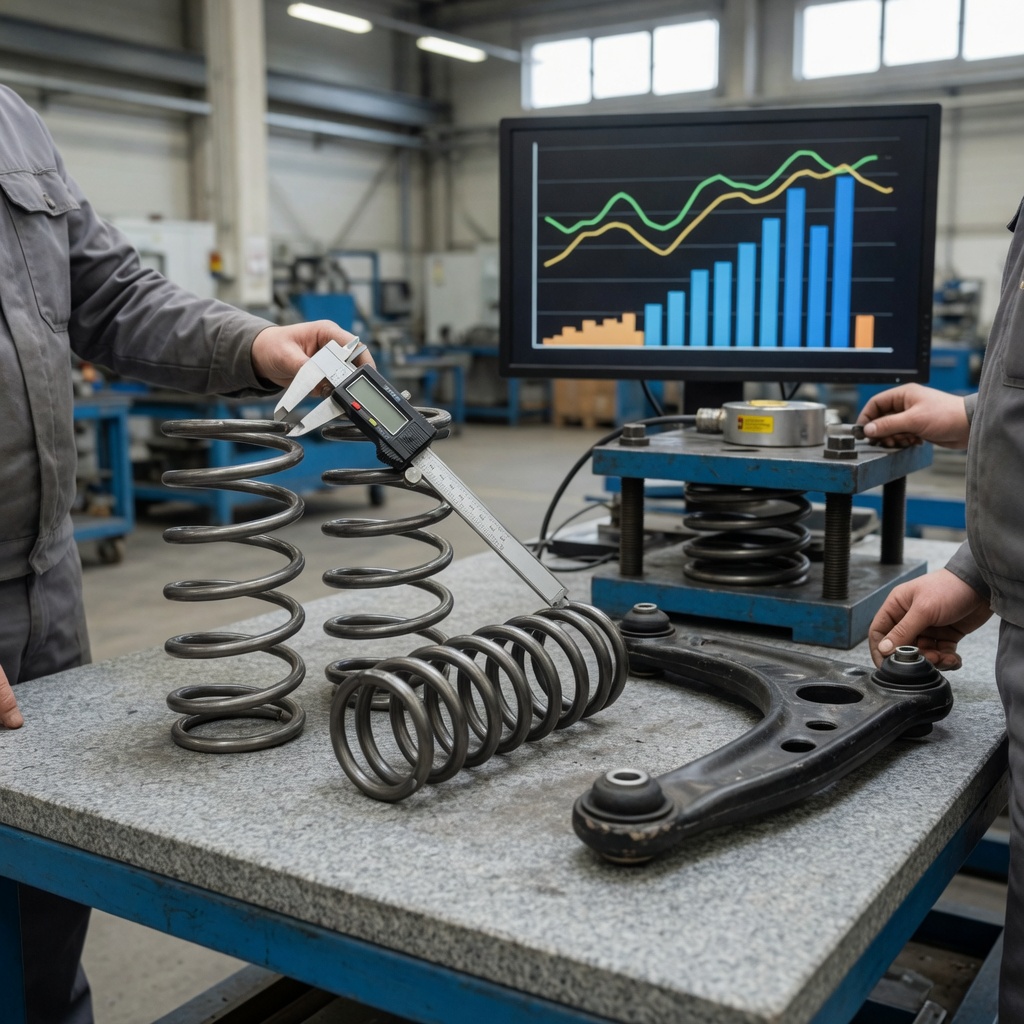
Coil Spring Sourcing Digital Integration Readiness for Malaysian Suspension Control Arm Buyers
Vincent Xi Editorial Author https://driventus.com/authors/vincent-xi/
For Malaysia-based procurement teams buying coil springs that ship into a suspension control arm program, coil spring sourcing digital integration readiness is an award gate, not a brochure line. Award only if the maker can prove three items before purchase order: inventory and lot data through a documented API or structured file the buyer's ERP can post without re-keying; inspectable digital test records and inspection logs from spring wire to the finished coil; and coil geometry plus material identity bound to each lot or serial so receiving, warranty, and PPAP stay aligned with the control-arm build. If any of those three is paper-only, email-only, or salesperson-mediated, hold the award. Run a digitally documented trial lot, or keep a dual source, until the feed, logs, and identity bind are proven on the part family.
Paper-only QC can look cheaper per piece. It moves cost into incoming inspection, mixed-heat risk, and slower document cycles. The TechBullion article on carbon steel and Industry 4.0 spring technology lists digital documentation, inventory APIs that can integrate with ERP, and environmental product declarations as part of that technology package (TechBullion on carbon steel and Industry 4.0 spring technology). A China coil spring factory sourcing page dated as a 2026 guide states that factories lacking digital QC logs fail 3× more than factories that keep those logs (unitless ratio published by that page; the excerpt does not define the failure event, sample size, baseline period, or study date) (China coil spring factory sourcing guide). Treat the 3× figure as that guide's published risk signal to test in the RFQ, not as a laboratory result and not as a measurement of any quoting plant. Digital capability also has a cost: API mapping, data-protection review, serialized marking, and a trial lot. Put those lines on the quote so the comparison is total landed process cost for the suspension control arm program, not unit price alone.
Award, hold, or reject: coil spring sourcing digital integration readiness
Use this rule on the Malaysia ship-to program before tooling kickoff.
- Award if you have a redacted production payload, a live screen share of wire-to-coil genealogy on an analog part, named buyer logins for Malaysia purchasing and SQE, geometry stored as fields (not only a PDF), and a contract number of years for digital-log retention after shipment to the Malaysia ship-to.
- Hold if the plant has a dashboard or mill certificates but cannot export lot, heat, quantity, and geometry into a file your ERP can post, or if Malaysia users cannot retrieve records without a salesperson.
- Do not award if identity is paper-only, inspection evidence is unscanned PDFs with no time stamp or write protection, geometry exists only on a drawing, or substitution controls cannot be opened by the buyer.
Those three outcomes are buyer actions. They are not a ranking of factories and not a claim about any one supplier's current certificate.
What digital integration must prove for suspension control arm procurement
A suspension control arm and a coil spring are different parts, but they ship into the same chassis file. If the arm lot is serialized in ERP and the spring lot exists only as a scanned mill certificate, a field claim or a receiving discrepancy cannot be closed to one heat of wire. For this procurement class, readiness means five connected capabilities:
- Identity — heat, coil, and finished-spring lot (or serial) bound in a digital record.
- Geometry as data — wire diameter, mean coil diameter, free height, total coils, end type, and load-at-height or rate stored as fields, not only as a drawing PDF.
- Process evidence — digital test records and inspection logs from wire receipt through coiling, any stress relief or heat treatment, load testing, and coating.
- Inventory feed — on-hand, in-transit, and allocated quantity available through an API or scheduled file your ERP can post.
- Buyer access — Malaysia purchasing and SQE users can retrieve those records during the contract without a salesperson as the search engine.
An ERP vendor page for the precision spring industry describes a stack that integrates wire procurement to inspection, with digital test records, inspection logs, supplier sourcing management, and full material traceability, plus API and IoT support for real-time coil spring production tracking. The same page references an ERP Readiness Checklist for Digital Integration in 2025 (document year as stated on that vendor page; not a measured plant-maturity score) (ERP for the precision spring industry). That is vendor documentation of what some plants implement. It is not proof that a factory quoting your control-arm spring currently runs that stack. The RFQ must map each capability to a live screen share, a sample payload, and a retention period.
The TechBullion article describes SGD Springs as using QR-coded digital twins with cloud data on coil geometry, residual stress, and fatigue life. Use that description as a pattern (unique ID plus retrievable geometry and process fields). Do not treat the brand name as a substitute for evidence on the plant you are actually quoting.
Inventory APIs, coil geometry data, and ERP mapping
Specify the payload, not the word “API.” Minimum fields to list for springs that support a suspension control arm buy:
- Customer part number (your program number) and supplier revision
- Supplier lot, heat number, and unique ID if serialized
- Quantity on hand, quantity allocated, promised ship date
- Geometry: wire diameter (mm), mean coil diameter (mm), free height (mm), solid height if specified (mm), active coils, total coils, spring rate (N/mm) or load at specified height (N)
- Last inspection result by characteristic ID
- Material grade and coating codes
- Packing-list / ASN lot ID that matches the physical mark and the digital record
The TechBullion article frames inventory APIs integrable with ERP as a smart-sourcing requirement alongside digital documentation and EPDs. Ask whether the interface is REST, EDI, or a nightly CSV/XML drop; who hosts it; whether a sandbox endpoint exists; the authentication method; the rate limit in requests per stated time window; the fallback if the feed is down; and whether geometry is included or only logistics quantities. A dashboard with no export is non-compliant if ERP posting is required.
Example calculation (assumption to verify in the supplier quote and your IT estimate, not a measured baseline): if incoming inspection currently keys 12 geometry and test fields per SKU, and the Malaysia program receives 40 spring lots per month, that is 480 keyed field-groups per month. If each field-group is timed at 3 minutes, that is 24 labor-hours per month of re-keying. Agree the unit of work with quality before using the number in a scorecard. Digital posting should move the process toward exception-only review. An EPD PDF, if an OEM or internal ESG file requires it, is a separate deliverable. It does not prove ERP integration.
Wire-to-coil traceability, digital test records, and inspection logs
Precision-spring ERP literature describes digital test records and inspection logs from wire procurement to finished inspection, with supplier sourcing management and full material traceability. For automotive coil springs that mate to a suspension control arm, the chain must answer:
- Which wire heat and mill certificate sit under this finished lot?
- Which coiling equipment and which load-test stand produced the recorded rate or load-at-height?
- Who signed the digital inspection log, and is the record time-stamped and write-protected?
- How many years are records retained after shipment to the Malaysia ship-to? State the number of years in the contract.
Distinguish a standard’s requirement from a plant’s practice. When IATF 16949 or an OEM PPAP file applies to your customer, traceability and retained inspection evidence are typically customer-file requirements. A digital log is one way to meet that file. A current quality-system certificate is a different artifact. Do not accept a dashboard screenshot as a substitute for an in-date certificate if the OEM file needs the certificate. Do not accept a certificate without retrievable lot-level logs if you need containment.
The 2026 factory guide cites blockchain-style traceability (it names VeChain) as a control against substitution. Substitution risk is real in commodity wire and look-alike springs. A token helps only if the Malaysia SQE can open the record, match the physical mark, and see the mill certificate. If there is no buyer login, score the claim as unmet.
QC dashboards, inspection-vision claims, and blockchain claims: what to verify
The same 2026 guide says China coil spring factories use digital sourcing platforms with real-time QC dashboards and automated inspection, and that procurement should prefer plants that invest in digital QC systems. Marketing language is not a test method.
On a live call, verify:
- Latency. Is “real-time” seconds, minutes, or end-of-shift batch? Write the unit of time into the RFQ.
- Vision inspection, if claimed. Which characteristics are in scope (end grind, nicks, coating voids, coil count)? What challenge-sample frequency is used? Are overrides logged?
- Buyer access. Read-only portal for named Malaysia users, including after shipment, with CSV/PDF export for the local quality file.
- Screen share. A 15-minute live walk-through of your part family or a close analog (15 minutes is an RFQ example interval to specify, not a sourced industry average).
Trade-off: higher visual coverage can catch defects sampling misses; it can also create false rejects that starve a just-in-time control-arm line. Require the false-reject handling rule and the buffer-stock rule in writing.
Malaysia buyer scorecard for digital integration versus paper supply
Use this scorecard when coil springs support suspension control arm procurement. Every row is a specify, compare, verify, approve, or order action. Score Ready only when minimum evidence is current and buyer-accessible. Score Partial when a portal exists but ERP export, geometry fields, or Malaysia logins are missing. Score Not ready when the row is paper-only or unverifiable.
| Capability | Why it matters on a Malaysia suspension control arm program | Minimum evidence to request | Typical failure if missing | Buyer action before PO |
|---|---|---|---|---|
| Inventory / lot API or structured feed | ERP receipts and ASN without re-keying | Sample JSON/XML/CSV, field dictionary, host, auth method, update frequency, down-feed fallback | Wrong-lot receipts; 24 labor-hours/month class re-keying (example calculation above—verify) | IT + SQE joint review of one live payload |
| Coil geometry as data | Physical spring must seat and load with the control arm as drawn | File or digital twin with wire Ø (mm), mean Ø (mm), free height (mm), coil count, rate/load | Fit, noise, or load issues found only at assembly | Golden sample + data file versus drawing |
| Wire-to-finished traceability | Containment of heat or process escapes | Heat-to-lot genealogy, mill cert, retention in years | Broad recall; delayed OEM or import documents | Trace one mock lot end-to-end on screen share |
| Digital test records and inspection logs | PPAP and incoming quality without paper lag | Time-stamped load-test and dimensional logs, electronic sign-off | Risk signal: plants without digital QC logs fail 3× more (2026 guide; failure event undefined) | Review last 30 days of logs on an analog part (30 days is an RFQ example window to specify) |
| Buyer-accessible QC dashboard | SQE in Malaysia can check status across time zones | Named login, export, history depth in days | Email-only status; hidden in-process scrap | Trial login before tooling kickoff (example: 14 days—specify in quote) |
| Unique ID (QR or equivalent) | Ties the physical coil to geometry / residual-stress / fatigue fields where offered | Mark location, contrast after coating, scan after pack | Unreadable mark = broken twin | Handling check on marked, coated samples |
| Substitution controls | Stops mixed-heat or look-alike springs in a control-arm kit | Process plus any portal the buyer can actually open | Mixed material in one shipment | Heat lock on approved purchase orders |
| EPD / digital document pack | Only if the OEM or internal ESG file is in scope | Current EPD or written not-applicable | Last-minute document scramble | List as a drawing-pack deliverable |
RFQ checklist for coil spring sourcing digital integration readiness
Issue this list with the spring drawing, the spring specification you actually use, annual volume, ship-to in Malaysia, Incoterms, and the suspension control arm program identifier. Each item is something the buyer specifies, compares, verifies, approves, or orders.
Specify
- Part identity. Customer part number for the coil spring and the related suspension control arm program code; supplier revision method.
- Data dictionary. Geometry, material grade, heat, lot, quantity, inspection characteristics, ASN/packing-list lot ID, and units (mm, N/mm, N at a stated height).
- Interface type. REST API, EDI, SFTP file, or portal export. State that a dashboard with no export is non-compliant if ERP posting is required. Name the host and whether a sandbox exists.
- Update frequency. On transaction, every N minutes, or daily; N must have a unit of time. Relabel any “real-time” claim with that unit. State the manual fallback if the feed is down.
- Traceability depth. Wire mill → heat → inbound inspect → coiling → stress relief or heat treatment if used → load test → coating → finished lot/serial.
- Marking. QR or Data Matrix location, size, contrast after coating, scan grade after packing.
- Malaysia user access. Number of named SQE and purchasing logins; language of the UI as a stated requirement.
- Security. Encryption in transit, access control, and data-processing terms that match company policy.
Compare
- Sample payload. One redacted production payload delivered with the quote, not after award.
- Commercial lines. NRE for API mapping; unit price with and without serialization; lead time to first integrated lot; Incoterms to the Malaysia port or 3PL; currency of the quote.
- Certificate versus practice. Copy of any quality-system certificate and a map from that system to the digital logs. Do not treat one as the other.
- Completeness metric. Supplier’s digital-log completeness for the last 12 months as a percentage of lots with complete files (12 months is the RFQ window to ask; if they cannot state a percentage, score as unknown).
Verify
- Inspection logs. Dimensional and load-test records, sampling plan, and 100% versus sample by characteristic (100% means every piece of that characteristic, as you specify in the RFQ, not a sourced industry rate).
- Vision inspection, if claimed. Characteristics covered, challenge-sample frequency, image retention, false-reject process, buffer-stock rule.
- Blockchain or equivalent, if claimed. Buyer login, substitution event it prevents, fallback if the network is down.
- Screen share. Live walk-through on your family or a close analog; specify the interval in minutes in the RFQ (15 minutes is an example interval to specify, not a sourced average).
Approve
- Retention. Numeric years of digital log retention after shipment to the Malaysia ship-to.
- PPAP pack. Which digital records attach to production part approval; who signs electronically.
- Change control. How a geometry or process change is pushed into the feed before parts ship.
Order
- Trial lot. Quantity and date for a digitally documented pilot that incoming inspection will reconcile line by line against the payload, mill certificate, mark, and geometry file.
- UAT acceptance. Written pass/fail rules for the trial (payload posts without re-keying; heat-to-lot opens; Malaysia users export CSV/PDF).
- Exit. How historical lots are exported if the spring is later resourced.
How this article was derived and what buyers must still verify
Source contexts. This page uses three public industry pages: a TechBullion feature on carbon-steel springs and Industry 4.0 (QR-coded digital twins, cloud fields for coil geometry, residual stress and fatigue life, ERP-integrable inventory APIs, and EPDs); an ERP product page for the precision spring industry (wire-to-inspection digital test records, inspection logs, material traceability, API and IoT tracking, and Digital Integration checklist language dated 2025); and a 2026 China coil spring factory sourcing guide (real-time QC dashboards, automated inspection, a 3× failure claim for plants without digital QC logs, and blockchain-style substitution controls).
Methodology. Statements above are extracted from those pages as described capabilities and published assertions, then converted into buyer verification steps for coil spring lots that support suspension control arm procurement. No plant audit, no laboratory test, and no ranking study was performed for this article. Named systems (SGD Springs digital twins as described in TechBullion, the eresource precision-spring ERP stack, VeChain as named in the factory guide) are attributed to those sources only.
Limitations / what to verify. The source pages include vendor and directory language. They are not Malaysian government standards and they do not measure any quoting factory. They are not keyword-demand evidence. Tropical durability hours, SIRIM, JPJ, or ASEAN automotive rules are not specified in the source set, so this page does not invent local test durations or certificate numbers; add those from the OEM file and import counsel. API schemas change. Certificates expire. Dashboard access is often withheld until it is too late. Verify every table row and checklist item against a current quote, a live payload, and a current quality certificate. Labor-hour, lot-count, 14-day login, 15-minute screen share, and 30-day log-window figures in this article are labeled examples or RFQ intervals to specify, not measured baselines.
Vincent Xi is the named editorial author for this procurement explainer. No factory-visit, laboratory, customer-outcome, or first-person operating claim is made.
Discuss Your Requirements
Review our manufacturing capabilities, then share your specifications for a supplier-fit review.