Coil Spring OEM Minimum Order Quantity for Suspension Control Arm Manufacturing in Canada
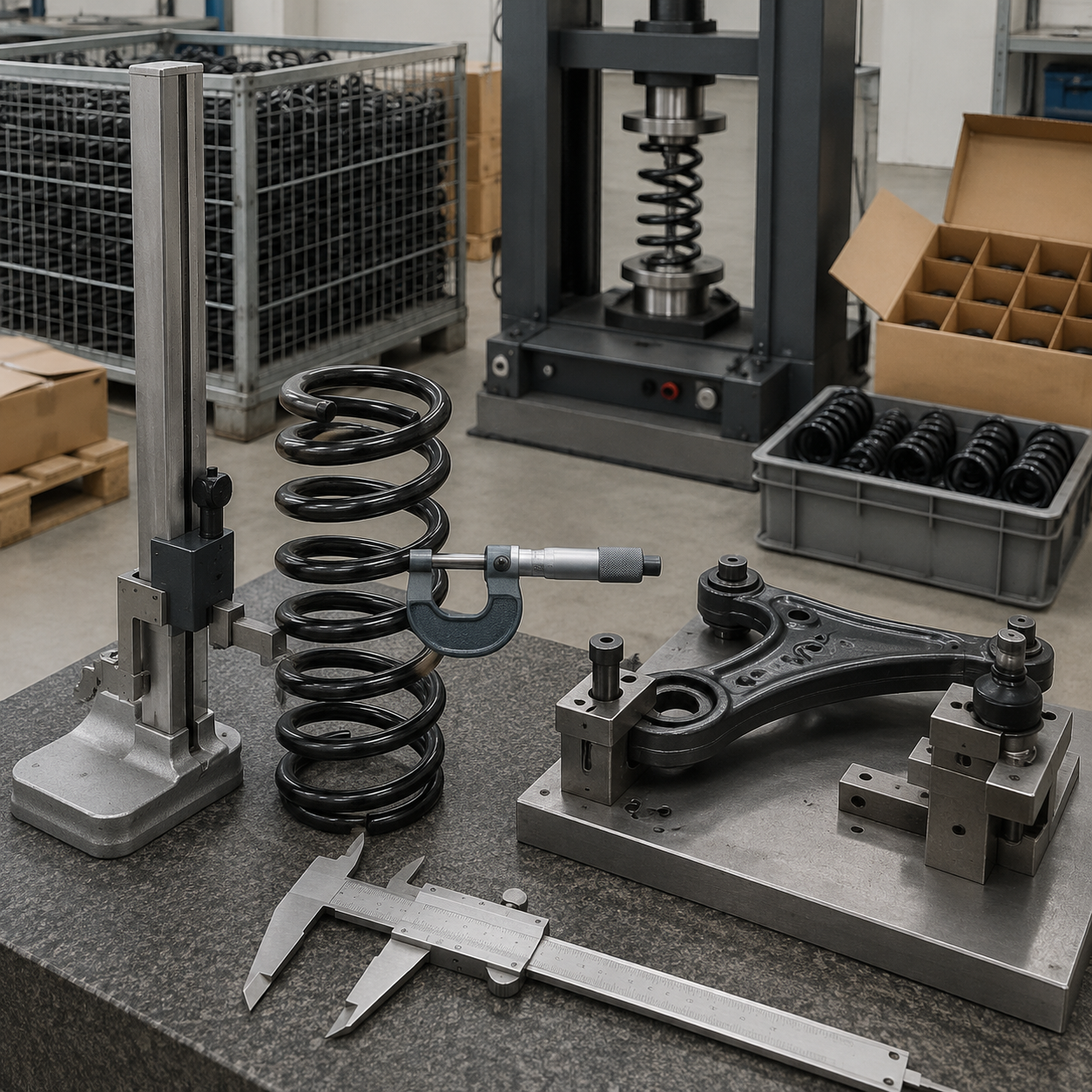
By Vincent Xi, Editorial Author
For a B2B sourcing program in Canada, treat a coil spring OEM minimum order quantity as award-ready only when it is tied to an exact part number, drawing revision, ordering unit, production lot, shipment release, packaging multiple, and commercial commitment. A standalone quantity cannot show how much must be produced, purchased, shipped, or held in inventory.
Keep the coil spring and suspension control arm on separate RFQ lines unless the buyer's controlled bill of materials and drawings define an assembled supply scope. A shared vehicle application or program name does not establish a shared quantity, ordering unit, approval status, or release schedule.
The practical decision is to:
- Approve when the quantity and release terms fit the approved forecast, technical revision, inventory policy, quality requirements, and named Canadian destination.
- Renegotiate when the technical offer is acceptable but the production lot, release size, packaging multiple, setup recovery, or inventory liability is not.
- Hold when the quote leaves part identity, quantity units, revision, stock ownership, cancellation exposure, or destination costs unresolved.
Canada minimum order quantity decision gate
Use the supplier's current written quotation together with the buyer's controlled RFQ, drawing, forecast, and quality documents. The controls below are buyer-side award criteria; the cited general sources do not establish the correct quantity for a specific part or program.
| Decision field | Evidence required | Approval condition | Hold or re-quote trigger |
|---|---|---|---|
| Part identity | Buyer drawing and supplier quote showing part number, revision, material or specification reference, finish, and ordering unit | The MOQ applies to the exact technical item | The quote states a quantity only for a product family or vehicle application |
| Quantity structure | Separate values for commercial MOQ, manufacturing lot, shipment release, packaging multiple, sample quantity, and any forecast commitment | Every obligation has a defined unit and scope | A single quantity conceals different production, purchasing, or delivery commitments |
| Quote basis | Dated supplier quotation with revision, validity, currency, payment terms, and exclusions | Competing offers use current, reconcilable terms | The quantity or price comes from an expired, undated, or superseded document |
| Setup and tooling | Itemized charges plus ownership, maintenance, reuse, access, and disposition terms | Charges and rights are explicit | Unit price depends on undisclosed setup or tooling recovery |
| Release and stock | Written release window, storage location, title transfer, risk transfer, and uncollected-stock terms | Supplier-held inventory exposure is measurable | Smaller deliveries depend on undefined ownership or release deadlines |
| Technical baseline | Controlled drawings, accepted deviations, inspection scope, records, traceability, and approval status | A quantity concession preserves the required baseline | A revised quantity changes material, dimensions, testing, records, or traceability without approval |
| Engineering changes | Written rework, cancellation, and obsolete-stock terms | Liability is allocated before production or stock is authorized | The buyer would absorb undefined remaining inventory |
| Canadian destination boundary | Supplier quote, current carrier input, and current broker or adviser input for the named destination | Compared quotes include the same cost elements and exclusions | Headline prices stop at different transport or clearance boundaries |
State minimum order quantity separately from production and release terms
The NetSuite MOQ resource and Fishbowl MOQ resource provide general purchasing and inventory context. Neither supplies a suitable quantity for a particular coil spring, suspension control arm, drawing revision, supplier, or Canadian program.
For a manufacturing RFQ, require the supplier to identify these obligations separately:
- Commercial MOQ: The minimum purchase commitment for the stated part number, revision, purchase order, and ordering unit.
- Manufacturing lot: The quantity proposed for production under the quoted setup and process conditions.
- Shipment release: The quantity dispatched against an agreed instruction or schedule.
- Packaging multiple: The quantity contained in an approved carton, rack, returnable container, pallet, or other handling unit.
- Sample or validation quantity: A separately quoted pre-production quantity required by the buyer's controlled approval process.
- Setup, tooling, material, or testing commitment: A charge or liability that may remain even when the shipment quantity is smaller than the manufacturing lot.
- Forecast or annual commitment: A volume statement that must be marked as binding or informational rather than treated automatically as the manufacturing lot.
The quote should also state whether the MOQ applies to each part number, each drawing revision, or an explicitly listed group of parts. Do not combine different spring dimensions, rates, materials, finishes, end configurations, or revisions merely to reach a commercial threshold. Apply the same control to handed, revised, or differently equipped suspension control arms. Any grouping needs written technical justification and buyer acceptance.
Coil spring and suspension control arm MOQ boundary
Normalize the technical scope before comparing quantities. The following fields are RFQ inputs to obtain from controlled buyer documents and verify in the supplier's response; they are not published specifications for a Driventus or supplier product.
| RFQ line | Technical identity to carry into the quote | MOQ issue to verify |
|---|---|---|
| Coil spring | Part number, drawing revision, ordering unit, material or specification reference, wire diameter, free length, controlled inside or outside diameter, coil geometry, end configuration, load at stated heights, spring-rate requirement, tolerances, finish, marking, inspection, traceability, and packaging | Which material, dimension, setup, process, test, or pack condition drives the quoted quantity |
| Suspension control arm | Part number, drawing revision, handedness, ordering unit, material and process references, controlled interfaces, and the included or excluded scope for bushings, joints, brackets, hardware, finish, marking, inspection, traceability, and packaging | Whether control-arm volume is being used to conceal separate coil-spring inventory, tooling, approval, or revision exposure |
| Program relationship | Controlled bill of materials, interface drawing, or inspection plan defining any fit, travel, or clearance relationship | Whether a common application name is being substituted for dimensional requirements or separate approval records |
When a supplier proposes a shared lot or grouped MOQ, ask which operations and purchased inputs are genuinely shared, which remain part-specific, and how traceability will be maintained. Record any accepted grouping in the quotation and controlled purchasing documents.
Worked minimum order quantity model for a Canadian RFQ
Every exact numeric value and result in this section is an illustrative assumption for one hypothetical Canadian coil-spring RFQ dated January 15, 2025. Each value concerns one hypothetical coil-spring part number and demonstrates the calculation method only. The figures are not supplier capabilities, market benchmarks, published prices, or purchasing recommendations. Replace them with the buyer's approved forecast and the supplier's dated quote.
| Example input or result | Illustrative value, unit, and scope | Required source for an actual award |
|---|---|---|
| Demand assumption | 600 finished coil springs per month for the hypothetical part number during the planning period beginning from the January 15, 2025 RFQ date | Buyer-approved part-number forecast current as of the actual RFQ date |
| Planning horizon | 12 months following the hypothetical January 15, 2025 RFQ date | Planning period stated in the buyer's actual RFQ |
| Horizon demand | 600 units per month x 12 months = 7,200 finished coil springs for the same hypothetical part number | Recalculate from the approved buyer forecast |
| Supplier MOQ assumption | 2,400 finished coil springs per part number per purchase order under the hypothetical January 15, 2025 quote | Supplier quotation valid for the required revision and ordering unit |
| Demand coverage | 2,400 units / 600 units per month = 4 months of hypothetical demand for that part number | Recalculate after confirming forecast, ordering unit, and release structure |
| Product-price assumption | CAD 18.00 per finished coil spring under the hypothetical January 15, 2025 quote, excluding freight, clearance, duties, taxes, storage, insurance, and other stated exclusions | Supplier's dated price and written cost boundary |
| Initial product commitment | 2,400 units x CAD 18.00 per unit = CAD 43,200 for the hypothetical purchase order | Recalculate from the normalized supplier quote |
| Full-delivery cycle-stock assumption | 2,400 units / 2 = 1,200 finished coil springs as hypothetical average cycle stock, assuming the entire MOQ is received at once and consumed evenly to zero | Buyer inventory model and accepted delivery schedule |
| Full-delivery cycle-stock value | 1,200 units x CAD 18.00 per unit = CAD 21,600 under the hypothetical January 15, 2025 assumptions | Buyer inventory model and accepted cost basis |
| Setup-charge assumption | CAD 12,000 per coil-spring part number as a separate hypothetical charge in the January 15, 2025 model | Supplier's itemized setup quotation |
| Setup allocation at MOQ | CAD 12,000 / 2,400 units = CAD 5.00 per finished coil spring for the hypothetical purchase order | Recalculate using the accepted charge and order quantity |
| Setup allocation across the planning horizon | CAD 12,000 / 7,200 units = CAD 1.67 per finished coil spring, rounded to the nearest cent for the hypothetical planning period | Use only when the volume commitment and charge allocation are contractually applicable |
The model isolates MOQ-related commercial effects. It does not calculate safety stock, demand variation, financing cost, storage cost, quality holds, rejected material, staged receipts, replacement timing, or engineering-change exposure. Add those inputs only from current buyer records and written supplier terms.
The setup allocation at MOQ measures the charge against the initial purchase commitment. The planning-horizon allocation answers a different question and is relevant only when the buyer is authorized to commit that horizon volume and the quoted charge applies across it.
Negotiate minimum order quantity from the documented driver
The Bufab high-MOQ article provides procurement context for handling high MOQ. The DocShipper MOQ article provides general sourcing, negotiation, and logistics context. Neither establishes a coil-spring quantity, suspension-control-arm capability, supplier cost, or Canadian destination charge.
Ask the supplier to identify the quantity driver before requesting a revised offer:
| Quoted driver | RFQ response |
|---|---|
| Setup | Request an itemized setup charge and prices at alternative quantities without changing the technical baseline |
| Material purchasing | Require the material reference, committed quantity, ownership, permitted reuse, residual-stock treatment, and revision exposure |
| Manufacturing lot | Separate the production lot from shipment releases and define storage, title, release deadline, cancellation, and deterioration terms |
| Packaging | Confirm the approved pack quantity, handling-unit dimensions, gross mass, protection method, and treatment of partial packs |
| Testing or validation | Separate sample quantity, production MOQ, test charges, approval conditions, and the effective point for production pricing |
| Forecast or annual commitment | Define whether the volume is binding, which part numbers and revisions it covers, the release schedule, and the liability created by a forecast change |
A revised quantity should not silently change the material or specification reference, controlled dimensions, process conditions, inspection scope, records, marking, traceability, packaging protection, or accepted deviations. Record each commercial or technical concession in the supplier quote and buyer-controlled documents.
Canada destination-cost controls for MOQ comparison
The DocShipper source supports considering logistics when evaluating MOQ and sourcing terms. It does not provide a Canada-specific tariff classification, duty rate, tax treatment, brokerage rate, freight quote, or destination-cost result. Obtain shipment-specific inputs from the responsible supplier, carrier, broker, or adviser.
Normalize these fields for the same named Canadian destination:
| Cost field | Required evidence | MOQ-related exposure |
|---|---|---|
| Currency and product price | Current supplier quote with stated inclusions and exclusions | Different currencies or exclusions can obscure the purchase commitment |
| Shipping point and destination | Supplier quote and buyer RFQ | Offers may stop at different cost boundaries |
| Freight and insurance responsibility | Written delivery terms and current carrier input | Product price alone does not show transferred transport cost or risk |
| Packaging data | Supplier-confirmed pack quantity, dimensions, gross mass, pallet arrangement, and protection method | MOQ, release quantity, and freight basis may use incompatible units |
| Clearance inputs | Current classification and origin documents reviewed by the responsible broker or adviser | The supplied sources do not establish the treatment applicable to the shipment |
| Duties, taxes, brokerage, storage, and exceptions | Current shipment-specific advice and quotations | Unverified amounts should remain open RFQ items rather than assumed rates |
| Supplier-held inventory | Written storage charge, title transfer, risk transfer, release deadline, and cancellation terms | Smaller releases can leave liability for the full manufacturing lot |
Compare offers only after they use the same destination and included-cost boundary. Keep unsupported amounts out of the award calculation until current documentary evidence is available.
Practical RFQ checklist for Canada: coil spring minimum order quantity
Use this as a send-to-supplier response sheet for a Canadian B2B RFQ. Require a written answer against every line; a blank, conditional, or TBD answer remains unresolved. These are buyer-side controls, not supplier capabilities or source-derived product facts.
- [ ] Supplier and quote control: State the legal entity, production site, quote date, validity, currency, payment terms, delivery term, and all exclusions.
- [ ] Exact coil-spring identity: Quote the part number, drawing revision, ordering unit, material or specification reference, finish, and whether the minimum order quantity applies per part number or revision.
- [ ] Separate product scope: Quote the coil spring on its own RFQ line and identify any suspension control arm components, bushings, joints, brackets, hardware, or assembled scope that is included or excluded.
- [ ] Quantity ladder: Provide commercial MOQ, manufacturing lot, minimum shipment release, packaging multiple, sample or validation quantity, and forecast or annual commitment as separate fields with units.
- [ ] Binding status: Mark each forecast, release, and volume commitment as binding, informational, or conditional, and state the liability created by a change.
- [ ] MOQ driver: Identify whether setup, material purchasing, process batching, testing, packaging, tooling, or another documented condition drives the quantity.
- [ ] Price and charges: Itemize unit price, setup, tooling, material, testing, packaging, storage, and other charges, with the quantity and cost boundary used for each calculation.
- [ ] Lead time and releases: Define lead-time start and end points, release cadence, production completion, shipment timing, and any minimum notice or release deadline.
- [ ] Inventory and change exposure: State title, risk, storage, cancellation, rework, engineering-change, obsolete-stock, and uncollected-inventory terms for both produced and supplier-held stock.
- [ ] Technical and quality baseline: Confirm that negotiated quantity does not change controlled dimensions, material or process references, load or spring-rate criteria, inspection, testing, records, marking, traceability, packaging protection, or deviation approval.
- [ ] Canadian destination boundary: Identify the named Canadian destination, shipping point, currency, packaging data, freight and insurance responsibility, clearance exclusions, and any duties, taxes, brokerage, storage, or exception costs requiring current advice.
- [ ] Approval evidence: Attach the current quote, drawings, deviations, sample or production-approval records, inspection requirements, and any current supplier approval or certification document required by the buyer.
Ask the supplier to return these fields in one response table: part number, revision, ordering unit, commercial MOQ, manufacturing lot, release quantity, packaging multiple, sample quantity, forecast status, price basis, setup or tooling, lead time, stock terms, and destination-cost boundary. Compare the completed response with the buyer's controlled RFQ before treating the quantity as commercially actionable.
Evidence and methodology
| Source | Supported use in this article | Boundary of the source |
|---|---|---|
| NetSuite | General MOQ and inventory-management context | Does not establish a product-specific quantity, technical specification, supplier capability, or Canadian charge |
| Fishbowl | General MOQ and purchasing context | Does not establish the correct quantity for a coil spring or suspension control arm |
| Bufab | Procurement context for responding to high MOQ | Does not establish coil-spring economics, supplier capability, or a program-specific recommendation |
| DocShipper | General MOQ negotiation, sourcing, and logistics context | Does not establish Canadian classifications, rates, charges, compliance results, or supplier capability |
| Vincent Xi author profile | Author name, role, and profile URL | Does not document a first-hand factory visit, manufacturing project, inspection, product test, certification, or customer outcome |
The methodology separates source-supported general context from buyer-defined RFQ controls and explicitly labeled example arithmetic. Quote comparison is performed by normalizing part identity, revision, ordering unit, production lot, release structure, packaging, charges, inventory liability, technical baseline, and destination-cost boundary. Every worked result is derived from the displayed hypothetical inputs; no cited source is used as a product-specific benchmark.
Author note: The Vincent Xi author profile identifies Vincent Xi as Editorial Author. The profile does not document a first-hand factory visit, manufacturing project, inspection, product test, certification, or customer outcome, so this article makes no such claim.
Limitations and what to verify
The supplied sources do not establish a universal minimum order quantity for an OEM coil spring or suspension-control-arm program. They also do not establish an actual drawing, material grade, dimension, spring rate, manufacturing process, price, supplier capability, approval, certification, or Canadian destination charge. Technical parameters in this article are RFQ fields to populate from controlled documents, not published product specifications.
Before issuing an order, verify the supplier's legal entity and production site; exact part numbers and revisions; ordering and pricing units; material and process references; controlled dimensions; load and spring-rate criteria; finish; inspection methods and frequency; record retention; traceability; sample and production-approval status; packaging; lead-time definition; quote validity; stored-stock ownership; cancellation and engineering-change terms; and current costs to the named Canadian destination.
No technical or management-system standard is assumed. When the buyer requires a standard, place its exact name, revision, scope, and evidence requirement in the controlled RFQ. Treat that standard as a buyer requirement, not as evidence that Driventus or a supplier is certified. Accept a certification claim only after reviewing a current document for the correct legal entity, production site, scope, and validity period.
Discuss Your Requirements
Review our manufacturing capabilities, then share your specifications for a supplier-fit review.