Hood Panel OEM Product Development Capability for Europe
By Vincent Xi, Editorial Author (author profile)
Answer first. For a Europe-only B2B RFQ in the mirrors-body product family, judge hood-panel OEM product development capability by release evidence rather than by a capability statement. Before tooling approval, require the bidder to define the panel level and material route; identify the CAD or scan input and revision; show forming and, where relevant, joined-assembly analysis; commit to initial-piece measurement and acceptance; state the included tryout changes; and separate the file and quote scope for EU destinations, EEA destinations outside the EU, the UK, and each country-specific destination. The sources cited here describe published methods or reported case results. They do not prove that a bidder has the same capability or result, holds certification, or satisfies a European destination requirement.
Europe RFQ gates for hood-panel product development capability
Use these release gates in the RFQ:
- Define the part: State whether the quote covers an outer skin, inner panel, or joined/hemmed assembly; the material route; CAD revision or scan specification; datum scheme; and measurement condition.
- Define the evidence: Require process design for wrinkle and springback risk, compensation output, forming analysis, joined-assembly analysis where relevant, and tryout measurement.
- Control the commercial scope: Set the included adjustment scope, recut ownership, acceptance report, fixture identity, and panel condition.
- Separate destination scope: Quote the engineering release separately from destination documents for EU destinations, EEA destinations outside the EU, the UK, and each country-specific destination. Require the bidder to list the records it will issue and what remains with the buyer or approval owner.
The cited technical pages do not establish a common legal rule for Europe. They are not a substitute for a destination-specific review. Keep EU destinations, EEA destinations outside the EU, the UK, and country-specific destinations as separate quote and approval lines, and ask the procurement or compliance owner to confirm which records are required. A process report or supplier declaration is not destination-market approval without the current supporting document.
The NIO hood case and the GM Volt hood account are used only as published method, material, and process contexts. They are not evidence that a bidder has reproduced the same process or outcome for a European program.
Turning the die-development sequence into RFQ evidence
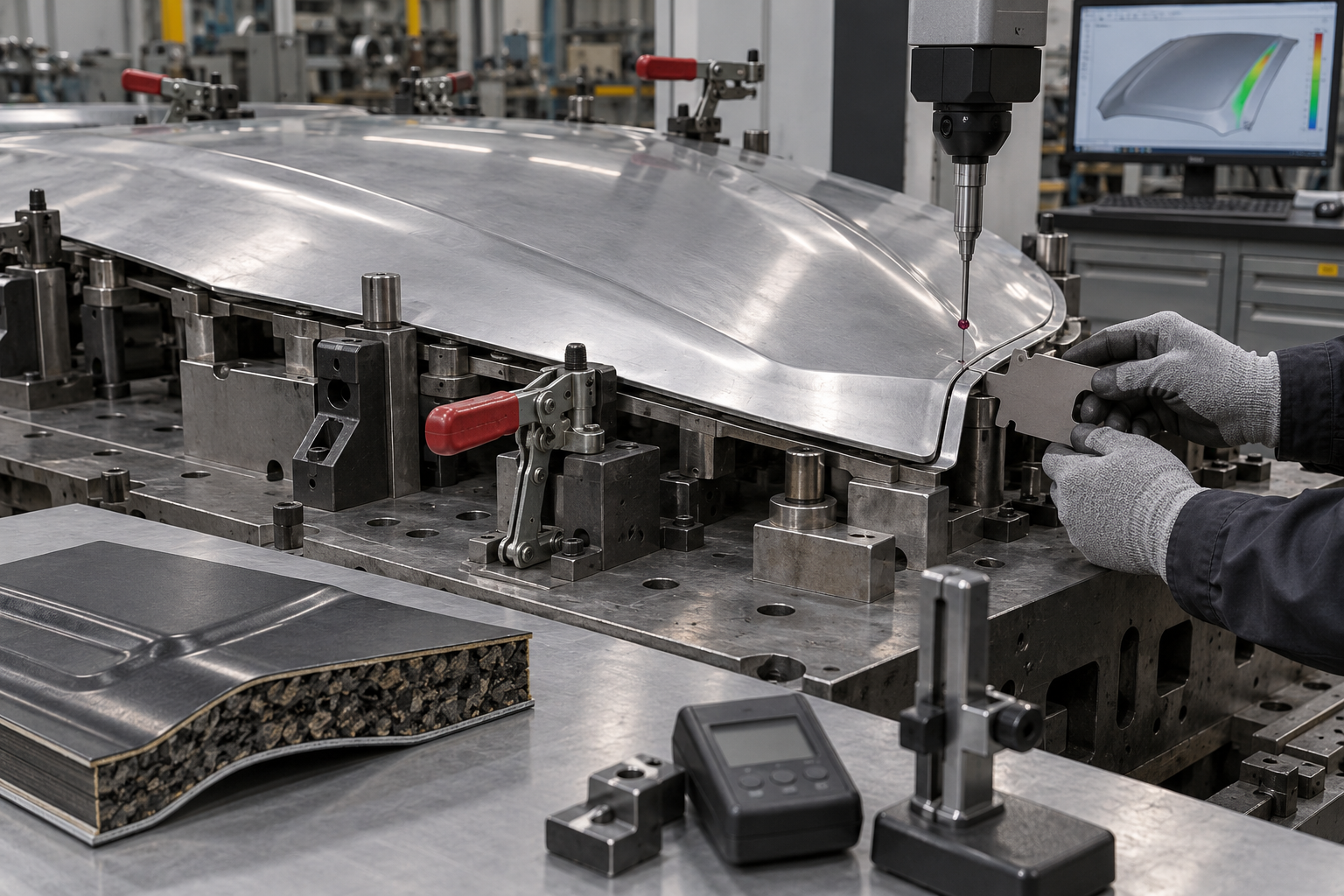
The linked die-development page describes a sequence that starts with scanning an OEM part or reviewing CAD, uses CAE to anticipate wrinkles and springback, proceeds through die design and manufacture, then tryout and adjustment, and ends with customer acceptance. It identifies a defect-free initial draw and dimensional accuracy as focus points. It does not state a numeric accuracy budget, sample size, or recut formula.
Translate that sequence into quote fields. Require the supplier to state whether its input is native CAD or a scan, the revision and datum scheme, and the part condition used for measurement. Ask for the process stations, compensation output, defect-risk list, tryout report, and acceptance trigger. For a hemmed or otherwise joined hood, require the bidder to state whether the evidence covers the assembly rather than only a formed skin. Cap included adjustments and identify who pays for extra recuts. These are buyer requirements, not claims that the cited page is a universal process or that a bidder has completed it.
Product development capability: forming, joining, and tryout data
Use published figures as context, not as a supplier benchmark.
Published data point — flush checks. The linked NIO hood case reports an 84% initial-piece tryout pass rate for flush-dimension checks. Unit: percent of flush-dimension checks. Scope: the published aluminum hood assembly described in that case. As of: the publication date displayed on the source page; verify the source-page date before using the figure in a dated supplier scorecard. Source: NIO hood case.
Published data point — simulation deviation. The same case reports 88% of simulations within 0.5 mm of measured results. Units: percent of simulations and millimetres for the simulation-to-measurement deviation band. Scope: the simulations and measured results reported for the same published hood case. As of: the publication date displayed on the source page; verify the source-page date before using the figures in a dated supplier scorecard. Source: NIO hood case.
Keep the measures separate. A flush-check pass rate is not simulation correlation, and a simulation-deviation band is not a part tolerance unless the drawing or purchase specification adopts it. Ask the bidder to define whether hemming or other joining operations are modeled and whether flush measurement is taken on the joined assembly. Require the quote to carry the case source, date check, measurement method, and acceptance rule separately from any supplier commitment.
Material-route evidence for a Europe hood-panel RFQ
The linked CompositesWorld account describes a reinforced-thermoplastic sandwich for the GM Volt hood, with a Superlite GMT core and unidirectional-tape skins. It characterizes the construction as offering steel-like modulus, aluminum-like mass and coefficient of thermal expansion, greater ductility, a Class A surface, and lower tooling cost. These are qualitative source descriptions, not design allowables, measured tables, current certificates, or guarantees for another part.
Published data point — process cycle. The linked article reports cycle times as low as 4 minutes per cycle through RocTool inductive mold heating. Unit: minutes per process cycle. Scope: the hood process described in that account. As of: the publication date displayed on the source page; verify the source-page date before using the figure in a dated supplier comparison. Source: CompositesWorld account.
Use this account as a route-comparison prompt:
- Dimensional maturity: Ask each bidder to quote flush acceptance separately from simulation correlation, with the measurement condition, feature or point scope, unit, and pass rule.
- Cycle and tooling: Require a named process boundary for cycle time, tool price, included tool changes, and heating-system assumptions. Do not let a short published cycle hide an undefined tryout rule.
- Mass, stiffness, and thermal behavior: Require predicted part mass from the buyer's CAD, the stiffness-check method, and treatment of thermal expansion where different materials meet. Any figure not calculated from the buyer's model should be labeled an assumption in the quote.
- Surface acceptance: The source phrase Class A surface is a description, not a measurement or certificate. Require the applicable OEM surface specification and state whether acceptance is before or after paint.
- Joining and repair: For a joined or multi-material hood, require the joint design, corrosion approach where relevant, repair method, and simulation scope. If the quote omits these fields, mark the route undefined rather than advanced.
Buyer decision table for the hood-panel RFQ
Published context is not a promise. An empty bidder cell stays open until the quote fills it for the part and destination in scope.
| Gate | Buyer decision | Cited context | Supplier response required | Hold or approve rule |
|---|---|---|---|---|
| Panel scope | Outer skin, inner panel, or joined/hemmed assembly | The die-development page describes hood die development, tryout adjustment, and customer acceptance | Exact part level, material route, drawing or CAD revision, and measurement condition | Hold tooling approval until scope is unambiguous |
| Input route | Native CAD versus scan | The die-development page describes scanning an OEM part or reviewing CAD | Input route, revision, datum scheme, scan specification, and compensation assumptions | Do not release surfaces against an undefined input route |
| Forming evidence | Wrinkle and springback prediction before tool completion | The same page describes CAE followed by die manufacture and tryout | Simulation output, compensation surface, station plan, and defect-risk list | Hold tool kickoff if compensation and risks are not described |
| Joined geometry | Forming-only analysis versus assembly analysis | The NIO hood case describes forming and assembly simulation where joining affects hood dimensions | Whether hemming or other joining is modeled, where flush is measured, and which acceptance features are covered | Reject a skin-only file when the drawing requires a joined assembly |
| Material route | Metal route versus reinforced-thermoplastic sandwich | The CompositesWorld account describes a GMT-core and unidirectional-tape construction, qualitative property comparisons, and a process-cycle claim | Mass from buyer CAD, process-boundary cycle time, tool price, surface method, and joint assumptions | Approve a route only after missing numbers are bidder-owned |
| Tryout commercial control | Included adjustment loops versus extra work | The die-development page describes tryout adjustment and customer acceptance but gives no commercial formula | Included changes, recut ownership, extra-loop rate, fixture identity, panel condition, and acceptance report | Do not order tooling on an open-ended adjustment clause |
| Europe file split | Engineering release versus destination requirements | The cited technical sources do not allocate EU, EEA, UK, or country-specific legal scope | Records the bidder will issue, records it will not issue, and destination scope assumed in the quote | Do not treat process approval as destination-market approval |
RFQ Checklist
- Ask the supplier to define the hood level in scope—outer skin, inner panel, or joined/hemmed assembly—and attach the CAD revision or scan specification it will develop.
- Require the manufacturer to identify the forming, trim, flange, hem, and other joining operations included in simulation and tryout evidence.
- Specify the initial-piece acceptance rule with the measurement condition, feature or point list, unit, pass threshold, fixture, and panel condition.
- Ask the supplier to quote the simulation-to-measurement deviation screen separately from flush acceptance, with its scope, measurement method, and source date if published evidence is cited.
- Require the manufacturer to quote metal assumptions separately from reinforced-thermoplastic assumptions, including mass from buyer CAD, process-boundary cycle time, tool price, and surface acceptance.
- Specify tooling, tryout, report, delivery, and acceptance milestones, and require the quote to state what event moves the program from design release to tool build and then to acceptance.
- Require the manufacturer to cap included tryout adjustments and identify the cost, timing, and approval process for extra recuts.
- Specify the documents required for the Europe engineering release, and require the supplier to list any EU, EEA, UK, or destination-country documents it will not supply.
- Verify any required certificate or declaration by obtaining the current document, scope, validity or expiry, and issuing party; do not treat a published case study as certification.
- Compare returned quotes on the same decision-table rows before approving tooling spend or placing the purchase order.
Methodology, limitations, and what to verify
Methodology. The die-development page is used for the CAD-or-scan, CAE, die, tryout, and acceptance sequence. The NIO hood case is used for the flush-pass and simulation-deviation figures. The CompositesWorld account is used for the reinforced-thermoplastic construction and reported cycle-time claim. The recommendations translate those source statements into buyer-owned RFQ fields; they do not average, benchmark, or generalize the cited results. Each figure is retained with its stated unit and case scope, and its source-page date should be checked before use in a live scorecard.
Limitations and what to verify. The NIO figures describe the specific published aluminum hood case, not an industry average or a guarantee. The die-development page does not prove a supplier's capability or establish a universal acceptance formula. The thermoplastic account's modulus, mass, expansion, ductility, surface, and tooling statements are qualitative source descriptions, not design allowables, measured tables, current certificates, or a commitment for a new program. The reported cycle-time claim is process-specific. The cited material does not provide a part-specific drawing tolerance, tool price, capacity plan, or destination-market approval decision. Verify source-page publication dates, the bidder's part-specific calculations, current technical documents, the measurement and acceptance method, and the separate EU, EEA, UK, or country-specific file scope before approval.
If the RFQ requires a certificate or declaration, obtain the current document, scope, validity or expiry, and issuing party from the bidder. Do not infer certification from a case study or from the phrase Class A surface.
Author note: The Vincent Xi author profile identifies Vincent Xi as an Editorial Author.
Discuss Your Requirements
Review our manufacturing capabilities, then share your specifications for a supplier-fit review.