EGR Sourcing Business Continuity Planning for Australian Buyers
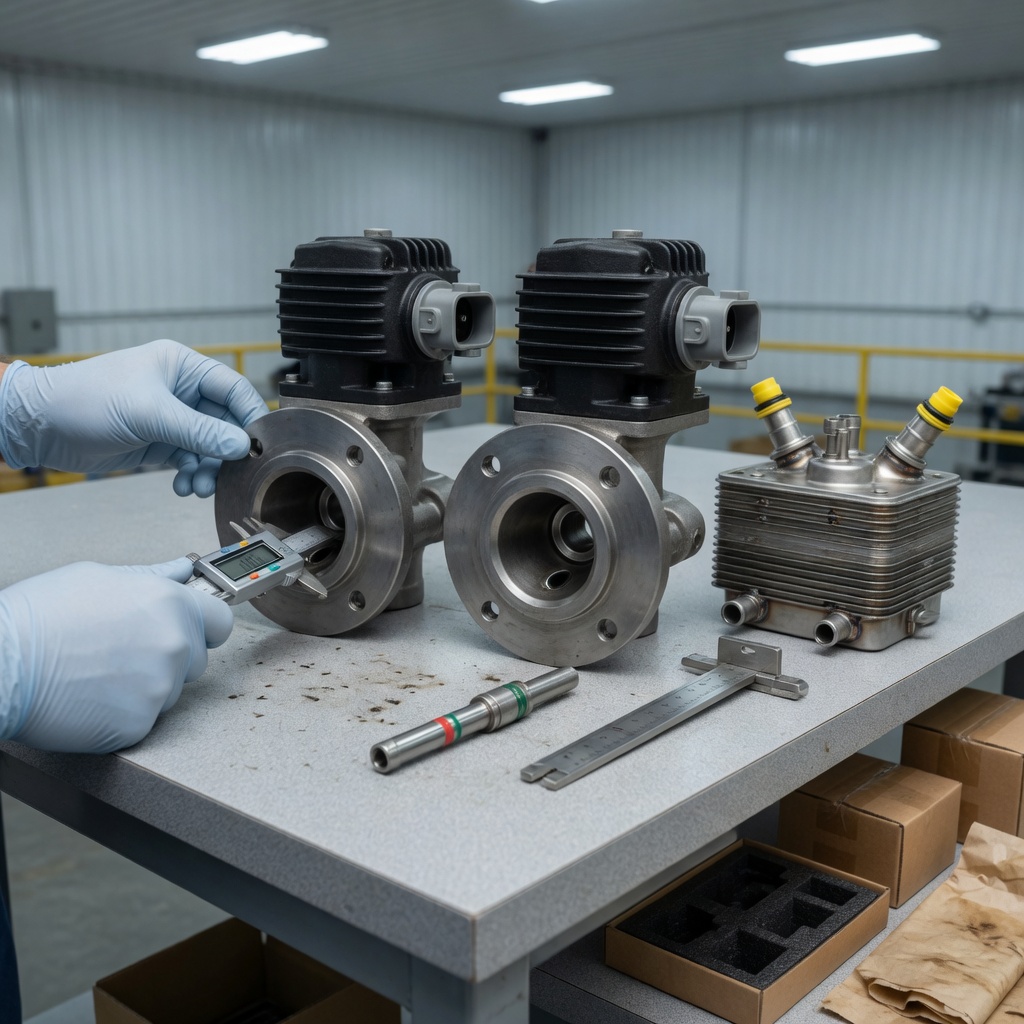
EGR Sourcing Business Continuity Planning for Australian Engine-Part Buyers
By Vincent Xi, Editorial Author Profile: https://driventus.com/authors/vincent-xi/
Australian B2B buyers should not release a purchase order for a critical EGR valve, cooler, pipe, gasket, or actuator until EGR sourcing business continuity planning is scored and written into the award. Price remains a scored line. It does not replace plant identity, a stated recovery-time objective, or a second source that can actually ship the released specification. A single-origin EGR award is still a continuity choice: if the only approved plant, material grade, or actuator lot stops, the engine stays off the repair or production schedule until a second source is tooled, sampled, and released.
Score the award in that order. Qualify two independent production plants against the same released engine-part specification. State a recovery-time objective (RTO) in calendar days to the named Australian receiving site. Size on-hand buffer and second-source ramp so the RTO is physically achievable. Require a next-tier materials map and an escalation path with a notification window in hours. Attach emergency freight, allocation, and change-control clauses before the first order.
This is an editorial procurement note published on Driventus Auto Parts. Vincent Xi is named Editorial Author. It does not claim factory visits, laboratory tests, author-held certifications, named customers, or first-person operating experience.
What Australian buyers should specify before any EGR award
For Australian workshops, fleet workshops, and engine-part distributors, EGR hardware is a high-consequence SKU in engine parts procurement. Continuity planning cannot recover an unreleased part number. Specify identity first: OE number and/or aftermarket number; EGR type (valve, cooler, tube, gasket, or actuator); engine application; flange and port geometry from the released drawing; material call-outs; gasket temperature class; and, where the valve is electronic, connector identity and calibration applicability. A visually similar valve that is not released for that number is not a continuity asset.
Public BCP guidance describes procurement’s continuity role as sourcing alternative suppliers, managing inventory, and keeping delivery of critical goods moving during a disruption, using supplier mapping, backup identification, risk-mitigation plans, and inventory audits. How procurement services can support business continuity planning Those items belong on the RFQ as scored fields, not as a brochure appendix. State the receiving site (port plus inland warehouse or workshop), SKU criticality, RTO in calendar days, and whether an invoice from a trader is acceptable if the production plant is undisclosed. An undisclosed plant fails backup identification and should be held or rejected for a critical EGR SKU.
This note does not import an Australian duty, biosecurity, or labeling manual that the cited pages do not contain. Transit time, customs dwell, and inland haul to the Australian site belong in the freight quote as calendar days. Packaging, corrosion protection, and connector sealing should be asked as specification questions, not written as unverified national climate or labeling claims.
Data point 1 (source-backed). A published EGR supply-chain discussion frames resilience around geographic concentration in Europe and Asia, together with material constraints and capacity limits, and it points to alternative sourcing, supplier-assessment frameworks, strategic inventory, and disruption communication protocols. Unit: two named regions (Europe and Asia). Scope: exhaust-gas recirculation components as covered by that report. As-of: the cited report page. Those region names are manufacturing-origin and concentration fields, not sales-market targets. Supply chain impact of EGR components
Dual-source mapping for EGR valves, coolers, and related engine parts
Dual-source means two production plants that can ship the same released specification, not two trading names in front of one plant. Require plant A and plant B answers in parallel columns. For EGR valves, record housing material, pintle/seat specification, motor or solenoid type, and connector. For EGR coolers, record plate-pack alloy, brazed versus gasketted construction, coolant-port geometry, and gas-path orientation. For tubes and gaskets, record wall, flex-joint design, and temperature class. If source B cannot pass the same dimensional and functional checks as source A, it is not a continuity source—hold the award.
Mapping should go one tier down. Ask each bidder to name—at least by commodity and country of production—the next-tier items that would halt their line (examples to collect, not asserted failure-rate statistics: plate stock, brazing capacity, a unique gas-path stamping, actuator, position sensor, connector), and whether those items have an alternate. Country of production here is a manufacturing-origin field, not a sales-market target. Communication protocols during a disruption are a named EGR-chain recommendation in the supply-chain discussion cited above; require a named contact, a time-to-notify in hours, and a written allocation rule.
Treat tooling and first-article status as quoted calendar days, not as assumed swap speed. Ask whether tooling is complete at each plant, whether a first-article pack exists from that plant, sample lead time versus production lead time (each in calendar days), and remaining qualification duration in calendar days. Do not treat a second plant as dual-source until those answers are on the comparison sheet.
A 70/30 annual volume split is an example allocation to verify in the supplier quote, not a measured industry average. Scope: one critical EGR SKU’s annual order split between two plants; unit: percent of annual units; as-of: not a dated market survey—replace with the split the MOQs actually allow. If the second source’s minimum order quantity exceeds the intended share of annual demand, rewrite the split or treat the SKU as buffer-heavy single-source until a real second source exists.
Business continuity planning clauses for EGR procurement RFQs
Business continuity planning for procurement is described as maintaining critical buying processes during disruption by identifying critical suppliers and materials, defining alternative sourcing options, and setting escalation processes. Named strategies include dual-sourcing for critical materials, strategic buffer stock, flexible contracts with emergency clauses, and regular testing via simulations. Business Continuity Plan (BCP) in procurement
Data point 2 (source-backed). Those four strategies are the countable set on the cited glossary page. Unit: four named strategies. Scope: procurement BCP application as defined on that page, not an EGR laboratory result and not a Driventus process claim. As-of: the cited glossary page.
Translate each strategy into a clause the buyer can score before award:
- Dual-sourcing — two plant identities, two quality packs, one shared specification.
- Strategic buffer stock — units on hand at the Australian receiving site and/or held finished stock, with shelf-life and supersession rules.
- Emergency clauses — pre-agreed air-freight or alternative-port terms, allocation priority, and a price mechanism for emergency production (formula or cap, not a blank cheque).
- Testing via simulations — the supplier states the month and year of the last continuity exercise and which EGR SKU family was in scope. A blank field is a hold, not a pass. This note does not assert that any supplier has run that test.
If the buyer asks for alignment to ISO 22301 (business continuity management systems), that is a standard-alignment request. It is not proof of certification and is not this company’s stated practice. Only a current certificate or audit report, with scope and expiry, would evidence certification, and this article does not hold or display such a document for any company. IATF 16949 or ISO 9001, if requested, should be treated the same way: compare the certificate file, scope, and expiry; do not treat a marketing sentence as a certificate.
Escalation should be operational. Name who is called if a lot fails incoming inspection, a vessel misses a slot, or a sub-tier actuator is allocated. Set a notification window in hours (the buyer specifies the window). An example assumption to verify in the quote is notification within 24 hours of the supplier becoming aware of a halt. Unit: hours; scope: supplier-aware halt on a critical EGR SKU; as-of: not a dated industry rule—use the window the buyer will enforce. A BCP that cannot be escalated is a file, not a process.
Buffer stock, RTO, and measurable cost-versus-recovery trade-offs
RTO is the maximum acceptable calendar days from source-stopped to usable EGR parts at the Australian receiving site. Ocean pipeline cannot serve a short RTO if the origin is the failed node, because units already on the water were made by that origin unless the buyer has already proven they were produced at an independent plant.
Data point 3 (example calculation / assumption to verify in the supplier quote and the buyer’s usage file). Assume demand of 40 EGR valves per month (480 units per 12-month year) for one critical SKU. Unit: valves per month and units per year. Scope: one SKU worksheet, not Australian market demand. As-of: not a survey date—replace with the buyer’s usage file. Assume a 40-calendar-day door-to-receiving-site pipeline from a manufacturing origin in Asia into Australia, illustrated as 30 days main-leg ocean transit plus 10 days port, customs, and inland haul. Unit: calendar days per segment; scope: one illustrated lane; as-of: not a tariff or customs manual—verify each segment with the freight quote. Using a 30-day commercial month, 40 calendar days of pipeline is 40 × (40/30) ≈ 53 units already in transit. A 14-calendar-day RTO equals about 19 units of demand (40 × 14/30). If the origin stops, in-transit units do not restore supply unless they are already independent of the failed plant. On-hand buffer at the Australian site must cover the RTO plus the second source’s remaining ramp, which the bidder must quote in calendar days. None of these figures is a measured market average, freight schedule, or supplier test result.
Measurable trade-offs the award committee can score with quoted values:
- Unit price versus concentration. Dual-source may change average unit price because volume is split and two quality packs are maintained. That is a quote comparison, not a measured industry premium. The continuity offset is a lower chance that 100 percent of supply stops with one plant.
- Inventory cash versus RTO. Buffer shortens RTO and consumes cash. Using the example 19-unit RTO cover, carrying cost is 19 × unit cost × the buyer’s cost-of-capital rate for the holding period—calculate from the quote; this note does not assume a rate.
- Air freight versus ocean buffer. Emergency air can cut transit but spikes cost. A pre-agreed clause should state who pays and which Incoterm applies. This note does not quote air rates.
- Obsolescence versus coverage. EGR valves and coolers can supersede when an engine calibration or emissions package changes. Buffer beyond known remaining platform life is waste. Ask for current supersession status of the OE number.
- Qualification time versus claimed backup. A second source that still needs 90 calendar days of sampling (example duration to verify in the quote; unit: calendar days; scope: remaining first-article/qualification for one EGR SKU; as-of: not a dated industry norm) cannot support a 14-day RTO. Either extend RTO, buy buffer, or do not call it dual-source.
Inventory audits, named in the procurement-BCP guide cited above, should compare on-hand units, units in transit, and units at the supplier’s finished-goods hold against the RTO. Count only released lots.
Decision table: which EGR continuity model to approve
Replace every example duration with quoted values before approval or order. Missing evidence is a hold or reject, not a silent pass.
| Decision factor | Single released source | Dual-source, split volume | Dual-source plus Australian on-hand buffer | Buyer action before approve/order |
|---|---|---|---|---|
| RTO after plant or material halt | Remaining output at one origin plus full freight cycle | Second source’s quoted ramp after the halt | On-hand units cover the stated RTO while source B ramps | Specify RTO in calendar days; reject bids that cannot evidence it |
| Geographic concentration (Europe/Asia manufacturing-origin pattern described for EGR components) | One region/plant | Two plants; still verify they do not share one sub-tier | Two plants plus local stock | Require plant addresses and sub-tier commodity countries |
| Tooling and first-article status | One tooling set | Two tooling sets, both complete, or disclose remaining days | Same as dual-source; stock from released lots only | Require a first-article or equivalent pack from each plant |
| Average unit cost | Compare the quoted invoice price | Compare the quoted average across two plants | Compare quoted price plus quoted carry | Compare total cost to serve the RTO, not unit price alone |
| Inventory cash at the Australian site | Pipeline only | Pipeline on two lanes | Pipeline plus safety stock sized to RTO | State maximum days of cover and supersession risk |
| Quality alignment between sources | One specification pack | Two packs must match fit, material, and function | Same, and mixed lots must be traceable | Require a side-by-side goods-in inspection plan |
| Contract flexibility | Weak unless emergency clauses are added | Needs allocation and ramp clauses | Needs replenishment triggers at reorder point | Insert emergency freight and allocation clauses |
| BCP test evidence | May be a paper plan only | Ask whether both plants were in the last simulation | Ask whether stock drawdown was in the simulation | Record last simulation month/year; blank = hold |
| Order quantity mechanics | One MOQ | Two MOQs; split volume only if both MOQs allow | Reorder point in units | Put MOQ, price break, and reorder point on the PO |
Award, hold, or reject (use quoted values, not the examples above). Approve dual-source plus Australian on-hand buffer when both plants have released first-article (or equivalent) packs, the sub-tier map is complete, emergency clauses are priced or capped, and on-hand units cover the stated RTO while plant B ramps. Hold if plant B tooling is incomplete, remaining qualification days exceed RTO with no buffer, the simulation field is blank, certificate files were requested but not attached, or packing/corrosion/connector-cap answers are missing. Reject a critical EGR award that uses an undisclosed plant, a second trading name in front of one plant, or a claimed backup that cannot pass the same dimensional and functional checks.
Minimum evidence pack before award. Plant of manufacture addresses for source A and source B; first-article or equivalent pack from each plant; sub-tier commodity-and-country map with alternate yes/no; RTO in calendar days; quoted transit, port/customs, and inland days; on-hand units and reorder point in units; notification window in hours; change-control notice in calendar days; emergency freight/allocation terms with a price formula or cap; lot traceability method; and, if standards were requested, certificate files with scope and expiry.
Multi-tier mapping and supplier financial checks
Continuity fails at the tier that actually stops. The RFQ should require a simple multi-tier map: finished EGR SKU → own plant → named critical commodities → production country of those commodities → alternate commodity source (yes/no). Legal names may be withheld if commodity and country are still disclosed; a blank map is not acceptable for a critical SKU.
Financial health is a continuity input because a distressed plant may allocate, stretch lead times, or stop buying sub-tier parts. This note does not publish ratios, credit scores, or named financials. The buyer can still specify attachments: latest available financial statements or a credit-insurance/credit-limit letter; a yes/no on whether finished EGR production exists at more than one site; and whether a written sub-tier allocation agreement exists. Treat missing attachments as a scored gap, not as a rumor about insolvency.
Change control belongs in the same pack. Require written notice before a plant move, a material-grade change, or a sub-tier swap, with the notice period in calendar days. An example assumption to verify is 90 calendar days—unit: calendar days; scope: written notice before plant, material, or sub-tier change; as-of: not a dated statutory rule in the cited pages—replace with the period the buyer will actually enforce. Unannounced substitutions defeat both dual-source and buffer logic.
RFQ checklist for EGR sourcing business continuity planning
Issue the RFQ with plant A and plant B columns. Each item is a specify, compare, verify, approve, hold, or order action.
- Specify the SKU: OE number, aftermarket number, EGR type (valve / cooler / tube / gasket / actuator), engine application, and whether mixed brands are forbidden.
- Specify the Australian receiving site: port of discharge, inland warehouse or workshop, and acceptable Incoterm.
- Specify RTO: calendar days from notified halt to usable parts at that site.
- Specify dual-source intent: two production plants, not two invoice names; require plant addresses and plant of manufacture on the commercial invoice.
- Require a continuity document: a BCP or equivalent that names critical EGR materials, alternate sourcing options, and escalation contacts (BCP definition and procurement application).
- Require backup identification: for each critical commodity, an alternate source or an explicit no-alternate flag (procurement mapping and backup identification).
- Require quality packs from both plants: flange/port dimensions from the released drawing, material call-out, and the functional check that applies to the valve or cooler.
- Require last BCP simulation data: month/year and SKU family in scope, or a written statement that no simulation has been run (hold if blank).
- Require pipeline and buffer math: quoted transit days, quoted customs/inland days, on-hand units the bidder can hold, and the reorder point in units.
- Require emergency-clause terms: air-freight option, allocation priority, price formula or cap, and who pays incremental freight.
- Require a multi-tier map: plant → critical commodities → production countries → alternate yes/no, consistent with EGR concentration and capacity-limit concerns described for Europe and Asia as manufacturing origin (EGR supply-chain impact).
- Require change-control notice: calendar days of written notice before plant, material, or sub-tier change.
- Require traceability: lot/heat or equivalent on the carton, packing list, and invoice line, enough to segregate mixed dual-source stock.
- Require financial attachments: statements or credit-insurance evidence, plus yes/no on dual production sites—compare completeness, do not invent health scores.
- Require lead-time split: sample lead time and production lead time in calendar days, plus remaining qualification days if first-article is not complete.
- Require packing answers: corrosion protection, connector caps or port plugs, and whether mixed lots may share one export crate.
- Approve only released lots for order: the first purchase order should state plant of manufacture, quantity by plant if split (use the quoted MOQ-feasible split, not an assumed 70/30), and the goods-in inspection plan.
- Verify certificates only from files: if ISO 22301, IATF 16949, or ISO 9001 is requested, compare scope and expiry on the document; do not treat a webpage claim as a certificate.
Evidence method and limitations
Source contexts (three public pages; two would meet the minimum). (1) A procurement-services guide on how buying work supports business continuity planning (alternative suppliers, inventory, delivery, mapping, backups, audits). (2) A procurement glossary definition of a business continuity plan (critical suppliers/materials, alternatives, escalation, dual-sourcing, buffer stock, emergency clauses, simulation testing). (3) An EGR-component supply-chain discussion (Europe/Asia concentration as manufacturing origin, material and capacity constraints, alternative sourcing, assessment frameworks, strategic inventory, communication protocols).
Claim-to-source map. Alternative suppliers, inventory management, delivery continuity, supplier mapping, backup identification, risk-mitigation plans, and inventory audits → ESO Consultants guide. Dual-sourcing, strategic buffer stock, flexible contracts with emergency clauses, and simulation testing, plus identification of critical suppliers/materials, alternatives, and escalation → Tacto BCP glossary. Two-region (Europe and Asia) concentration, material and capacity constraints, alternative sourcing, assessment frameworks, strategic inventory, and disruption communication protocols → PatSnap EGR supply-chain page. All other numeric values in this note are labeled example calculations or assumptions.
How the data was derived. Qualitative requirements were taken from those pages and rewritten as RFQ fields and award/hold/reject gates for EGR engine parts. Countable source-backed points are the two named regions (Europe and Asia) and the four named BCP strategies. Numeric pipeline, demand, RTO, MOQ split, notice-period, sampling-duration, and notification-window figures are labeled example calculations or assumptions. They are worksheets for the quote, not measurements of Australian demand, not freight tariffs, and not supplier test results.
What to verify before award. Verify actual usage, current lead time, plant identity, sub-tier countries, first-article status, certificate files and expiry, MOQ, price, emergency freight, packing specification, and the legal terms that would force allocation. The cited pages are not Australia-specific customs or labeling manuals, not live capacity surveys, and not evidence of any Driventus Auto Parts production capability, price, certification, or customer outcome. This article does not add those claims. Replace every example number with the bidder’s written values before approving the order.
Discuss Your Requirements
Review our manufacturing capabilities, then share your specifications for a supplier-fit review.