EGR OEM Sample Approval for United States Engine Parts
By Vincent Xi, Editorial Author
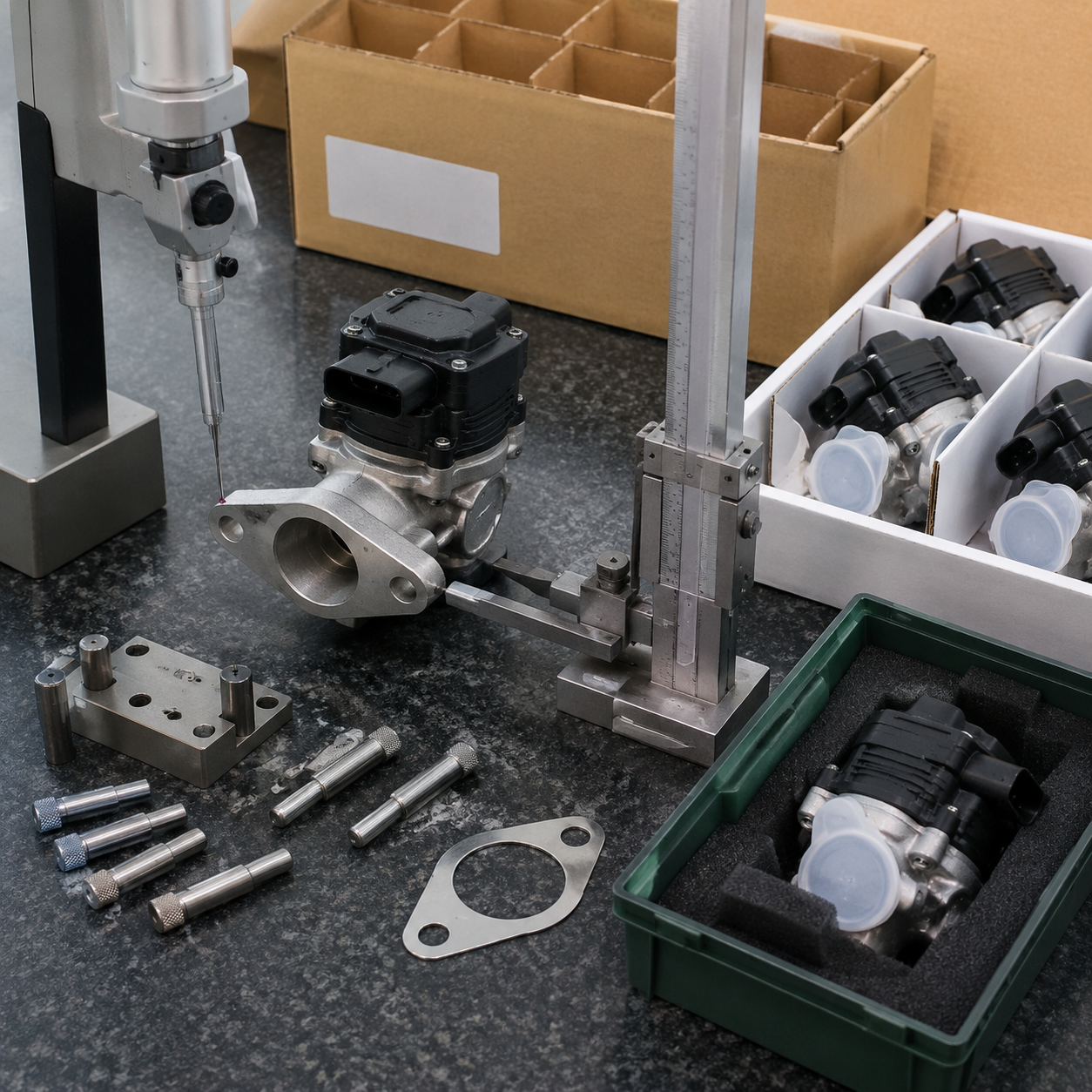
For a United States B2B buyer, EGR OEM sample approval is a bounded release decision for one identified part configuration. The approval record should connect the buyer and supplier part references, drawing revision, application scope, assembly contents, sample lot, manufacturing site, tooling state, process route, and submitted evidence. It should not silently expand into approval of another application, plant, process, or production lot.
CarParts states that EGR valve selection can depend on the engine, emissions configuration, and model year. It also distinguishes a bare valve from packages that may include a gasket, tubes, or fittings (CarParts). Those points support configuration questions in an RFQ, but they do not establish universal dimensions, test limits, or interchangeability.
The purchasing decision is therefore narrow: does the submitted evidence represent the exact EGR configuration that the buyer intends to order, and are the technical, packaging, cost, and delivery conditions controlled well enough for release?
Practical RFQ Checklist for United States EGR Sample Approval
SourceDay describes an approved supplier list as a controlled procurement record connecting approved sources with items, locations, status, and supporting evidence (SourceDay). Applied as a procurement-control principle, not as an EGR specification, this supports recording approval against the exact item, manufacturing site, and evidence set reviewed.
Before issuing or closing the RFQ, the buyer should be able to mark every applicable checklist item complete:
- [ ] Identify the buyer part reference, supplier part reference, drawing revision, application scope, and governing document hierarchy.
- [ ] Attach or identify the current drawing, application matrix, functional test plan, packaging specification, and approved deviations.
- [ ] State the required manufacturing site, tooling state, process route, sample-lot identity, sample tagging method, and production-representation statement.
- [ ] Require an itemized list of the valve, gasket, tubes, fittings, fasteners, protective caps, and documents included in the quoted assembly.
- [ ] List each controlled dimensional feature, datum, buyer-issued limit, unit, inspection method, and required actual-value reporting format.
- [ ] List each applicable electrical, actuation, feedback, leakage, flow, or durability test with the buyer-approved procedure, conditions, and acceptance limit.
- [ ] Require construction and workmanship evidence covering applicable materials, finishes, purchased components, cleanliness controls, repairs, and process differences.
- [ ] Require each dimensional and functional record to identify the tested sample, lot, equipment, calibration status, method, conditions, test date, and observed result.
- [ ] Request unit, inner-pack, and outer-carton proofs showing proposed part identification, lot traceability, origin treatment, barcode data, pack quantity, and physical protection.
- [ ] Assign responsibility for reviewing United States origin marking and any product-specific labeling or emissions-related requirements.
- [ ] Require an itemized quotation stating currency, price-break basis, quote validity, packing basis, manufacturing origin, delivery boundary, and included or excluded charges.
- [ ] Normalize landed-cost comparisons to the same delivery boundary and the same definition of a saleable received unit.
- [ ] Separate sample manufacture, report submission, buyer review, production, dispatch, transit, and final delivery in the proposed schedule.
- [ ] Define the event that starts each quoted duration and require disclosure of tooling, purchased-component, test-fixture, technical-release, and buyer-response dependencies.
- [ ] State how deviations will be submitted, who may approve them, what order scope they cover, and when they expire.
- [ ] Define which design, material, component, tooling, process, site, packaging, or label changes require notification, resubmission, or reapproval.
- [ ] State the available dispositions: approved, conditionally approved under a signed deviation, resubmission required, or rejected.
- [ ] Require the supplier's final return package to include the completed compliance matrix, reports, sample identifiers, configuration images, packaging proofs, quote, schedule, disclosed conflicts, and signed declarations requested by the RFQ.
The checklist should produce a traceable response rather than a general assurance. A missing record, unresolved conflict, or undocumented substitution remains open until the buyer records a disposition.
| Control | Buyer freezes in the RFQ | Supplier returns | Hold or reject trigger |
|---|---|---|---|
| Part and application identity | Buyer part reference, drawing revision, application matrix, and document-precedence rule | Supplier reference, proposed application mapping, configuration images, and disclosed conflicts | References conflict, the application is ambiguous, or the submission uses an obsolete revision |
| Assembly contents | Required valve, gasket, tubes, fittings, caps, fasteners, and documents, where applicable | Itemized quoted contents and sample photographs | The sample or quote omits, adds, or substitutes an item without written disposition |
| Sample provenance | Required site, tooling state, process state, lot selection, sample identifiers, and production-representation statement | Lot record, manufacturing site, process route, tooling status, and prototype-to-production differences | Identity is not traceable, or an alternate site, temporary process, material route, or rework operation is undisclosed |
| Physical interface | Controlled datums, flange features, holes, ports, sealing surfaces, connector orientation, envelope, and gasket interface | Actual-value dimensional report with units, method, equipment identity, and calibration-status evidence | The report shows pass marks without values, omits a controlled feature, or cannot be tied to the submitted sample |
| Functional evidence | Applicable electrical, actuation, feedback, leakage, flow, or durability procedure and buyer-issued limits | Results linked to each tested sample, with method, conditions, units, equipment, and test date | Conditions or limits are undefined, or results cannot be traced to the approved procedure and sample |
| Construction and workmanship | Material, finish, purchased-component, cleanliness, surface, and process requirements that apply to the identified design | Construction declaration, process flow, photographs, inspection results, and nonconformance disclosure | A material, component, finish, process, or repair differs from the submitted declaration |
| Packaging and labeling | Protection method, pack structure, quantity basis, required label fields, barcode data, and artwork route | Unit, inner-pack, and outer-carton proofs plus pack-out evidence | Part identity, lot traceability, origin treatment, barcode content, or physical protection remains unresolved |
| Commercial and delivery scope | Currency, price-break basis, charges, quote validity, order quantity, packing basis, delivery boundary, milestones, and start events | Itemized quote and schedule tied to the submitted configuration and site | The quote covers another configuration, excludes unresolved charges, has expired, or uses undefined timing assumptions |
| Change control | Changes requiring notice, buyer disposition, resubmission, or reapproval | Written control covering design, material, components, tooling, process, site, packaging, and labels | A controlled change can occur without notice and documented buyer disposition |
Use a controlled status such as approved, conditionally approved under a signed deviation, resubmission required, or rejected. Conditional approval should identify the affected characteristic, authorized order scope, required corrective action, responsible parties, and expiry event. Informal acceptance should not replace the release record referenced by the purchase order.
Freeze the EGR Sample Approval Baseline
Before the supplier manufactures samples, the RFQ should state which document controls when information conflicts. The hierarchy may include the buyer drawing and specification, application matrix, functional test plan, construction declaration, packaging specification, approved deviations, and any buyer-validated physical reference.
The application matrix should request the relevant vehicle and engine identifiers, model-year scope, fuel and emissions configuration, actuator type, connector details, and calibration-dependent distinctions where they apply. Treat an OEM reference number as an identification input. It does not by itself establish affiliation or prove interchangeability across every cross-referenced application.
PolyGel identifies specifications, compatibility, required volume, scalability, due diligence, and supplier responsiveness as OEM supplier-selection inputs (PolyGel). For EGR sample approval, these broad inputs become useful only after they are converted into RFQ fields, traceable supplier records, and objective release conditions.
For every controlled characteristic, define:
- The controlling document and revision.
- The feature, datum system, and buyer-issued acceptance limit.
- The inspection or test method and recorded conditions.
- The sample-selection and traceability method.
- The required equipment identity and calibration-status evidence.
- The units, actual-value format, and result format.
- The responsibility and disposition route for failed or indeterminate results.
A dimensional report should contain actual measured values and units rather than pass marks alone. A functional report should identify the tested sample, lot, procedure, equipment, conditions, acceptance limit, test date, and observed result. Photographs can support identity, workmanship, connector orientation, label placement, and packaging review, but they do not replace dimensional or functional records.
If the buyer requires a particular product-approval submission format, name that format and list the required records in the RFQ. Do not infer the format solely from the product category. When a supplier submits a quality-management certificate, verify the current document, issuing body, covered manufacturing site, stated activity scope, and validity. A current certificate may support supplier-level due diligence within its documented scope; it is not approval of the submitted EGR sample.
United States Specifications, Labeling, Landed Cost, and Delivery
Specifications: Require the quote, sample tag, inspection report, test report, packaging proof, and approval record to carry the same buyer part reference and revision. The supplier should disclose uncertain or conflicting cross-references instead of resolving them through visual similarity. Apply the RFQ document hierarchy and record the buyer's written disposition for every accepted conflict or deviation.
Labeling and traceability: Review proofs for the unit, inner pack, and outer carton before production printing. Buyer-controlled fields may include buyer and supplier part references, revision, pack quantity, lot or batch code, manufacturing origin, and scannable data. The importer of record or a qualified adviser should verify the United States origin-marking and product-specific labeling treatment for the identified goods and entry. Supplier artwork is review evidence, not proof of legal compliance.
Landed cost: Compare quotations at the same delivery boundary and against the same definition of a saleable received unit. A buyer-defined comparison formula is:
landed cost per saleable received unit = included goods, inspection, packing, transport, insurance, import, brokerage, terminal, and domestic-delivery costs / saleable units received
Require the quote to identify currency, validity, manufacturing origin, proposed customs classification, included and excluded charges, packing basis, and delivery boundary. Treat supplier-proposed origin and classification as review inputs. The importer of record and its customs adviser should validate the applicable treatment. When currency conversion is needed, record the exchange-rate source and effective date used for the comparison.
Delivery: Separate sample manufacture, report submission, buyer review, production, dispatch, and transit. Define the event that starts each duration and disclose dependencies such as technical release, tooling completion, purchased components, test fixtures, or buyer responses. If the contract uses an Incoterms rule, state the selected rule, named place, and edition. That commercial term should not be treated as technical sample approval or evidence of certification.
Emissions-related use: Physical sample approval does not establish suitability for every vehicle application or regulatory jurisdiction. For the intended United States application, verify the required records and applicable federal or state restrictions through qualified compliance resources. Any supplier compliance statement should identify the exact part, application scope, supporting document, document date, and issuing party.
Example Assumptions to Verify Before Sample Approval
Every numerical value below is an example assumption to verify in the supplier quote, buyer drawing, and approved test plan. The values are not universal EGR requirements, measured results, market prices, supplier capabilities, or delivery promises.
- Example assumption to verify in the supplier quote, pilot-lot scope: For the single pilot-lot RFQ under review, request 6 sample units from 1 identified pilot lot, plus 1 retained master unit. Inspect all 6 submitted sample units against the buyer-controlled plan. This scope describes only the identified submission and does not demonstrate lot-to-lot stability.
- Example assumption to verify in the supplier quote, dimensional control: For one flange characteristic on the buyer drawing revision under review, assume a mounting-hole center distance of 72.00 mm nominal with a tolerance of +/-0.10 mm. Record results for 6 sample units using equipment with an example displayed resolution of 0.01 mm. Replace the nominal value, tolerance, datum system, method, sample quantity, and equipment-suitability decision with released buyer requirements.
- Example assumption to verify in the supplier quote, schedule at quote date: Assume sample completion takes 20 calendar days after written technical release, with the complete inspection report due 2 business days before dispatch. The supplier must confirm both durations for the quoted configuration and identify all start conditions and dependencies.
- Example calculation and assumptions to verify in the supplier quote, one shipment at the buyer's comparison date: Assume USD 4,000 per shipment for goods covering 100 saleable units, USD 600 per shipment for freight and insurance, and USD 900 per shipment for import, brokerage, terminal, and domestic-delivery charges. The hypothetical total is USD 5,500 per shipment, or USD 55 per saleable received unit. Replace every input with validated quotation, logistics, importer, and receipt data. This is not a tariff, duty, or price forecast.
A larger submission may provide more observations from the identified lot, but sample quantity alone does not establish future process capability. A sample produced through temporary tooling or a prototype process can support only the scope the buyer explicitly accepts after the production differences are disclosed and dispositioned.
Record the EGR Sample Approval Decision
The final record should identify the submitted samples, lot, manufacturing site, process and tooling state, governing documents, reviewed evidence, deviations, commercial quote, packaging proof, disposition, authorized approver, and approval date. It should also state the events that require resubmission.
Typical resubmission triggers include a controlled change to the design, material, purchased component, tooling, process route, manufacturing site, assembly contents, packaging, or label data. A lapse in quote validity or a change in delivery boundary requires commercial review even when the technical sample remains unchanged.
Reference the approved specification, reports, deviations, packaging evidence, commercial scope, and change-control obligations in the production purchase order. This keeps the order tied to the configuration actually reviewed instead of relying on an unqualified statement that the supplier or product family is approved.
Evidence Method and Limitations
Source contexts: CarParts was used only for EGR application-selection and package-configuration context. SourceDay was used only for the item-, location-, status-, and evidence-specific structure of an approval record. PolyGel was used only for broad OEM supplier-evaluation inputs translated into RFQ controls. None of these sources establishes a particular supplier's capability, a universal EGR specification, a United States legal conclusion, a price, a delivery promise, or certification.
Methodology: The edit separated source-supported product context from buyer-issued requirements and supplier-submitted evidence. Each RFQ control was tied to an approval, conditional-approval, resubmission, or rejection decision. Numerical content was limited to explicitly labeled assumptions and arithmetic examples that must be replaced or confirmed using the applicable supplier quote, released drawing, approved test plan, logistics inputs, and receipt data.
Limitations and items to verify: EGR dimensions, materials, finishes, connectors, electrical behavior, leakage, flow, durability, application coverage, packaging, and labels depend on the identified program and released requirements. Before approval, verify the current drawing, application matrix, test method, acceptance limits, sample provenance, equipment calibration status, manufacturing site, process route, material source, purchased components, assembly contents, label artwork, manufacturing origin, customs treatment, delivery boundary, and quote validity. Verify any certification claim against a current document covering the relevant site and scope.
EGR OEM sample approval supports only the identified samples, lot, site, process state, configuration, and submitted evidence. It does not by itself establish future process capability, delivery performance, legal suitability for unlisted applications, or approval of other engine parts.
Discuss Your Requirements
Review our manufacturing capabilities, then share your specifications for a supplier-fit review.