EGR OEM Product Development Capability for European Engine Parts Manufacturing
Byline: Vincent Xi, Editorial Author (author profile)
Decision first for OEM and tier-1 buyers in Europe. Treat EGR OEM product development capability as a gated engineering system, not a catalog line. Do not award hard tooling on a production-only unit price. Before kick-off on a named EU, EEA, or UK vehicle program, lock four items: (1) who owns the exhaust gas recirculation (EGR) specification and hardware boundary; (2) whether the quality-system certificate is design-responsible at the producing site; (3) a DVP&R mapped to the destination type-approval file, not a brochure envelope; (4) a substance and change-control pack that will survive IMDS, GADSL, REACH or UK REACH, and SCIP where the article is placed on the EU market.
A quote that omits APQP, DFMEA, DVP&R, PPAP, and IATF design-responsible scope leaves emissions, durability, and launch risk with the customer. This page is a procurement specification aid for engine parts manufacturing destined for programs in Europe. It is not a factory, laboratory, or customer report. EU whole-vehicle type-approval, EEA administrative practice, and the UK’s separate post-withdrawal framework are not one rule set: name the jurisdiction in the RFQ.
Award co-development only when the bidder can evidence those four gates on the nominated engine family. Hold if machining and assembly look strong but design, calibration interfaces, or validation sit in unnamed subcontracts. Reject a co-development pack that is build-to-print only while the program still needs system ownership. Reject hard-tooling payment before a signed, application-specific DVP&R for the destination file (EU, EEA, or UK as named).
What EGR OEM product development capability must cover
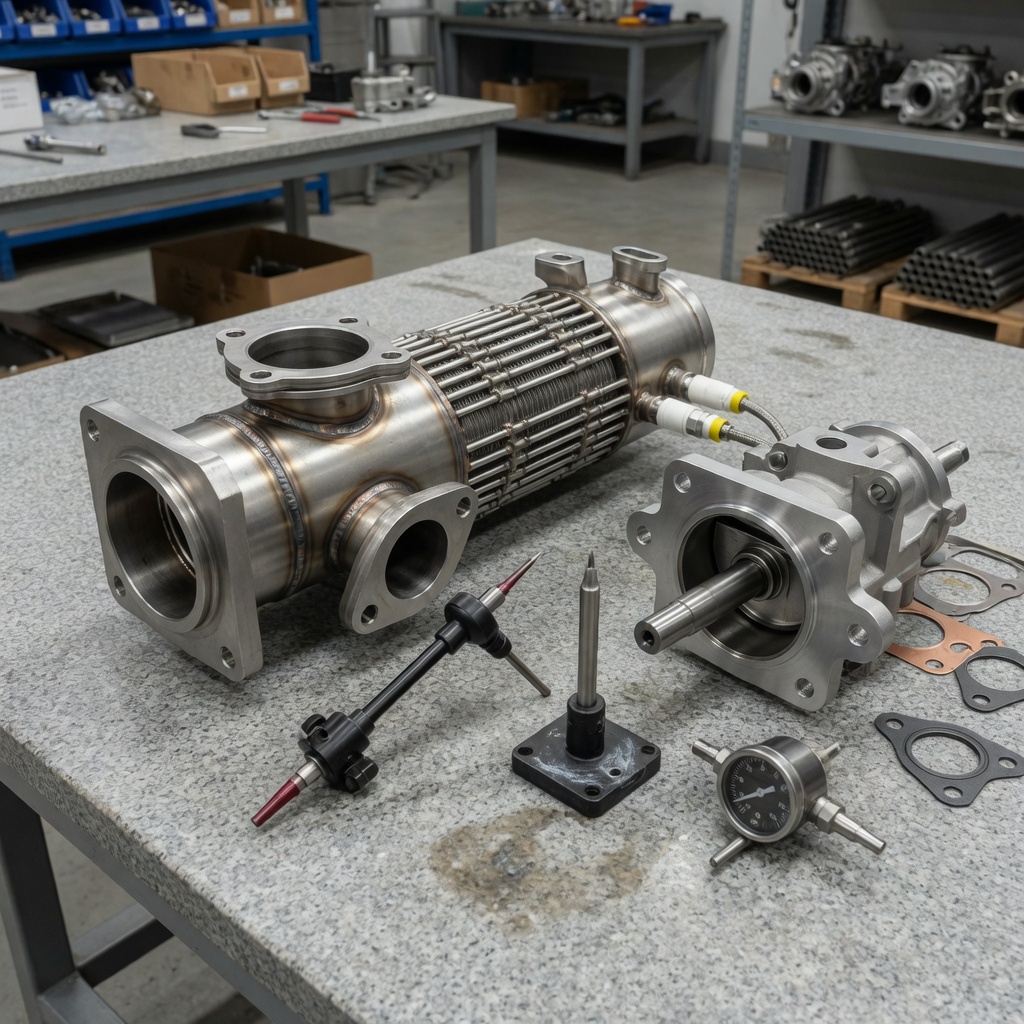
EGR hardware is not a single SKU. High-pressure (HP) EGR, low-pressure (LP) EGR, and dual-loop layouts combine valves, coolers, bypasses, sensors, ducts, and sometimes integrated modules. Product development capability here means the supplier can own or co-own the system specification—thermal effectiveness, soot and condensate behaviour, actuator durability, leakage, NVH, packaging, and engine-control interfaces—not only machine a frozen drawing.
BorgWarner has published that it can design and develop fully integrated high- or low-pressure EGR systems tailored to customer specifications, and has described next-generation coolers for engines from 0.9 to 92 liter displacement (BorgWarner intake and exhaust gas management). That 0.9–92 liter figure is a supplier-stated engine-displacement envelope (unit: liters of engine displacement; scope: next-generation EGR coolers as described on that technology page; as-of: as published on the cited page—confirm the live-page date in the RFQ; source: the BorgWarner page cited). It is not application approval for a duty cycle in Europe, and it is not a Driventus Auto Parts range. Still require the actual DVP&R, cooler effectiveness maps, and corrosion/thermal-cycle evidence for the nominated engine.
Discrete supply (valve only, or cooler only) can cut NRE and unit price, but it shifts integration, calibration, and warranty interfaces back to the OEM or tier-1. On programs in Europe that shift often reappears as extra loops against the destination emissions map: for an EU light-duty file, the WLTP/RDE evidence the OEM specifies; for heavy-duty, the in-service rules the OEM names; for the UK, the separate post-withdrawal type-approval file. Do not treat those as one test list for all of Europe.
Name standards as RFQ requirements; do not treat a webpage as current practice. IATF 16949 is the automotive quality-management standard OEM RFQs commonly name when design and production of automotive parts are in scope; ISO 9001 is a more generic QMS. A certificate is a supplier claim until the buyer holds a current PDF and checks design-responsible versus manufacturing-only scope, site address, and expiry. Neither standard name replaces the EGR DVP&R, and neither is implied here as Driventus Auto Parts practice.
EGR procurement constraints in Europe: EU, EEA, and UK files
Put the destination legal framework in the RFQ in plain language. EU type-approval for complete vehicles follows the EU whole-vehicle type-approval (WVTA) framework. EEA states generally apply aligned product rules but are not automatically identical in administrative practice. The UK operates a separate type-approval and marking environment after leaving the EU. Country-level plant requirements—label language, packaging, ASN/barcode formats, notified-body or technical-service preferences—sit on top of those files.
EGR content also triggers substance and end-of-life reporting: IMDS, GADSL, REACH, and—where articles are placed on the EU market—SCIP where applicable. UK REACH is a separate file. The OEM or tier-1 usually owns vehicle type-approval; the EGR supplier owns the evidence pack that must survive PPAP and running changes. If a cooler material, gasket, or coating change cannot be controlled into IMDS and customer change-management, the launch file for the named plant is incomplete even if the part measures in spec on a bench.
Do not assume a non-destination validation matrix is sufficient for an EU RDE-sensitive calibration, or that an EU file is automatically accepted in the UK (or the reverse). Ask for the test standards, laboratories, and duty cycles actually used, then map them to the OEM’s DVP for the named jurisdiction. Name the OEM’s APQP/PPAP handbook (AIAG, VDA, or customer-specific) rather than assuming one process for every plant in Europe.
Vertical integration, NPD staffing, and data speed-to-market
Category warning. Two pages cited in this section describe an OEM-oriented manufacturer whose trade name includes “EGR.” Use them only as published examples of how one product organisation states NPD headcount share, design-to-finish vertical integration, QMS certificate names, OEM-supply duration, and product-data speed. They are not evidence of exhaust-gas recirculation valves, coolers, or modules. They are not Driventus Auto Parts claims, certificates, customer lists, or staffing ratios.
When comparing manufacturing partners, separate three public signals that appear in OEM-oriented product organisations: the share of people who develop new products, whether design-to-finished-product work is held in-house, and whether product-data quality is treated as a speed constraint. Use them as RFQ probes, not as transferable proof for an exhaust-gas valve or cooler.
One vertically integrated manufacturer that supplies OEMs with vehicle products states that over 20% of its global workforce develops new products, that it produces most products in-house from the design stage through to the finished product, and that it holds ISO 9001 and IATF 16949 certifications (About EGR USA). A related product-data case restates that the same organisation has supplied some of the world’s largest OEMs for nearly 50 years, again with over 20% of the workforce developing new products, and describes slow speed-to-market being addressed through improved product data quality and a collaboration platform (PDM Automotive on EGR product data).
Published comparison anchors (verify live pages and the quote—not as specification limits, and not as exhaust-gas EGR hardware proof):
- Over 20% — unit: percent share of global workforce; scope: that manufacturer’s published allocation of global headcount to new-product development; as-of: as published on the cited About page (no as-of date in the supplied excerpt; confirm the live page when you issue the RFQ); source: About EGR USA.
- Nearly 50 years — unit: years of stated OEM-supply duration; scope: the same organisation’s published OEM-supply history in the product-data case; as-of: as published on the cited case page (confirm current wording); source: PDM Automotive on EGR product data.
- 0.9 to 92 liter — unit: liters of engine displacement; scope: published envelope for next-generation EGR coolers on the cited technology page; as-of: as published on that page (confirm the live page); source: BorgWarner intake and exhaust gas management.
Those figures support questions such as “show current NPD headcount by site and role for this EGR part” and “show which processes from CAD to packed part are in-house versus subcontracted.” They are not proof that an exhaust-gas EGR valve or cooler will be developed to an OEM pack for a plant in Europe.
A high NPD staffing ratio and a vertical design-to-finish model typically raise fixed engineering cost and NRE, but they reduce drawing/version errors and hidden subcontract lead time. A thin NPD layer with outsourced design can quote faster on a build-to-print cooler, then fail when the OEM issues a running change or a calibration tweak on the named EU, EEA, or UK file. EGR modules generate dense BOMs, 3D, and characteristic data; poor data quality shows up as late PPAP, wrong IMDS, and missed sample dates—not as a line on the price sheet.
Measurable development trade-offs buyers should price
Integration versus discrete parts. Full HP/LP system ownership (valve + cooler + ducts + control interfaces) improves emissions and packaging optimisation and matches the fully integrated high- or low-pressure EGR systems model described on the cited technology page (BorgWarner intake and exhaust gas management). It also concentrates NRE, prototype hardware, and warranty in one contract. Discrete cooler-only or valve-only supply can be appropriate for a locked OEM drawing, but the buyer must add internal system-engineering hours.
Envelope versus application. A published cooler envelope from 0.9 to 92 liter engines is a capacity signal, not application approval. Example comparison only (replace both displacements with the nominated engine in the RFQ; not a laboratory result): a 2.0 liter passenger-car HP-EGR cooler and a 13 liter commercial LP-EGR cooler do not share the same soot, condensate, vibration, or coolant-chemistry risks. Require exact engine displacement (L), fuel, rated power (kW) and speed (r/min), EGR rate (%), coolant temperatures (°C), maximum gas inlet temperature (°C), and duty cycle in the RFQ.
Timeline versus evidence depth. Faster collaboration on product data can shorten the path from design freeze to packed samples, as argued in the data-quality case (PDM Automotive on EGR product data). Programs for plants in Europe still need time for PPAP, IMDS, and any additional tests the OEM maps to the EU, EEA, or UK file. Compressing samples without a complete DVP&R is deferred launch risk, not a saving.
Quality-system scope versus certificate name. IATF 16949 with design in scope is a different offer from ISO 9001 manufacturing-only. Replace webpage certification claims with current certificates for the producing site of the EGR part. Name the standard in the RFQ; treat practice as unproven until document, site, and scope are checked.
Change control versus first-off PPAP. EGR coolers and valves see running changes (gaskets, coatings, actuators, software). Ask how ECNs, 3D, special characteristics, and IMDS stay aligned. Vertical integration from design to finished product still needs a written change process that matches the named receiving plant in the EU, EEA, or UK.
Buyer decision table: specify, compare, verify, approve, order
Use this table in sourcing workshops. Every row is an action for the RFQ, the scoring sheet, or the PPAP gate. Figures in the Compare column are third-party published probes only.
| Capability area | Specify in the RFQ | Compare across bidders | Verify / approve before tooling | Order / launch control |
|---|---|---|---|---|
| System ownership | HP, LP, or dual-loop; valve / cooler / module boundary; ECU interfaces | Full-loop designer vs discrete part maker | Named design owner, DFMEA, interface FMEA | Freeze boundary in the purchasing spec |
| Engine envelope | Displacement (L), fuel, power (kW), speed (r/min), EGR rate (%), coolant range (°C) | Published envelopes (example probe: 0.9–92 L coolers as a supplier-stated range on the cited technology page) vs actual DVP | Application-specific test reports, not brochure range | Call out engine family on the PO |
| NPD capacity | Roles, site, design tools, hours in the quote | Stated NPD share of workforce (example probe: over 20% global headcount on one OEM supplier’s about page; not exhaust-gas EGR proof) vs named team for this part | Org chart, responsible engineers, workload | Hold a named program engineer in the contract |
| Vertical process | Which steps from CAD to packed part are in-house | Design-to-finish in-house vs multi-tier subcontract | Process flow, subcontract list, incoming QC | Ban silent resourcing changes |
| QMS scope | IATF 16949 design-responsible vs manufacturing-only; ISO 9001 if only that is offered | Certificate claims vs certificate files | Current certificate, scope, site, expiry | Condition first PO on valid cert |
| Data quality and speed | CAD/PDM, characteristic data, collaboration method | Manual data vs platform-enabled collaboration (as described in a published data-quality case) | Sample data-pack quality, revision-control demo | Require a data pack with every sample |
| Validation depth | DVP&R mapped to OEM tests for the destination jurisdiction (EU, EEA, or UK as named) | Bench-only vs thermal, vibration, corrosion, leakage, soot/condensate | Lab scope, standards, traceability | No SOP without signed DVP |
| Substances and IMDS | IMDS, GADSL, REACH, UK REACH, SCIP if in scope for the EU market | Who files IMDS and when | Live MDS, full disclosure | Gate PPAP on accepted MDS |
| Type-approval interface | EU WVTA support pack vs EEA vs UK separate file | One “Europe” clause vs jurisdiction list | RACI with OEM type-approval owner | Do not ship unmarked or mis-marked parts |
| Prototypes | Quantity, process (soft vs hard tooling), lead time, measurement plan | Additive-only vs process-representative metal | Dimensional, leak, material certs on samples | Order prototypes on a separate line with accept criteria |
| Special characteristics | Characteristic list, MSA/GR&R, cleanliness method if the OEM pack names one | Verbal vs documented control plan | Capability evidence on special characteristics | Freeze the control plan with PPAP |
| Change control | ECN timing, PPAP delta, IMDS delta | Verbal vs documented APQP change | Last three ECN examples (redacted) | Running-change clause in the supply agreement |
| Plant logistics (named site) | Label language, barcode, packaging, Incoterms, delivery site | One export pack vs EU-plant and UK-plant packs | Packaging trial to the named plant | ASN and label approval before serial orders |
| Commercial gates | NRE and tooling tied to evidence, not calendar alone | Pay-on-date vs pay-on-gate | Design freeze, DVP, PPAP as payment milestones | No hard-tool payment before DVP sign-off |
Practical RFQ checklist for EGR OEM co-development in Europe
Copy these items into the RFQ so a buyer can specify, compare, verify, approve, or order.
- State the legal destination: EU type-approved vehicle, EEA, UK, or a split (do not write “Europe” as a single rule set).
- Name the engine: displacement in liters, fuel, rated power (kW), speed (r/min), application (passenger, light commercial, heavy-duty), and whether the EGR path is HP, LP, or dual.
- Define the product boundary: valve, cooler, bypass, sensors, ducts, integrated module, and who owns calibration and actuator software version control if the actuator is electric.
- Attach or require the OEM specification pack: drawings, 3D, GD&T, DVP&R, DFMEA, characteristic list, cleanliness, leakage, and corrosion targets, each with units.
- Name the OEM’s APQP/PPAP handbook (AIAG, VDA, or customer-specific) and the PPAP level, including prototype and production-representative samples, with calendar dates—not “TBD after award.”
- Demand the current IATF 16949 (or ISO 9001 if that is all that is offered) certificate PDF for the producing site of this EGR part, with design in or out of scope, site address, and expiry. Treat webpage claims as unverified, including third-party about-page certificates that are not this producing site (About EGR USA).
- Ask which processes from design through finished packed product are in-house versus subcontracted, with named subcontractors for cores, fins, actuators, coatings, and machining.
- Request the NPD team for this program (roles, site, hours in the NRE). Use public staffing ratios only as a probe, not as proof, and not as exhaust-gas EGR evidence (About EGR USA; PDM Automotive on EGR product data).
- Specify the data environment: native CAD, PDM, characteristic export, and how revision conflicts are prevented before PPAP.
- List validation evidence: thermal cycle, vibration, corrosion, leakage, actuator life, cooler effectiveness, soot/condensate, and any emissions-contribution claims, with laboratories, standards, temperatures (°C), and cycle counts the OEM file actually requires.
- If a supplier cites a wide cooler envelope (example probe: 0.9 to 92 liter engines as published for next-generation coolers), require the subset of tests that apply to the nominated engine, not the brochure range (BorgWarner intake and exhaust gas management).
- Require IMDS submission timing, full material disclosure, REACH / UK REACH statements, GADSL, and SCIP where the article is placed on the EU market.
- Define change management: how ECNs update 3D, characteristics, PPAP, and IMDS, including running changes after SOP.
- State prototype quantities, process (soft tool, hard tool, additive), measurement plan, MSA on special characteristics, and accept/reject criteria that allow a go/no-go to tooling.
- Add plant logistics for the named receiving site in Europe: Incoterms, delivery location, document and label languages, barcodes, packaging tests, and whether UK and EU plants need different packs.
- Require a RACI against the OEM’s type-approval owner so EGR evidence files are not assumed to be “included” in a unit price.
- Ask for redacted examples of prior OEM PPAP (no customer names required) that show design-responsible scope, not only production PPAP.
- Tie payment of NRE and tooling to evidence gates (design freeze, successful DVP, PPAP approval), not to calendar alone.
- State warranty, field-return, and 8D ownership for the EGR boundary you are buying—module versus discrete part.
- Require technical documentation language (English plus receiving-plant language) and a spare-part / service drawing freeze if the OEM aftersales file is in scope.
Source context, methodology, and what to verify
Source context 1. Manufacturer “about” and technology pages that describe OEM product-development organisations and EGR-system hardware envelopes: share of workforce in new-product work, vertical integration from design to finished product, and named QMS certifications on an OEM-accessory manufacturer’s about page (About EGR USA); published ability to design fully integrated high- or low-pressure EGR systems tailored to customer specifications, and coolers for a published engine-displacement envelope of 0.9 to 92 liters (BorgWarner intake and exhaust gas management).
Source context 2. A product-data case describing nearly 50 years of OEM supply, the same over-20% new-product workforce statement, and speed-to-market limits caused by product-data quality, addressed through collaboration tooling (PDM Automotive on EGR product data).
Methodology / how the data were derived. Figures and capability phrases in this article are taken only from those public pages as quoted above. “Over 20%” is a supplier-stated share of global workforce in new-product development on the cited about page. “Nearly 50 years” is a supplier-stated duration of OEM supply on the cited case page. “0.9 to 92 liter” is a supplier-stated engine-displacement envelope for EGR coolers on the cited technology page. No independent audit, factory visit, or laboratory test was performed for this editorial. Where a number is used as an RFQ example (for instance, asking a bidder to show NPD headcount against a published 20% signal, or contrasting example 2.0 L and 13 L engines), it is labelled as a comparison probe or example assumption to be replaced and verified in the supplier quote—not as a specification limit.
Limitations / what to verify. The EGR USA and related product-data pages describe OEM accessory/vehicle-product development and certifications; they are not evidence of exhaust-gas recirculation valve or cooler hardware. BorgWarner’s page describes EGR systems and cooler envelopes; it is not evidence about any other company, including Driventus Auto Parts. Certifications are time-bound documents: obtain current ISO 9001 / IATF 16949 files for the producing site and read the scope. Rules in Europe are not uniform: specify EU, EEA, and UK separately, then add country-plant logistics. Do not infer that Driventus Auto Parts, or any unnamed bidder, holds the staffing ratios, vertical processes, certificates, customer lists, or cooler ranges quoted from third-party pages. Verify engine-specific DVP, IMDS, PPAP, and type-approval RACI on the part that will be ordered.
Editorial author: Vincent Xi, Editorial Author (https://driventus.com/authors/vincent-xi/). This page is a procurement specification aid for engine parts manufacturing programs in Europe. It does not claim first-hand factory, test, or customer experience.
Discuss Your Requirements
Review our manufacturing capabilities, then share your specifications for a supplier-fit review.