Radiator OEM Quality Control Inspection for Europe: RFQ Release Gates
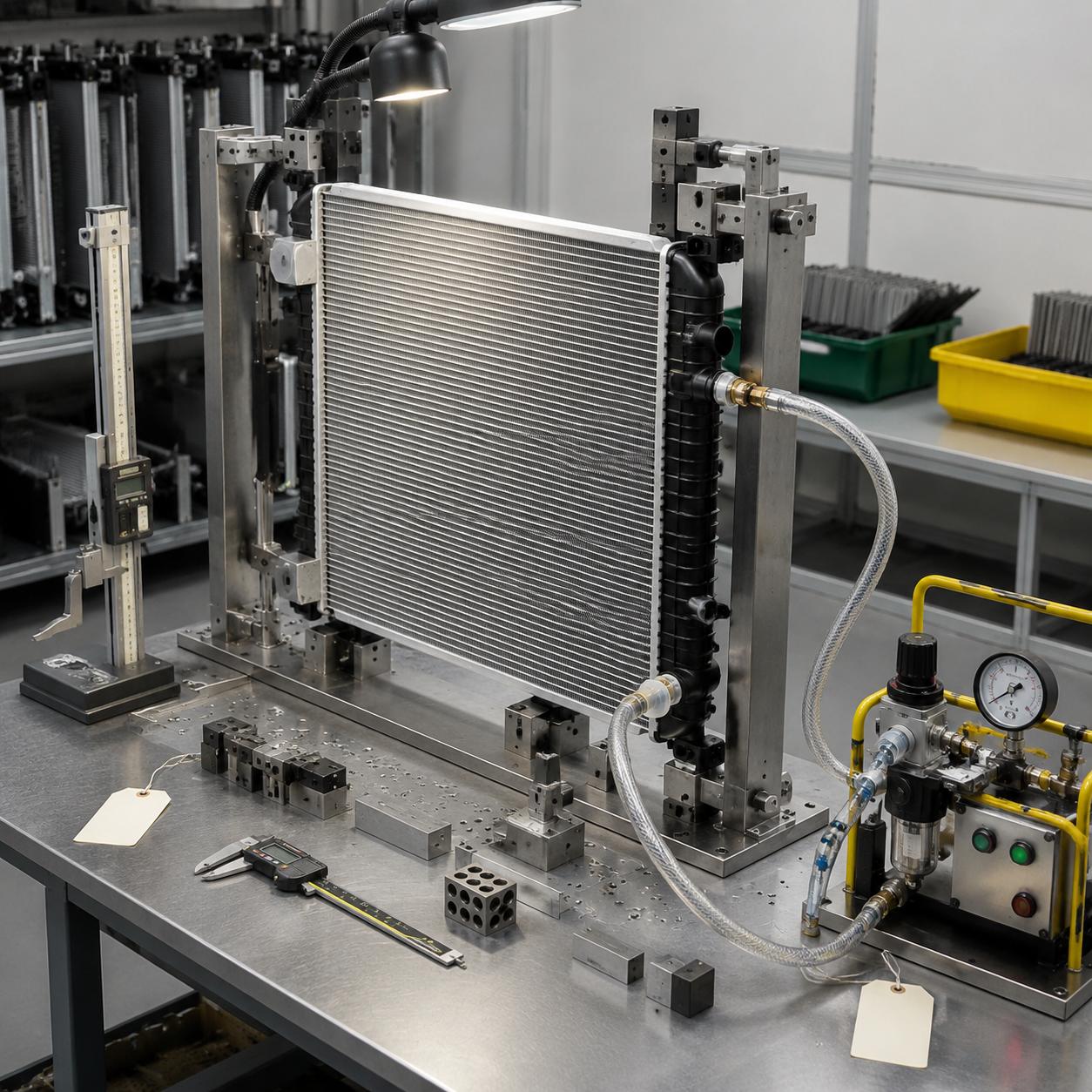
By Vincent Xi, Editorial Author
Direct answer: For radiator procurement in Europe, do not approve a quotation or authorize tooling until the supplier returns a revision-controlled quality control inspection plan tied to the buyer part number, drawing revision, and intended destination path. The return should define the proposed construction, manufacturing stages, inspection characteristics, methods, acceptance limits, coverage, traceable records, failure response, and shipment-release authority.
List intended EU destinations, EEA destinations outside the EU, UK destinations, and country-specific requirements separately where applicable. A generic claim of Europe compliant is neither a measurable radiator acceptance criterion nor destination-specific evidence.
For this RFQ, treat OEM quality only as production against the buyer-approved radiator specification. The phrase does not establish vehicle-manufacturer approval, original-part equivalence, certification, supplier capability, or legal compliance. Each claim needs current evidence applicable to the quoted part, manufacturing site, and destination.
The evidence boundary is deliberately narrow. A supplier-published radiator QC article discusses material verification, process controls, testing, records, and traceability (HD Auto Parts radiator QC article). A supplier checklist identifies fin density, tube arrangement, quality procedures, and leak- or pressure-test documentation as buyer clarification points (Radicore OEM radiator supplier checklist). A general sourcing overview distinguishes in-process inspection from final inspection (Indsource quality control and inspection overview). These sources support RFQ questions and control categories. They do not establish buyer-specific acceptance values, verified supplier capability, product performance, or legal requirements for a European destination.
Europe Radiator Quality Control Inspection: Quote Release Gates
Use these gates to determine whether a radiator quote is technically comparable and ready for commercial review.
| Release gate | Supplier return required with the quote | Hold condition |
|---|---|---|
| Controlled product identity | Buyer and supplier part numbers, drawing revision, quotation revision, intended duty, approval status, assumptions, and deviations | The quote relies on a catalogue description, unidentified drawing, or unresolved part identity |
| Declared construction | Materials, core construction, tube and fin configuration, tank design, joints, interfaces, finish, permissible repairs, and proposed substitutions | A material, dimension, or process is described only as equivalent, standard, or typical |
| Manufacturing control plan | Process flow, incoming checks, setup approval, in-process controls, final inspection, validation activities, and failure-response rules | The response contains only a general quality statement or an uncompleted template |
| Defined test evidence | Characteristic, method, conditions, equipment principle, coverage, acceptance rule, retest rule, and report format | A test is promised without measurable conditions, limits, coverage, or output |
| Traceability and change control | Lot definition, material and process linkage, record retention proposal, nonconformity procedure, and change-notification route | Records cannot be linked to the quoted revision and released production lot, or changes may occur without buyer review |
| European destination file | Separate evidence proposals for intended EU, EEA outside the EU, UK, and country-specific paths where applicable | A generic European declaration replaces destination-specific buyer review |
A passed gate means the supplier has provided enough information for buyer evaluation. It does not itself approve the radiator, supplier, manufacturing site, certificate, or destination file.
Freeze the Quoted Radiator Definition
Issue the same controlled input pack to every supplier. Unresolved fields should remain marked TBD and appear in the supplier's assumptions and deviation schedule.
| RFQ subject | Buyer-controlled input | Supplier return with the quote |
|---|---|---|
| Product identity | Buyer part number, controlled drawing revision, RFQ revision, intended interface, and approval status | Supplier part number, revision acknowledgement, assumptions, exclusions, and deviations |
| Fit and interfaces | Datums, overall envelope, core dimensions, mounting points, inlet and outlet geometry, filler or cap interface, drain, sensor ports, fan-shroud points, and auxiliary connections where applicable | Measurement methods, fixture concept, inspection coverage, and blank dimensional-report format |
| Construction | Required materials, tube and fin definition, core and tank design, joint requirements, finish, permissible repair, and substitution restrictions | Declared construction, manufacturing route, material evidence, process controls, and proposed deviations |
| Cooling duty | Buyer-controlled operating media, interfaces, duty point, validation method, and acceptance criteria | Available test capability, instrumentation, sample source, frequency, laboratory responsibility, and report format |
| Workmanship and handling | Defect catalogue or approved reference, cleanliness criteria, protected surfaces, connection protection, and packaging requirements | Inspection method, handling flow, packaging proposal, and approval-sample plan |
| Traceability | Required links among material, process, finished radiator, test result, packing, and shipment | Code structure, lot definition, retrieval method, retention proposal, and example record chain |
| Destination | Intended European destination countries and buyer-required document, language, labelling, packaging, and responsible-entity fields | Destination-specific evidence matrix, document revision, responsible party, and declared gaps |
The Radicore checklist identifies fin density and tube arrangement as details for buyer clarification (Radicore OEM radiator supplier checklist). Use those categories to request controlled drawing values; the source does not establish the correct construction for the quoted radiator.
The supplier should also state whether any unresolved field affects price, tooling, samples, manufacturing lead time, inspection capacity, or validation scope. Do not close a TBD item through an undocumented production assumption.
Build the Manufacturing Quality Control Inspection Plan
Require a completed control-plan row for each characteristic that can affect fit, sealing, cooling duty, workmanship, traceability, or release status. Every row should identify:
- The buyer part number, supplier part number, and drawing revision.
- The controlled material, dimension, interface, joint, sealing feature, construction detail, appearance condition, or performance output.
- The manufacturing stage at which the control occurs.
- The instrument, fixture, test medium, controlled procedure, or approved visual reference.
- The proposed coverage, including every-unit screening, defined lot sampling, setup sampling, or validation sampling.
- The buyer drawing tolerance, purchase specification, approved defect catalogue, or contractually invoked requirement used for acceptance.
- The measured result, machine record, material document, retained sample, photograph, signed report, or traceable test file retained as evidence.
- The isolation boundary, escalation route, rework authority, retest requirement, and lot-release decision after failure.
| Manufacturing stage | RFQ questions | Evidence expected before release |
|---|---|---|
| Incoming material | What material identity, condition, document, supplier-lot link, and acceptance criteria apply? | Material records linked to the radiator production lot and any approved deviation |
| Setup approval | Which fixtures, process settings, sample checks, and authorization rules release production? | Setup record tied to the quoted part and revision |
| In-process control | Which product or process characteristics are checked, by what method, at what coverage, and with what reaction rule? | Recorded results and containment evidence for any failed check |
| Final inspection | How are identity, completeness, controlled dimensions, workmanship, cleanliness, connection protection, packaging, traceability, and test status confirmed? | Final report linked to the released lot |
| Periodic or design validation | Which buyer-required performance or durability evaluations apply, and how are samples, conditions, frequency, acceptance, and responsibility defined? | Buyer-approved report for the controlled radiator design and stated validation scope |
The HD Auto Parts article presents material verification and production controls as radiator QC activities (HD Auto Parts radiator QC article). The Indsource overview treats in-process inspection separately from final inspection (Indsource quality control and inspection overview). Neither source supplies radiator-specific limits, sampling plans, measurement capability, or failure-response rules. Those items must come from the controlled buyer specification and the approved supplier plan.
A method mentioned in supplier material is not automatically mandatory or suitable. When a supplier proposes a method, require the examined feature, procedure revision, equipment principle, controlled conditions, interpretation rule, qualification evidence where applicable, coverage, record output, and failure response.
Define Radiator Test Evidence Before Supplier Approval
Treat each acceptance decision as a separate RFQ line. A general certificate or an unexplained pass result should not replace characteristic-specific evidence.
| Radiator decision | Buyer must define | Supplier must return | Release evidence |
|---|---|---|---|
| Material and construction | Controlled materials, tube and fin configuration, core and tank definition, joints, substitutions, and permissible repair | Proposed materials, manufacturing route, incoming controls, sub-supplied work, and deviations | Approved specification, material records, setup evidence, and traceable deviation approvals |
| Dimensional fit | Datums, critical interfaces, tolerances, coverage, and required checking fixtures | Measurement method, fixture control, sampling proposal, measurement capability, and failure response | Measured report tied to the part number, drawing revision, and production lot |
| Sealing | Test medium, pressure profile, temperature, stabilization, hold, detection threshold, coverage, reject rule, and retest rule | Equipment principle, fixture, record output, failed-unit isolation, rework limits, and available capacity | Traceable results and disposition for every affected radiator or lot |
| Cooling performance | Duty point, test circuit, controlled conditions, instrumentation, sample source, frequency, and acceptance rule | Internal or subcontracted capability, method deviations, report content, and approval route | Buyer-approved validation report for the controlled radiator design |
| Workmanship and handling | Defect locations, severity definitions, approved images or sample, cleanliness, protection, and packaging | Lighting and viewing method, inspection coverage, handling controls, and packaging proposal | Final inspection report and buyer-approved packaging evidence |
| Traceability | Material-to-shipment links, lot definition, code format, retention, and retrieval expectations | Record system, identifier application, retrieval process, and treatment of reworked radiators | Demonstrated record chain for the released production lot |
The Radicore checklist supports asking for quality procedures and leak- or pressure-test documentation (Radicore OEM radiator supplier checklist). Request blank templates during supplier evaluation and completed, lot-specific records before shipment release. Each completed report should identify the part, revision, lot, method, result where applicable, acceptance limit, inspection date, disposition, and responsible inspector.
Numeric Assumptions to Verify in the Supplier Quote
The values below are buyer-created example assumptions to verify in the supplier quote. No cited source reports or validates them. They are not product specifications, test recommendations, or evidence of supplier capability. Each assumption applies only to its stated scope and only as of the issue date recorded on the controlled RFQ revision. The supplier must confirm, replace, or reject it before the buyer establishes an acceptance requirement.
| RFQ field | Buyer-created example assumption to verify | Scope and as-of context | Source status and required quote response |
|---|---|---|---|
| Finished-radiator leak screen | 150 kPa gauge test pressure, 60 seconds stabilization, 60 seconds hold, and 20 +/- 5 degrees C ambient temperature | Each finished radiator for the quoted part number, revision, and production lot; applicable only as of the controlled RFQ revision's recorded issue date | No cited source supplies these values. The supplier must verify safe pressure, test medium, fixture, sensor range, detection threshold, reject logic, result record, permitted rework, and complete retest rule |
| Finished-radiator dimensional audit | 600 +/- 1 mm core-width target, +/- 0.5 mm mounting-hole-centre tolerance, and 5 finished units per 500-unit production lot | The quoted radiator revision and buyer-defined production lot; applicable only as of the controlled RFQ revision's recorded issue date and presented without a claimed statistical basis | No cited source supplies these values. The supplier must replace them with controlled drawing requirements and confirm datums, method, measurement uncertainty, sampling rationale, escalation, and report format |
| Inspection-record retention | 36 months after the shipment date | Production and inspection records for each released lot supplied under the RFQ revision in force on its recorded issue date | No cited source supplies this period. The supplier must confirm storage format, unit or lot linkage, retrieval method, access terms, and any different contractual or destination-specific requirement |
Do not transfer an example assumption into a purchase order until the controlled drawing, application requirements, supplier quotation, and signed inspection plan agree on the final value.
Europe Destination Evidence Is a Separate Release Gate
The cited sources do not establish current legal requirements for EU, EEA, UK, or individual-country destinations. The following is a procurement review structure, not a statement that a particular rule applies. Record transaction-specific conclusions from the buyer's qualified compliance adviser before order or shipment release.
| Destination path | RFQ instruction | Release control |
|---|---|---|
| EU destination | Identify each intended EU destination country and the relevant contracting, importing, or supplying entity. Request the supplier's proposed product, material, packaging, labelling, and documentation evidence list. | Buyer compliance review confirms which obligations and documents apply to the intended transaction. |
| EEA destination outside the EU | Create a separate destination row and request a destination-specific evidence proposal. | Do not close the review solely because a file prepared for an EU destination was supplied. |
| UK destination | Create a separate UK destination row and request a current, transaction-specific evidence proposal. | Do not substitute a generic European or EU declaration for the buyer's UK review. |
| Country- or customer-specific terms | State applicable contractual language, labelling, packaging, document, responsible-entity, and end-of-life information fields. | Separate contractual customer requirements from legal conclusions and identify the approving authority for each item. |
Management-system evidence does not replace radiator lot acceptance. When a certificate is contractually required, request the current document and verify its covered legal entity, manufacturing site, scope, issuer, validity information, and exclusions. Evaluate the controlled drawing, inspection results, test records, deviations, and released lot separately.
If a supplier or buyer invokes a standard, record its exact title, edition or date, applicable clauses, acceptance criteria, and required objective evidence. Describe an internal supplier procedure as supplier practice unless a contract or applicable standard makes it a requirement. Do not state or imply certification without a current document covering the proposed entity, site, scope, and supply.
Control Failures, Changes, and Shipment Release
Nonconformity: Require the affected part and drawing revision, production lot, requirement, observed result, affected quantity, containment boundary, proposed disposition, retest requirement, and approval authority. Preserve the original result when a record is corrected.
Rework and deviation: Require an approved rework instruction, traceability to affected radiators, and repetition of every inspection the rework could affect. A use-as-is decision should be a written buyer deviation limited to identified product and lot. It should not change future acceptance criteria.
Manufacturing change: Require advance notice and buyer disposition for controlled changes to materials, dimensions, tube or fin configuration, joints, tooling, fixtures, test methods, production site, or controlled sub-supplier. The notice package should define the proposed change, reason, validation evidence, implementation boundary, and traceability of product made before and after implementation.
Shipment release: Name the release authority in the purchase terms. The evidence pack should identify the purchase order, product and drawing revision, production lot, shipped quantity, inspection status, test records, approved deviations, traceability, packaging approval, and destination-review status.
The quote is ready for final RFQ review only when:
- [ ] The quoted part and revision match the controlled buyer input pack.
- [ ] Construction, assumptions, substitutions, and deviations are explicit.
- [ ] The manufacturing quality control inspection plan contains measurable methods, coverage, limits, evidence, and reaction rules.
- [ ] Blank report templates demonstrate that required part, lot, result, and disposition fields can be recorded.
- [ ] Traceability, nonconformity, rework, change-notification, and shipment-release responsibilities are assigned.
- [ ] Destination paths and unresolved evidence gaps are listed separately for buyer review.
Evidence Method, Source Context, and Limitations
| Source | Source context | Supported use | Use excluded from this article |
|---|---|---|---|
| Vincent Xi author profile | First-party author profile | Supports the author name, role of Editorial Author, and profile URL | Does not support engineering credentials, factory inspection, product testing, certification, customer outcomes, or first-person experience claims |
| HD Auto Parts radiator QC article | Supplier-published radiator QC overview | Supports using material checks, process controls, testing, records, and traceability as RFQ question categories | Not treated as independent proof of capability, certification, performance, or buyer-specific acceptance values |
| Radicore OEM radiator supplier checklist | Supplier-published OEM radiator checklist | Supports requests for fin and tube definition, quality procedures, and leak- or pressure-test documentation | Not used as a controlled radiator specification, validated test method, or supplier approval |
| Indsource quality control and inspection overview | General sourcing and inspection overview | Supports separating in-process inspection from final inspection | Not used for radiator-specific limits, sampling, test conditions, or validation requirements |
Methodology: The supplied pages were compared for recurring controls that could be translated into radiator RFQ decisions about product definition, manufacturing stage, inspection method, test evidence, traceability, and release. Statements derived from a source are attributed where used. Supplier-published material is treated as a source of control categories and procurement questions, not as verified performance evidence. Technical values absent from the sources are omitted or expressly labelled as buyer-created example assumptions requiring supplier verification.
Limitations and items to verify: The cited material does not establish an application-specific pressure limit, dimensional tolerance, thermal duty, sampling rationale, measurement uncertainty, defect rate, service-life result, current certificate, supplier capability, product specification, inspection result, or destination-specific legal conclusion. The buyer must verify final requirements through the controlled drawing, application engineering, approved validation method, destination review, supplier quotation, and signed purchase specification. Source publication dates and current legal applicability were not established by the supplied evidence and should be checked before release.
Author basis: The author name, role, and profile link are supported only by the Vincent Xi author profile. No first-person testing, factory-visit, engineering-credential, certification, or customer-outcome claim is made.
Discuss Your Requirements
Review our manufacturing capabilities, then share your specifications for a supplier-fit review.