Radiator OEM Product Development Capability for Europe-Bound RFQs
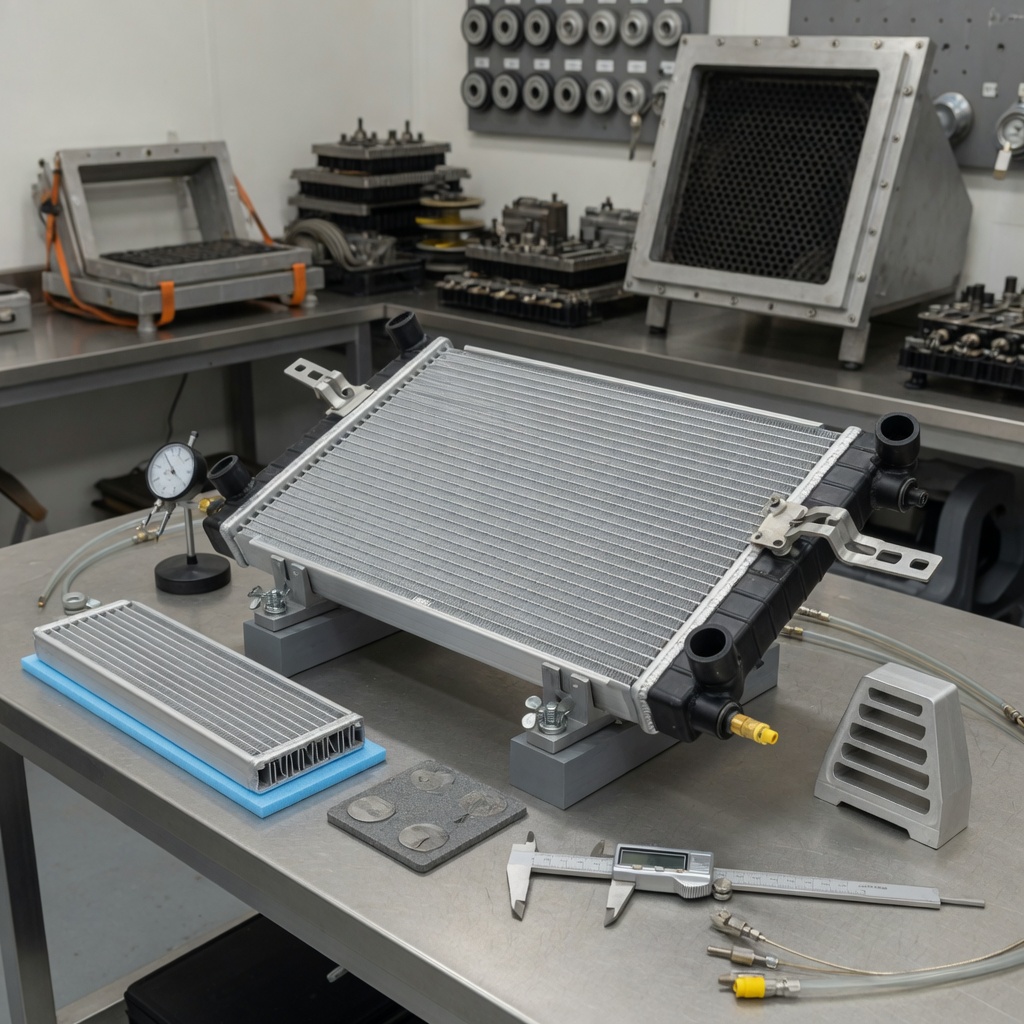
By Vincent Xi, Editorial Author
For a Europe-bound radiator RFQ, radiator OEM product development capability is the supplier’s ability to convert buyer-controlled cooling system inputs into a validated radiator design and a manufacturing release for the quoted production site. The bid should expose that evidence chain: approved requirements, controlled calculations or simulations, released design files, identified prototypes, requirement-linked validation records, site-specific process controls, and itemized commercial commitments.
Destination applicability belongs inside the same RFQ. Record EU, non-EU EEA, UK, named-country, and customer-specific requirements in separate fields. The supplied source set does not establish which legal rules apply to a given radiator or destination. The buyer’s designated legal or compliance owner should confirm applicability; the bidder should identify the responsible entity, supporting evidence, and quotation impact.
The cited supplier pages are used only as source contexts for procurement questions. Detroit Radiator’s OEM capabilities page describes application-specific thermal design, legacy-system reverse engineering, and prototype-to-production scaling. NBR’s custom radiator page describes requirement analysis, system-level and CFD simulation, fan design, rapid prototyping, and named validation activities. The Nanyang factory page describes feasibility analysis, CFD, soft-tooling prototypes, APQP and PPAP documentation, reliability testing, and production scaling. These are publisher-specific statements, not independent proof of a bidder’s current project or site capability.
Europe RFQ decision gates for radiator OEM product development capability
Use the status labels confirmed, conditional, outsourced, and unavailable. Confirmed means the quotation includes the activity and attaches project- and site-relevant evidence. Conditional means the dependency, owner, timing, and commercial effect are disclosed. Outsourced means the responsible facility, controls, schedule, and report ownership are identified. Unavailable remains an explicit gap.
| Decision gate | Buyer-controlled RFQ input | Bidder evidence | Release rule |
|---|---|---|---|
| Destination and applicability | EU, non-EU EEA, UK, named-country, and customer requirements entered separately where applicable | Matrix identifying the requirement source, responsible entity, evidence provider, review owner, and approval owner | Hold if the response groups destinations under an undefined claim such as compliant for Europe |
| Development-input baseline | Application, duty conditions, interfaces, environment, constraints, and acceptance criteria | Controlled requirement matrix showing sources, revisions, assumptions, conflicts, open items, owners, and quotation status | Hold while a critical input is missing, conflicting, or unowned |
| Thermal and flow feasibility | Heat-rejection duty, coolant conditions, airflow conditions, and pressure-drop limits | Calculation or simulation report with controlled inputs, model revision, outputs, sensitivity review, and prototype-correlation plan | Compare bidders only at identical buyer-defined boundary conditions |
| Controlled design release | Packaging envelope, interfaces, permitted design variables, materials, loads, and service constraints | Controlled CAD, drawings, bill of materials, tolerance analysis, interface review, and design trade-off record | Hold until interfaces and performance assumptions are approved |
| Prototype and validation | Sample purpose, failure modes, methods, severity, acceptance criteria, and reporting rules | Build identity, production-equivalence matrix, approved test matrix, raw data, deviations, and dispositions | Do not treat an unresolved non-equivalent sample as production-validation evidence |
| Manufacturing release | Released design, production site, traceability scope, inspection needs, programme assumptions, and change rules | Process flow, manufacturing risk analysis, control plan, tooling and gauge records, capacity basis, and change procedure | Hold until the evidence applies to the quoted site, product revision, tooling, and process route |
| Commercial nomination | Engineering, tooling, prototypes, validation, production parts, delivery, ownership, and exclusions | Itemized quotation, assumption register, delivery basis, ownership terms, and change-pricing rules | Resolve omitted or ambiguous scope before purchase-order release |
Cooling system inputs that make product development capability measurable
The RFQ should define the boundary between the radiator and the surrounding cooling system. Fans, shrouds, sealing, airflow recirculation, pumps, hoses, controls, installation restrictions, and adjacent components should be identified as buyer-controlled inputs or included in the bidder’s development scope.
| Input block | Buyer provides | Bidder returns |
|---|---|---|
| Scope and objective | Application, installation position, development objective, intended service, and scope boundary | Scope confirmation, exclusions, feasibility concerns, and missing-input register |
| Operating duty | Controlled duty points, operating sequence, transient expectations, and acceptance margins | Requirement-by-requirement feasibility response and calculation plan |
| Coolant side | Coolant specification, concentration, temperature and flow ranges, pressure limits, contamination assumptions, and connection conditions | Compatibility response, predicted performance, restriction results, and stated assumptions |
| Air side | Ambient conditions, airflow and density basis, fan information, shroud arrangement, sealing, and nearby restrictions | Boundary-condition statement, performance outputs, and unresolved system dependencies |
| Packaging and interfaces | Controlled envelope, interface CAD, hose positions, mounting points, service clearances, and adjacent geometry | Interface proposal, tolerance stack, clash review, and requested changes |
| Mechanical, material, and joining conditions | Mounting loads, vibration inputs, pressure cycling, permitted materials, environmental compatibility, joining constraints, and coating requirements | Proposed architecture, verification approach, sub-supplier scope, inspection controls, and open risks |
| Validation and production programme | Intended service, failure modes, test specifications, forecast, ramp assumptions, approved site, document rules, and change requirements | Requirement-linked validation plan, capacity basis, bottleneck statement, deliverable register, and change-control response |
Every submitted value should carry its unit, operating scope, source document, document revision, source date or quotation date, responsible owner, and status. The bidder should mark each returned value as buyer-supplied, assumed, calculated, simulated, measured, or pending confirmation.
Engineering evidence package
A software name, rendering, or CFD image is not a reviewable engineering submission by itself. Ask for a controlled report that identifies:
- the requirement identifier and acceptance criterion being addressed;
- the source, revision, and approval status of every input;
- the evaluated operating points and complete boundary conditions;
- geometry, material, joining, fan, and installation assumptions;
- the calculation or simulation method and model revision;
- predicted heat rejection and coolant-side and air-side restriction;
- sensitivity to critical inputs and design variables;
- the intended correlation method for prototype measurements;
- unresolved risks, deviations, and engineering conclusions.
If CFD is proposed, request the controlled geometry revision, computational domain, boundary conditions, mesh approach, convergence evidence, output definitions, and correlation plan. A change to a critical input after quotation should trigger revised technical outputs and commercial assumptions under document control.
An illustrative RFQ architecture is a brazed aluminium flat multiport-tube and louvered-fin core, formed aluminium headers, engineering-polymer end tanks, and mechanically crimped tank-to-header joints. This is not a Driventus specification or a supplier result. The bidder should confirm or replace the architecture in its dated quotation and explain the effects on tooling, validation, inspection, service, and change control.
All values below are undated illustrative assumptions and example calculations to verify in the supplier’s dated quotation. They are not supplier results, product specifications, test data, or design recommendations.
| Scope | Illustrative assumption to verify | Example decision use | Evidence to request |
|---|---|---|---|
| Complete radiator assembly | Maximum envelope of 760 mm width × 520 mm height × 80 mm overall depth, with 42 mm core depth | Use only to demonstrate how a packaging limit is entered; it does not support a fit or release conclusion | Controlled CAD, drawing, tolerance stack, mounting definition, and clearance review |
| Thermal duty | At a buyer-defined maximum-duty point, assume a requirement of 100 kW and an example prediction of 112 kW under identical coolant, air, fan, and installation conditions | Example margin: 12 kW, equal to 12% of the stated requirement | Controlled input set, model revision, result, sensitivity or uncertainty review, and prototype-correlation plan |
| Coolant-side restriction | At buyer-defined coolant flow and temperature, assume an allowable radiator pressure drop of 25 kPa and an example prediction of 22 kPa | Example headroom: 3 kPa at the stated duty point | Coolant properties, flow condition, method, and controlled pressure-drop output |
| Air-side restriction | At buyer-defined airflow and air density, assume a radiator-core restriction budget of 180 Pa and an example prediction of 145 Pa | Example remaining budget: 35 Pa under the stated conditions | Airflow basis, density basis, method, fan-system dependencies, and controlled restriction output |
Place design trade-offs in the RFQ as matched-condition comparisons. A fin or louver proposal should show both heat rejection and air-side restriction at the same boundary conditions. A tube or core change should show coolant-side restriction, joining, tolerance, tooling, and validation effects. Tank, header, mount, hose-port, fan, or shroud changes should include controlled interface drawings and explicit ownership of system assumptions.
Prototype equivalence and radiator validation evidence
Prototype timing should correspond to the decision the sample is intended to support. Every departure from the intended production design or manufacturing route should be disclosed before the sample is used as evidence.
| Sample purpose | Buyer decision | Records to request |
|---|---|---|
| Packaging sample | Whether interfaces, clearances, mounts, hose routing, and service access are acceptable | Controlled geometry, sample material, build route, interface report, and deviation list |
| Thermal sample | Whether predicted performance can be correlated at agreed boundary conditions | Build record, core specification, instrumentation plan, raw data, and correlation report |
| Durability sample | Whether selected failure modes meet buyer-defined acceptance criteria | Sample identity, method, severity definition, equipment-status record, results, deviations, and disposition |
| Process-development sample | Whether joining, tooling, inspection, and handling controls are feasible | Process route, tooling status, manufacturing observations, nonconformance records, and corrective actions |
| Production-representative sample | Whether the released design and intended production route have supporting validation evidence | Equivalence matrix, released bill of materials, site confirmation, process evidence, and approval record |
The production-equivalence matrix should compare core geometry, tubes, fins, headers, tanks, mounts, materials, joining methods, tooling, production site, sub-suppliers, inspection methods, and temporary prototype operations. A difference is not automatically unacceptable, but its technical effect, commercial effect, owner, and approval status should be clear.
NBR’s custom radiator page states that its own process includes requirement analysis, system-level and CFD simulation, fan design, rapid prototyping, and wind-tunnel, vibration, and thermal-cycle activities. This supports asking a bidder to identify available methods, facilities, outsourced work, equipment status, and report ownership. It does not establish that a named method or unspecified test severity is suitable for the buyer’s programme.
Detroit Radiator’s OEM capabilities page describes application-specific thermal design, reverse engineering for legacy systems, and prototype-to-production scaling as parts of its own offering. For a legacy radiator RFQ, use that context to request an input-reconstruction plan covering sample condition, measurement methods, material identification, missing original data, proposed changes, and buyer approval of assumptions. The page is not a substitute for project-specific records.
If prototype measurements differ from a quoted prediction, request an investigation record, corrected input set, model disposition, resulting design decision, and review of previously approved outputs affected by the change.
Manufacturing release evidence for the developed radiator
Serial nomination should remain on hold until the bidder connects the released radiator design to the quoted manufacturing conditions. The submission should show that:
- drawings and bills of materials use consistent released revisions;
- prototype-to-production differences are documented and approved;
- process flow, manufacturing risks, controls, and inspection points correspond to the released design;
- tools, fixtures, gauges, and inspection methods have controlled acceptance records;
- material and component sources are traceable to the contractually required level;
- outsourced joining, testing, coating, or other operations identify the responsible facility and control route;
- capacity evidence applies to the quoted product, site, tooling, process route, and operating assumptions;
- nonconformance, concession, rework, corrective-action, and escalation routes are defined;
- design, material, process, tooling, sub-supplier, and site changes follow the contracted notification or approval route.
The Nanyang factory page states that its own operation uses feasibility analysis, CFD, soft-tooling prototypes, APQP and PPAP documentation, in-house reliability testing, and production scaling. Treat those statements as prompts for records to request, not as a current audit result, certificate, validated capacity study, or evidence about another bidder.
The cited page does not establish APQP or PPAP as an EU, non-EU EEA, UK, or country-wide legal requirement. Call for those documents only when an applicable buyer or customer specification requires them, and define the required submission content, approval route, timing, and resubmission triggers.
If a bidder claims certification to a named standard, request the current document showing the certified legal entity, site, scope, issuing body, validity, and exclusions. Keep the claim unconfirmed until that document has been reviewed.
For capacity, distinguish installed equipment capacity from validated capacity for the released radiator. The response should disclose the calculation basis, bottleneck operation, operating pattern, maintenance assumptions, outsourced processes, tooling duplication, ramp constraints, and recovery approach. An unqualified production-scaling statement is not quantified capacity evidence.
Europe destination controls inside the radiator RFQ
Keep destination review tied to the product-development and manufacturing decision rather than turning the RFQ into a general country guide. The buyer’s responsible legal or compliance function should identify the applicable source and approval route for each field.
| Destination field | Controlled RFQ entry |
|---|---|
| EU destination | Named destination, applicable source, product scope, responsible owner, bidder evidence, and approval route |
| Non-EU EEA destination | Named destination, separately confirmed source, product scope, responsible owner, bidder evidence, and approval route |
| UK destination | Named destination, separately confirmed source, product scope, responsible owner, bidder evidence, and approval route |
| Country-specific requirement | Named country, controlled requirement document, affected scope, required evidence, and approval owner |
| Customer-specific requirement | Customer specification, document revision, submission format, affected product scope, and approval owner |
| Documentation and delivery | Required language, format, authorized signatory, retention expectation, delivery responsibility, customs responsibility where applicable, and document-control method |
| Supply-chain control | Approved production site, declared sub-suppliers, tooling location, traceability scope, and change-notification route |
The cited supplier pages do not determine legal applicability for any of these destination fields. Do not transfer an approval conclusion from the EU field to a non-EU EEA, UK, or country-specific field without a separately identified source and responsible-owner confirmation.
Commercial terms that complete the manufacturing decision
The quotation should separate development expenditure from production-part pricing so that scope gaps, dependencies, ownership, and change exposure are visible before nomination.
| Quotation line | Required commercial detail |
|---|---|
| Development engineering | Work package, deliverables, assumptions, exclusions, responsible site, review stages, and change basis |
| Tooling, fixtures, and gauges | Itemized scope, ownership, location, acceptance method, maintenance responsibility, transfer rights, and replacement basis |
| Prototype samples | Purpose, quantity, build route, unit price, timing, tooling status, and production-equivalence status |
| Validation | Method, sample requirement, facility, outsourced scope, raw-data access, report ownership, retest rules, and deviation costs |
| Production parts | Price basis, forecast assumptions, approved site, material basis, packaging, delivery point, and adjustment mechanism |
| European delivery scope | Named destination, transport responsibility, returnable-packaging terms, customs responsibility where applicable, and required documents |
| Data and intellectual property | Ownership and permitted use of CAD, drawings, calculations, simulation files, test data, tooling data, and project improvements |
| Changes and quotation controls | Engineering-change pricing, tooling-change rules, schedule effects, cancellation exposure, obsolete-material treatment, currency, validity, and approval dependencies |
Require a consolidated assumption register. If a technical condition is excluded from the price, the quotation should state its possible effect on performance, validation, timing, manufacturing release, or destination approval.
Radiator OEM product development capability nomination checklist
- [ ] Every critical design input has a value or controlled specification, unit, scope, source, revision, date, status, and owner.
- [ ] Assumptions, exclusions, conflicts, dependencies, and open questions are visible in the quotation.
- [ ] Thermal and pressure-drop comparisons use identical buyer-defined boundary conditions.
- [ ] CAD, drawings, and the bill of materials use controlled and consistent revisions.
- [ ] Each prototype has a stated purpose, build identity, and production-equivalence assessment.
- [ ] Validation links requirements and failure modes to methods, samples, acceptance criteria, raw data, results, deviations, and dispositions.
- [ ] Outsourced engineering, testing, and manufacturing activities identify the responsible facility, controls, and report ownership.
- [ ] Manufacturing evidence applies to the quoted radiator, production site, tooling, and process route.
- [ ] Capacity assumptions, bottlenecks, ramp conditions, and recovery responsibilities are disclosed.
- [ ] EU, non-EU EEA, UK, country-specific, and customer-specific fields are separated where applicable.
- [ ] Engineering, tooling, prototypes, validation, production, delivery, data, and ownership terms are priced or explicitly excluded.
- [ ] Change notification, deviation approval, corrective action, and serial-release rules are contractually defined.
Set nomination-ready status only when each critical requirement is traceable through design, prototype identity, validation, manufacturing control, and commercial commitment. A capability mentioned on a website remains unconfirmed until supported by current project- and site-specific evidence.
Source context, methodology, and limitations
| Supplied source | Retained source context | Use in this article | Limitation |
|---|---|---|---|
| Detroit Radiator OEM capabilities | Describes application-specific thermal design, legacy-system reverse engineering, and prototype-to-production scaling as parts of that publisher’s offering | Supports questions about thermal records, legacy-input reconstruction, prototype identity, and scaling evidence | Does not prove another bidder’s capability or provide project-specific records |
| NBR custom radiator | Describes requirement analysis, system-level and CFD simulation, fan design, rapid prototyping, and named validation activities as parts of that publisher’s process | Supports questions about simulation inputs, facilities, prototype controls, validation methods, and report ownership | Does not establish method suitability, test severity, current equipment status, or another bidder’s capability |
| Nanyang factory | Describes feasibility analysis, CFD, soft tooling, APQP and PPAP documentation, reliability testing, and production scaling for that publisher’s operation | Supports questions about development records, industrialization documents, testing access, and capacity evidence | Does not establish a current certificate, audit outcome, validated capacity, or product-specific performance |
| Vincent Xi author profile | Supports the byline name and Editorial Author role | Used only for author identification in the visible byline and structured data | Not used as evidence of factory, testing, certification, project, or customer experience |
Methodology: Supplier-page statements were retained only in attributed form. Each statement was mapped to buyer-controlled RFQ inputs, records to request, and release hold points; those controls are procurement recommendations, not claims that Driventus or a bidder possesses the capability. The numerical table uses constructed assumptions solely to demonstrate RFQ formatting and arithmetic under matched conditions. Every value must be replaced or confirmed in the supplier’s dated quotation.
Limitations and what to verify: The supplied evidence package does not include independent audit findings, current project files, raw test data, calibration records, complete equipment records, validated product-specific capacity studies, or current site-specific certificates. It does not establish Driventus-specific equipment, certification, product performance, factory visits, testing outcomes, customer outcomes, prototype timing, production capacity, or previous programme experience. Before nomination, verify the bidder’s legal entity, production site, responsible personnel, equipment access, outsourced scope, test methods, calibration status, prototype equivalence, document ownership, certificate claims, capacity basis, manufacturing controls, change route, destination-specific evidence, and binding quotation commitments.
Discuss Your Requirements
Review our manufacturing capabilities, then share your specifications for a supplier-fit review.