Brake Pad Wholesale Supplier Sustainability Sourcing Criteria for Europe
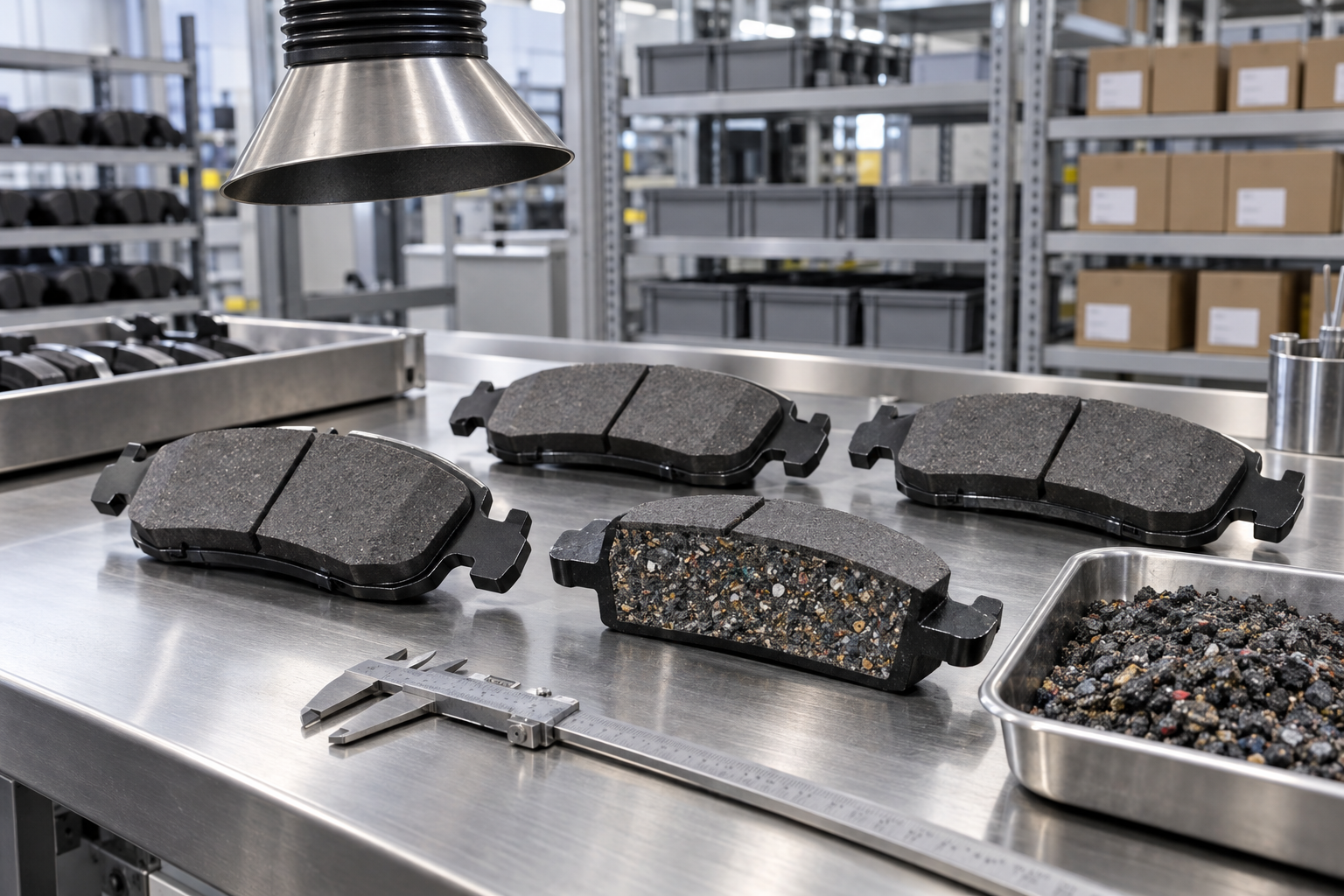
A brake pad wholesale supplier sustainability sourcing criteria review for European commercial buyers requires verifiable engineering documentation rather than marketing slogans. When evaluating wholesale supply proposals for brake-system components across Europe, procurement teams must verify four critical technical baselines before comparing unit pricing: the mass share of recycled or landfill-diverted materials alongside its exact denominator; third-party laboratory evidence of copper-free or restricted heavy-metal compliance; audited plant-level energy, carbon, and manufacturing waste metrics with explicit baseline years and boundary definitions; and full alignment with destination-specific chemical and vehicle end-of-life regulations. European regulatory requirements are not unified under a single blanket checklist. Directives and chemical controls differ across European Union Member States, European Economic Area (EEA) countries, Great Britain under UK REACH, and Northern Ireland under post-Brexit arrangements. A general environmental claim from an overseas factory cannot satisfy destination-specific import and distribution compliance across Europe without itemized technical documentation.
Editorial author: Vincent Xi, Editorial Author, profile at https://driventus.com/authors/vincent-xi/. The byline identifies the author of this procurement review. It does not record a factory visit, laboratory testing, proprietary certification, or first-person manufacturing experience; no first-person experience is claimed or implied.
Published friction manufacturer and automotive trade-press disclosures show the concrete metrics European procurement managers encounter during wholesale evaluations. These published metrics reflect specific producer programs rather than universal industry averages. PFC Brakes reports that its friction composites incorporate over 20% recycled or landfill-diverted materials, maintains a stated corporate target of 50% by 2035, and documents copper-free product development dating back to 1984 under an environmental management system addressing particulate emissions (PFC Brakes green innovation). The BRAKE Report details ICER Brakes’ Goes Green program as ISO 14001:2015 certified, utilizing 78% renewable energy and over 13% recycled materials (including recycled tire rubber) in copper-free and heavy-metal-free friction formulations, achieving a 35.7% CO2 emissions reduction since baseline year 2021 and reducing manufacturing waste generated per brake pad by 27% (The BRAKE Report on ICER Brakes). Frontech Auto Parts identifies wholesale brake pad options featuring ceramic and organic friction materials, recycled material integration, and reduced dust emissions across manufacturing, supply chain, packaging, and logistics (Frontech on eco-friendly wholesale brake pads). These published figures demonstrate operational targets that commercial buyers can formalize into contractual requirements.
Sustainability Sourcing Criteria for European Brake Pad Wholesale Supply
Procurement managers should translate sustainability sourcing criteria into contractually binding line items attached directly to the quoted friction formulation code. Each criterion must establish an objective engineering baseline that can be verified during incoming batch inspection.
Recycled or landfill-diverted content must be defined by mass fraction and material boundary. Without an explicit denominator, a percentage claim is unverified. For instance, PFC’s disclosed figure of “over 20%” refers strictly to the friction composite formulation rather than the finished pad assembly, while its 50% figure represents an unverified forward target for 2035. ICER’s reported figure of “over 13%” encompasses recycled raw materials such as devulcanized tire rubber within the compound matrix. In contrast, qualitative supplier descriptions that note recycled content without specifying mass units cannot be scored in a technical evaluation. RFQ specifications must demand the exact mass percentage of recycled content, the denominator (friction block mass versus total pad assembly mass including backing plate and shims), and the third-party batch audit period.
Copper content and heavy-metal restrictions must be treated as distinct chemical verification fields. While PFC documents copper-free friction research dating from 1984, and ICER reports copper-free and heavy-metal-free formulations, neither citation establishes an automatic qualification for every European vehicle catalog code. Commercial buyers must require certified laboratory mass spectrometry or standardized chemical assay tests showing copper concentrations below contract limits (such as less than 0.5% by weight for copper-free classifications) and verify compliance with end-of-life heavy-metal prohibitions.
Manufacturing energy, carbon emissions, and scrap metrics represent facility-level indicators that require strict boundary definitions. ICER’s reported 78% renewable energy share, 35.7% CO2 reduction from a 2021 baseline, and 27% scrap reduction per pad are notable program achievements. However, buyers must determine whether the renewable energy metric covers total thermal and electrical energy or purchased grid electricity alone, and whether carbon figures represent Scope 1 direct emissions, Scope 2 indirect emissions, or Scope 3 supply-chain transportation. PFC notes domestic North American raw-material sourcing to control supply-chain emissions; when quoting for European distribution, transoceanic shipping emissions alter total lifecycle logistics footprints and must be evaluated against the specific European port of entry.
Environmental management certification must be distinguished from product-level compliance. ISO 14001:2015 establishes structural criteria for an environmental management system (EMS); it does not dictate a minimum recycled material threshold, specific energy efficiency percentages, or chemical composition limits for friction materials. ICER documents accredited ISO 14001:2015 certification for its manufacturing operations. PFC describes operating a comprehensive internal environmental management system without citing a specific accredited ISO registrar number in the reviewed text. In wholesale contracting, a current, accredited third-party ISO certificate carries greater evidential weight than an uncertified internal environmental policy.
Particulate emissions, ceramic compounds, and organic friction designations require standardized test protocols before scoring. Marketing descriptions often reference ceramic or organic compounds and low-dust performance as sustainable options. However, ceramic, non-asbestos organic (NAO), and low-metallic friction formulas exhibit differing thermal conductivity, wear life, and rotor abrasion characteristics. Without an identified dynamometer test cycle and comparative baseline pad, qualitative low-dust claims cannot be compared across suppliers.
Packaging and outbound transport footprints must be quantified for European destinations. Sustainable wholesale packaging requires measurable data, such as tare mass per master carton, post-consumer recycled paper content percentage, elimination of expanded polystyrene, and compliance with destination packaging waste directives.
Technical Analysis of Disclosed Manufacturer Metrics
Published metrics from manufacturing peers provide valuable benchmarks for structuring technical specifications, provided buyers analyze the scope and data limitations of each disclosure.
PFC’s published figure of over 20% recycled or landfill-diverted materials in friction composites represents a minimum formulation baseline, not a lot-release guarantee for all production codes. Its 50% target is scheduled for 2035; inserting a 50% recycled-content mandate into an immediate European supply contract would mistakenly conflate a forward development goal with current commercial availability. Similarly, PFC’s copper-free development history dating from 1984 confirms long-term engineering focus but does not verify whether a specific aftermarket part number meets copper-free thresholds.
ICER’s program performance reported by The BRAKE Report details four specific manufacturing achievements: 78% renewable energy utilization, over 13% recycled material content including tire rubber, a 35.7% CO2 emissions reduction against a 2021 baseline year, and a 27% reduction in manufacturing waste per brake pad produced. While these data points demonstrate operational efficiency, the source excerpt does not provide absolute tonnages, reporting dates, Scope boundaries, or the baseline waste mass in grams per unit.
An example calculation (hypothetical baseline model, not a reported supplier figure): assume an annual contract volume of 100,000 brake pads with an assumed baseline scrap rate of 50 g of friction scrap per pad. Applying the cited 27% reduction rate yields avoided process scrap of: 0.27 × 50 g × 100,000 = 1,350 kg (1.35 metric tonnes) per contract year. Here, only the 27% rate originates from ICER's published report; the 50 g baseline, 100,000-pad volume, and 1,350 kg avoided waste are explicit example assumptions to verify against an actual supplier quote. If an audited factory baseline is 30 g or 75 g per pad, the avoided mass changes accordingly.
A secondary boundary check involves renewable energy claims. A plant reporting 78% renewable electricity has not automatically reduced the embedded carbon of a delivered brake pad by 78%. If raw material extraction, backing plate stamping, chemical binding resins, and maritime logistics account for the majority of embedded emissions, facility electrical power accounts for only a fraction of total cradle-to-warehouse product emissions.
Europe Delivery Rules Are Not One Checklist
Commercial buyers must specify the exact delivery country and legal jurisdiction on the wholesale purchase contract. Writing "European compliance" on an RFQ is insufficient because chemical and environmental regulations vary significantly across the continent.
Within the European Union, brake pads supplied as finished articles fall under EU REACH (Regulation (EC) No 1907/2006). Suppliers must fulfill Article 33 communication obligations regarding Substances of Very High Concern (SVHC) on the Candidate List above 0.1% by weight and respect Annex XVII restrictions. In addition, vehicle components must comply with the EU End-of-Life Vehicles (ELV) Directive (Directive 2000/53/EC), which restricts heavy metals: lead, mercury, cadmium, and hexavalent chromium. An informal claim of "heavy-metal-free" must be validated against current EU ELV exemption annexes.
Regulatory requirements diverge outside the EU Member States. Non-EU countries within the European Economic Area (EEA), such as Norway and Iceland, implement REACH through the EEA Agreement. In Great Britain (England, Scotland, and Wales), UK REACH operates as an independent statutory chemical regime; EU REACH registrations and declarations do not automatically confer legal compliance in Great Britain. In Northern Ireland, under the Windsor Framework, EU chemical regulations continue to apply to manufactured goods. A single compliance dossier copied across all four jurisdictions represents a failure of import due diligence.
RoHS (Restriction of Hazardous Substances) compliance is frequently requested on generic wholesale forms. However, the EU RoHS Directive governs electrical and electronic equipment (EEE), not mechanical automotive friction components. Unless a brake pad assembly integrates an electronic wear indicator sensor containing active circuitry, demanding RoHS documentation demonstrates unfamiliarity with European automotive regulations. Buyers should focus audit resources on REACH, the ELV Directive, and applicable copper restrictions.
Brake-particulate emissions represent an emerging requirement within the EU under the Euro 7 framework, establishing standardized particle limits across vehicle categories. Conformance requires laboratory dyno testing to standardized cycles rather than general marketing claims. Because the United Kingdom is not subject to EU Euro 7 regulations, UK vehicle programs require separate contractual compliance checks.
Supplier manufacturing location also impacts logistics carbon calculations. PFC’s use of North American raw materials influences inbound transport emissions when goods are shipped to European ports. A supplier's regional footprint must be evaluated based on total freight lane emissions to the final European warehouse.
Decision Table for Comparing Wholesale Offers
Technical evaluations must score offers on a line-item basis per friction formulation code rather than averaging corporate environmental claims across unquoted catalogs.
| Sustainability Criterion | Technical RFQ Requirement | Evaluation Methodology | Disqualification Triggers |
|---|---|---|---|
| Recycled Material Share | Exact mass percent, explicit denominator (friction composite, complete assembly, or packaging), and reporting period | Compare offers only against identical denominators (e.g., PFC’s >20% composite share vs. ICER’s >13% total recycled content) | Unsubstantiated percentage lacking an identified denominator; quoting long-term targets (e.g., 2035) as current production levels |
| Copper and Restricted Metals | Quoted formulation code, copper mass concentration, restricted heavy-metal content, test standard, accredited laboratory name | Verify that laboratory test reports match the exact compound code on the purchase order | Generic brand slogans without lot-specific laboratory assay data; unverified heavy-metal claims |
| Plant Renewable Energy | Production facility site, reporting year, percentage share, electrical vs. thermal energy breakdown | Treat plant metrics (such as ICER’s 78%) as operational context; do not convert to product carbon footprint without an audited lifecycle assessment | Presenting site-level grid electricity percentages as cradle-to-gate finished product carbon neutrality |
| Greenhouse Gas Reductions | Baseline reference year, absolute emissions (tonnes) vs. intensity metrics, Scope 1/2/3 coverage, European shipping lane | Compare reduction percentages (such as 35.7% since 2021) only when baselines and Scope boundaries match | Reduction percentages quoted without a defined baseline year or excluding international freight to Europe |
| Process Waste per Unit | Waste unit (g/pad or percent reduction), scrap classification, baseline production volume | Validate baseline scrap rates using the provided calculation model before accepting percentage reductions (such as 27%) | Claiming scrap reduction when total plant scrap increased due to unadjusted production volume spikes |
| Environmental Management | Accredited certificate copy, registrar identity, site coverage, current validity dates | Confirm active ISO 14001:2015 certification for the production plant; uncertified EMS statements rank lower | Expired certificates; certification covering corporate sales offices rather than the production factory |
| Particulate & Friction Class | Friction material family (ceramic, NAO, low-met), dyno test cycle, baseline comparative wear metrics | Require standardized test results before crediting "low-dust" or eco-formulation claims | Unverified marketing terms such as "eco-friendly friction" without testing data |
| Destination Compliance | Explicit destination specification: EU Member State, EEA non-EU, Great Britain, or Northern Ireland | Review chemical dossiers against destination-specific frameworks (EU REACH, UK REACH, ELV Directive) | Submitting an EU-only declaration for delivery into Great Britain, or generic global statements |
Measurable Performance and Procurement Trade-Offs
Integrating recycled raw materials can affect mechanical friction properties. Introducing recycled materials, such as devulcanized tire rubber or recycled composite regrind, can alter compressibility, shear strength, thermal dissipation, and cold-friction coefficients. Sourcing teams must require complete friction dynamometer performance curves (such as SAE J2522 / AK Master testing) alongside recycled material declarations to verify that stopping performance, fading resistance, and pad wear life remain within specification.
Formulating copper-free friction compounds involves balancing thermal conductivity against noise and wear characteristics. Copper historically provided heat dissipation and stabilized the friction interface layer at elevated temperatures. Eliminating copper requires alternative metallic, mineral, or ceramic friction stabilizers. While copper-free formulations are widely commercialized, buyers must verify rotor compatibility, noise-vibration-harshness (NVH) behavior, and high-temperature shear strength for the intended vehicle platform.
Plant-level carbon reductions must be evaluated alongside transport logistics. A manufacturing facility achieving a 35.7% CO2 reduction since 2021 may still deliver a higher total carbon footprint to a European warehouse than a regional supplier if long-distance maritime and road haulage offset manufacturing efficiencies. Contract evaluations must evaluate total cradle-to-warehouse delivery emissions.
Scrap reduction claims must be cross-referenced against quality acceptance rates. A 27% reduction in waste per brake pad must represent true manufacturing process control rather than the reclassification of non-conforming parts or relaxed lot-acceptance tolerances. Buyers should review production line First Time Yield (FTY) and scrap re-melt procedures.
Management system certificates must not be substituted for physical part quality. A supplier holding an accredited ISO 14001:2015 certificate may still produce non-compliant friction batches if lot-traceability procedures fail. Management systems verify process control architecture, not final product conformity.
RFQ Checklist
- Ask the supplier to declare recycled or landfill-diverted content as a mass percentage for the quoted friction compound, identifying the denominator and audit period.
- Require the manufacturer to submit an accredited copper and restricted-metal laboratory report for the quoted compound code, including test method, laboratory identity, and test date.
- Specify the exact delivery destination (EU Member State, EEA non-EU, Great Britain, or Northern Ireland) and require destination-specific chemicals and end-of-life metal declarations.
- Require the manufacturer to provide a current ISO 14001:2015 certificate with site scope and expiry date, or a formal written disclosure stating that no accredited certificate is held.
- Ask the supplier to detail plant renewable energy share, greenhouse gas changes, and scrap per pad with explicit baseline years, metric boundaries, and freight coverage to the European warehouse.
- Specify packaging tare mass, packaging recycled-content mass percentage, and local take-back terms for the destination European warehouse.
- Require the manufacturer to substantiate any low-dust or friction-family claims with named test cycles and baseline comparative wear data.
- Ask the supplier to bind all sustainability disclosures to the exact backing plate, shim, wear sensor, and friction formulation itemized on the wholesale contract.
- Require the supplier to confirm in writing on the commercial quote that plant-level environmental figures apply directly to the quoted production run.
Methodology, Source Context, and What to Verify
This procurement review was synthesized by analyzing public technical and operational disclosures from friction manufacturers and trade documentation: Frontech’s wholesale catalog describing eco-friendly material classifications; PFC Brakes’ green-innovation publications detailing recycled-content shares, corporate 2035 targets, copper-free history since 1984, raw material origins, and particulate focus; and The BRAKE Report’s coverage of ICER Brakes’ Goes Green program detailing ISO 14001:2015 certification, 78% renewable energy utilization, over 13% recycled materials, 35.7% CO2 reduction from a 2021 baseline, and a 27% scrap reduction per unit. No physical laboratory testing or proprietary supplier auditing was conducted by the author. No commercial keyword search metrics, volumes, cost-per-click values, or ranking figures were evaluated or utilized.
Two primary source contexts define the scope of the cited operational data. First, the metrics published by PFC Brakes and ICER Brakes represent company-specific program results rather than industry-wide baseline standards or claims made by Driventus. Second, Frontech’s statements illustrate standard aftermarket product marketing that requires precise quantitative baselines before commercial contracting. A third context is European regulatory geography: commercial compliance must be differentiated across EU Member States, EEA non-EU countries, Great Britain, and Northern Ireland.
Key limitations to verify prior to commercial contract signing:
- The ICER operational metrics reflect published reporting in The BRAKE Report; procurement teams must verify the underlying reporting dates, full Scope 1/2/3 carbon boundaries, and absolute scrap baselines in grams per pad.
- PFC’s “over 20%” recycled content and “50% by 2035” target represent corporate program statements; buyers must obtain third-party batch test certificates for quoted part numbers.
- ISO 14001:2015 certification applies strictly to accredited facility locations and does not certify individual friction formulation contents.
- Chemical compliance (REACH SVHC declarations, ELV heavy-metal restrictions) and emerging Euro 7 brake-particulate standards must be verified against current statutory texts in force at the European delivery destination.
- Sustainability sourcing criteria must operate alongside, rather than replace, standard safety approvals (ECE R90 homologation), mechanical shear strength, fading resistance, and unit pricing.
Discuss Your Requirements
Review our manufacturing capabilities, then share your specifications for a supplier-fit review.