Brake Pad Sourcing Communication Workflow Review for United States Buyers
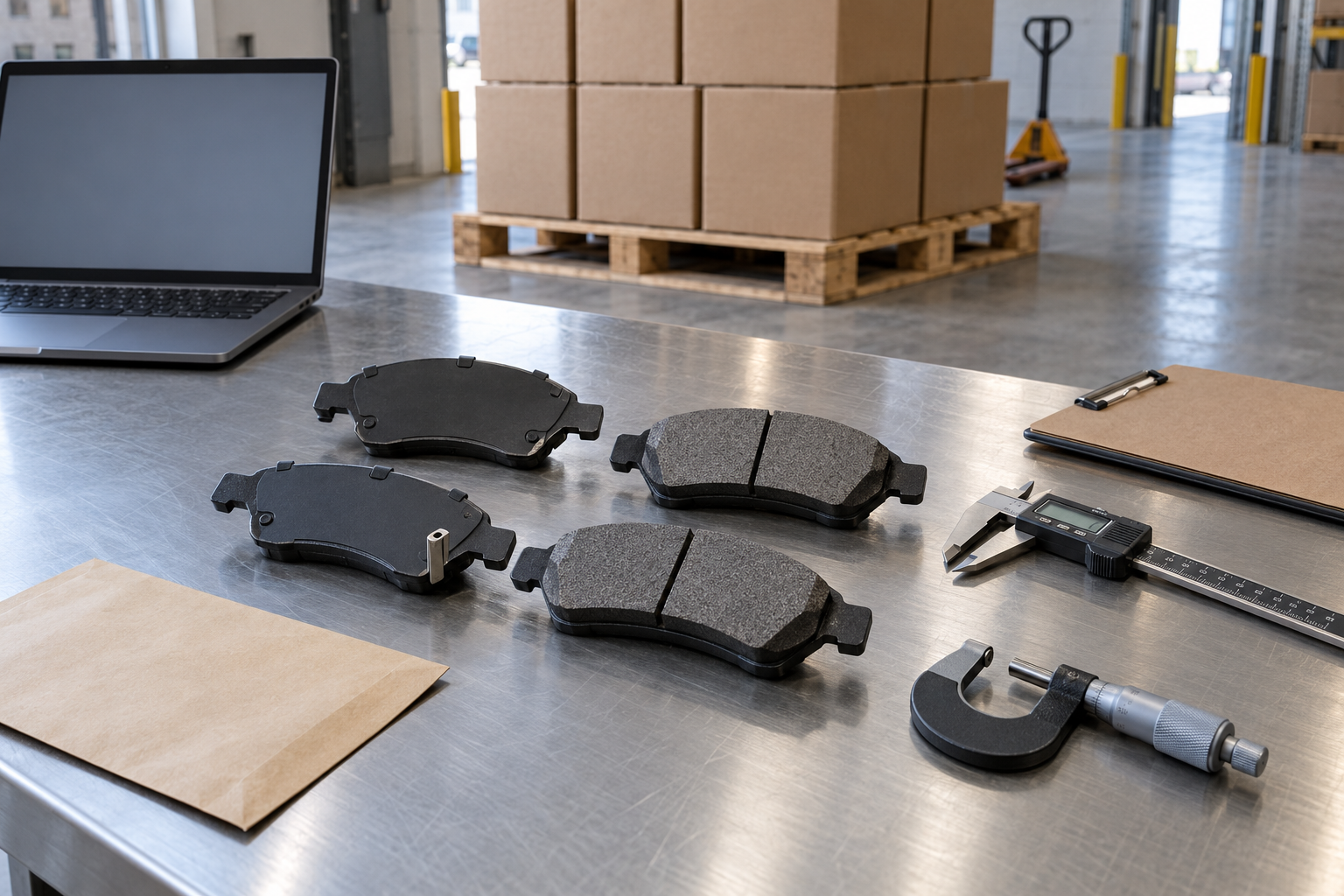
To execute an effective brake pad sourcing communication workflow review, United States brake system procurement teams should avoid unstructured email exchanges and follow a gated communication sequence. The workflow requires locking one exact part number and specification, issuing an itemized request for quotation (RFQ), comparing quotes line-for-line across identical units, and securing formal written sign-offs at sample approval and delivery acceptance before releasing payments. Vincent Xi, Editorial Author at Driventus Auto Parts (author profile: https://driventus.com/authors/vincent-xi/), prepared this evaluation using only the third-party sourcing and distributor records cited below. No first-person factory audits, laboratory friction tests, or client outcomes are claimed.
United States buyer communication workflow review gates
A communication workflow review verifies that every vendor interaction conveys an immutable specification, release volume, delivery date, and explicit acceptance condition. United States buyers must designate the exact destination facility, receiving label requirements, payment currency, applicable commercial terms, and pre-acceptance inspection criteria. While manufacturing operations may reside overseas, that constitutes a supply-chain origin rather than an additional target sales market, and it does not diminish the buyer's documented intake rules.
A sourcing guide presented under a 2026 framing defines 6 stages for brake-system procurement, specifically covering friction pads: Inquiry, Sample, Audit, Trial Order, Bulk, and Shipping. Unit: stages. Scope: brake-system sourcing journey (including pads) outlined in the source guide. Date/as-of context: as of the source's 2026 publication framing, rather than a regulatory enactment date. See Sourcing Brake Systems from China. Buyers should formally sign off on each stage in writing before committing capital to tooling, production runs, or ocean freight. The same guide highlights that establishing a precise specification alongside an OEM part number is critical both for fitment accuracy and for mitigating risks such as counterfeit documentation. This review does not validate any individual laboratory certificate or qualify any manufacturing facility.
Practical communication gates for the purchasing file include:
- Inquiry Gate: Closed only when the quoting party repeats the exact buyer part number, friction formulation family, hardware scope, and piece/set unit.
- Sample Gate: Closed only after dated component photos and dimensional measurement sheets are logged and countersigned.
- Audit Gate: Closed only when the buyer retains a current third-party inspection or facility audit report.
- Trial Gate: Closed upon written agreement on pilot order quantities and nonconformance remedies.
- Bulk Gate: Closed strictly against the frozen revision level approved during pilot testing.
- Shipping Gate: Closed once carrier milestone events match commercial invoices and warehouse intake manifests.
Example assumption to verify in the supplier quote: establish a 2-business-day quotation acknowledgment window. Unit: business days. Scope: initial quotation acknowledgment for one United States RFQ line. Date/as-of context: example workflow assumption for this review, not an established industry average or statutory baseline. If a quote fails to state an acknowledgment window, this assumption remains unmet.
What the first RFQ message must lock
Part-number discipline forms the foundation of commercial friction procurement. A technical lookup guide outlines part-number resolution, interchange catalogs, and structured RFQ formatting—encompassing part numbers, quantities, material grades, regulatory compliance items, hardware inclusions, shipping methods, and packaging—to facilitate like-for-like quote comparisons and avoid unsellable inventory. See Brake Pad Part-Number Lookup. These entries represent operational communication checkpoints rather than verified friction test ratings.
The initial RFQ message must establish these fields explicitly. State the buyer part number alongside any secondary interchange numbers, labeling interchanges strictly as informational references rather than authorization for unapproved substitutions. Vehicle make, model, or axle position should serve merely as clarifying descriptors, never as a substitute for an engineering part number. State order quantities using explicit units—such as individual piece, axle set, or vehicle set—and delineate whether the inquiry represents a pilot trial or volume bulk run.
Specify the required friction formulation category (such as ceramic, semi-metallic, or non-asbestos organic) as an engineering constraint rather than an arbitrary marketing claim. List hardware components on a discrete line-item matrix: anti-noise shims, abutment clips, return springs, and electronic wear sensors must each be marked as included or excluded. When engineering drawings exist, specify backing-plate thickness, slotting, and edge chamfer parameters; when drawings do not exist, require the supplier to submit written construction specifications for the quoted price. Outline packaging expectations, including inner box packaging, master carton counts, and barcode labeling detailing part number, lot number, quantity, and drawing revision. State preferred Incoterms and leave the United States destination port or distribution center for quotation modeling. A formal request for compliance documentation is an inquiry control, not proof that a certified system exists.
Like-for-like quote analysis fails when one vendor bundles hardware while another quotes bare pads, or when a vendor quietly substitutes friction formulation families to lower price points. The lookup guide directly associates such discrepancies with dead-stock exposure. While the source cites no specific variance rate, buyers must maintain a single RFQ reference number throughout communication so revisions cannot quietly overwrite baseline material selections.
When industry standards are referenced, distinguish official standard requirements from individual company procedures. Buyers may inquire whether a supplier provides documentation corresponding to SAE friction identification standards or federal motor vehicle safety regulations, and subsequently verify those submittals against official regulatory texts. SAE standards and United States federal motor vehicle regulations represent external legal frameworks; they do not constitute certifications held by Driventus Auto Parts, nor do they guarantee that a quoting supplier complies. The sourcing guide's warning regarding unverified certificates reinforces the requirement to examine document issuance dates, test scopes, and accredited testing bodies before issuing purchase orders.
Decision table for quote communication
Use this decision matrix to evaluate, compare, verify, and approve quotation communications prior to committing funds. Because public sources omit current commercial pricing schedules, price fields are omitted. Aligning communication parameters precedes any cost optimization.
| Communication item | Buyer action | Match across replies | Rework if |
|---|---|---|---|
| Part identity | Require the supplier to restate buyer part number and drawing revision | Exact alphanumeric match | A substitute part number lacks formal written authorization |
| Friction formulation | Specify required family (ceramic, semi-metallic, NAO) | Identical friction formulation across quotes | Material family is altered to artificially lower unit cost |
| Hardware scope | Specify include or exclude for shims, clips, and wear sensors | Itemized inclusion matrix | Hardware is grouped into an unitemized lump sum |
| Quantity unit | Specify piece, axle set, or vehicle set for trial vs. bulk | Identical unit definition and volume band | Minimum order quantity shifts the purchasing unit |
| Sample approval | Require dated photos and dimensional inspection sheets before trial | Formal sample verification file | Production pricing lacks a pre-production sample milestone |
| Documentation | Ask for test document title, revision level, and issuing authority | Verifiable file archived by buyer | Standards are cited without accompanying documentation |
| Commercial lines | Specify USD currency and named Incoterm destination | Itemized unit, tooling, and freight lines | Freight is omitted or pricing mixes currencies |
| Tracking status | Require ready-to-ship, departure, and dock delivery notices | Standardized milestone reporting | Status updates are limited to informal verbal calls |
| Packaging labels | Specify buyer part number, quantity, lot code, and revision | Written label template confirmation | Lot traceability cannot be maintained on cartons |
| Engineering change | Require written notice prior to material, tooling, or plant shifts | Binding notification window in quote | Supplier claims verbal authorization is acceptable |
Example calculation to verify in the supplier quote: a pilot run of 100 sets alongside a bulk production release of 1,000 sets for an identical part number represents a trial share of 10 percent of total bulk volume. Unit: sets and percent. Scope: single part number and friction formulation family. Date/as-of context: illustrative arithmetic for this review only. Confirm the supplier's actual minimum order quantity, volume price breaks at 1,000 sets, and drawing revision status before relying on this ratio. If supplier minimums exceed 100 sets, this example does not justify placing an unvalidated order.
Status paths among factory, distributor, and the buyer
A distributor logistics publication emphasizes that communication and supply-chain transparency are paramount, positioning distributors as operational hubs connecting manufacturers, logistics carriers, commercial retailers, and repair centers. The source identifies cloud infrastructure, real-time shipment monitoring, and electronic data interchange (EDI) as tools to communicate transit milestones, quality records, and cargo tracking so supply disruptions can be addressed proactively. See How Brake Pad Distributors Enhance Your Supply Chain. The reference material states no specific performance percentage, and this review does not state that Driventus Auto Parts operates an EDI gateway, proprietary portal, or distribution hub.
When multiple entities—such as an overseas manufacturing facility, an export trading agent, and a United States domestic distributor—interact on an order, establish a single communication authority for engineering approvals and one master log for shipping updates. Quality notifications must identify the inspection type, production lot number, and measurement outcome. Inbound shipping notices must correlate directly to specific purchase-order line items. Schedule adjustments must clearly state the original estimated arrival, the updated delivery date, and the operational cause so receiving facilities can reschedule labor. Messaging application screenshots do not constitute formal audit reports. Buyers requesting physical factory audits or pre-shipment inspections must commission those services independently and link the resulting reports directly to the RFQ record.
Example assumption to verify in the supplier quote: mandate 3 written status notification events per transit cycle. Unit: written notification events per shipment. Scope: one inbound shipment destined for a United States receiving warehouse. Date/as-of context: example workflow assumption for this procurement review. The three required events comprise ready-to-ship verification, freight departure notification, and arrival at the United States port or dock. Digital supplier dashboards satisfy this requirement only if the data can be exported into the buyer's procurement file. Freight tracking that cannot be archived does not meet this assumption.
United States landed cost, labeling, and acceptance
Require supplier quotations to separate itemized United States dollar (USD) amounts for the friction pad unit, tooling amortization, and estimated ocean or air freight, clarifying which party covers United States customs entry, harbor maintenance fees, and inland drayage under the selected Incoterm. Reject consolidated single-figure landed cost quotes that conceal line-item charges. This publication provides no specific customs duty percentages, import bond fees, or ocean freight rate indices. Import costs fluctuate based on Harmonized Tariff Schedule (HTS) classifications, country of origin, port of entry, and shipment date. United States buyers must verify landed cost models directly with their licensed customs broker; third-party supplier quotations do not substitute for official binding customs rulings.
Delivery communications must define the governing Incoterm, named delivery place, production lead-time window, and United States receiving window. Outbound packaging specifications must require clear labeling on each master carton: buyer part number, quantity, manufacturing batch lot, and drawing revision level. Stating packaging standards in an RFQ establishes a contractual specification; it does not confirm the factory has already implemented the labeling practice. Receiving protocols should specify piece-count verification methods, dimensional spot-checking tolerances, and formal nonconformance quarantine workflows. Receiving teams must place shipments on administrative hold whenever physical carton markings deviate from advance shipping notices (ASNs). Formal acceptance occurs only upon written sign-off by receiving quality personnel, not upon a carrier delivery scan.
Example assumption to verify on the quote and with counsel: budget 5 business days at the United States receiving dock for piece counts, carton verification, and dimensional spot checks before commercial silence constitutes contractual acceptance. Unit: business days. Scope: one inbound production lot on an individual purchase-order line. Date/as-of context: operational assumption for this workflow review, not a statutory regulation or universal carrier standard. Do not incorporate this timeframe into formal purchase orders without legal and logistical review. Because cited sources provide no baseline production lead-time figures, none are assumed. United States buyers should require quoting suppliers to state production lead times as a definitive calendar range triggered by formal sample sign-off.
RFQ Checklist
- Specify the buyer part number, drawing revision, friction formulation family, and hardware inclusion scope in the initial RFQ package before requesting pricing.
- Require the supplier to restate the exact buyer part number, quantity unit, and friction family on the quotation to enable a line-by-line comparison.
- Require separate United States dollar (USD) line items for piece unit price, tooling charges, and estimated freight under the designated Incoterm.
- Require dated production photographs and a dimensional inspection report, and approve that sample submission in writing before releasing a trial order.
- Ask the supplier to state the official document name, standard edition, and issuing date for all compliance assertions, treating unverified claims as uncertified.
- Specify three mandatory shipment notifications—ready-to-ship, port departure, and final delivery—mapped directly to the purchase-order line and United States receiving facility.
- Require written buyer approval prior to any change in raw friction materials, tooling, or manufacturing plant location.
- Compare aftermarket cross-references strictly as non-binding lookup guides, withholding purchase orders until any substituted part number receives written authorization.
- Verify that outer carton and inner packaging labels display the buyer part number, lot number, carton count, and revision level for warehouse intake.
- Ask the supplier to document shelf-life parameters and revision changeover cutoffs to prevent obsolete inventory from entering bulk delivery streams.
Methodology, limits, and what to verify
Methodology: The 6-stage sourcing framework (Inquiry, Sample, Audit, Trial Order, Bulk, Shipping), the emphasis on locking OEM part numbers, and cautions regarding unverified certifications derive from the 2026 brake-system sourcing guide cited above. Core RFQ field categories and dead-stock risks linked to mismatched quote comparisons are sourced from the part-number lookup guide. Descriptions of distributor communication hubs, EDI integrations, and milestone tracking stem from the cited distributor supply-chain analysis. No additional third-party technical databases were used. Sourcing stages are not expanded into proprietary manufacturing formulas or universal pass-fail dimensional tolerances, as those parameters are omitted by the source texts.
Every exact number outside the 6-stage sequence represents a labeled operational assumption or calculation. The 2-business-day response window, the 100-set trial versus 1,000-set bulk calculation (10 percent), the 3-event shipment tracking structure, and the 5-business-day receiving dock acceptance window are explicit operational assumptions to verify in commercial quotes. Each data point includes unit, scope, and date/as-of context. None reflect proprietary performance measurements, historical lead-time averages, or laboratory benchmarks from Driventus Auto Parts.
This editorial review contains no keyword search volume, cost-per-click, ranking difficulty, search intent scores, traffic estimates, or competitive visibility metrics. Sourced industry literature serves solely to corroborate technical communication workflows, not commercial search demand.
Limitations: Cited references do not publish live component price sheets, certified test lab results, active compliance certificates, standard factory lead times, United States HTS tariff schedules, or documented corporate case histories. This review does not audit manufacturing facilities or authenticate regulatory test documents. Part-number cross-reference catalogs may contain superseded or inaccurate data. Digital logistics tracking tools add value only when shipping notices match physical dock receipts. Customs compliance, federal vehicle safety standards, and packaging requirements vary by commercial importer role and must be cross-referenced against current official legal texts. Before binding purchase orders are issued, verify part identity, technical specifications, commercial terms, and final acceptance criteria with suppliers, freight forwarders, customs brokers, and legal counsel.
Author record: Vincent Xi, Editorial Author, https://driventus.com/authors/vincent-xi/.
Discuss Your Requirements
Review our manufacturing capabilities, then share your specifications for a supplier-fit review.